
The Automatic Vent Opener For Small Greenhouse UK Owners Fit In Ten Minutes And Never Plug In
We earn commission from qualifying Amazon purchases. It costs you nothing and does not affect what we recommend.
It runs on a cylinder of wax, needs no wiring, and clamps onto most greenhouse frames without a single drilled hole. It can also dump its oil over your tomatoes. Both of those things are true of the Bayliss XL, and which one you get is mostly decided in the first fortnight.
- It Opens On Melted Wax And Closes On A Spring
- What A Small Greenhouse Needs From An Automatic Vent Opener
- No Drilling Required, Unless Your Greenhouse Is A Palram
- Put The Wax Tube In The Fridge Before You Touch A Screwdriver
- When It Fails, It Fails By Leaking
- The Tube Is A Consumable, And Bayliss Seems To Know It
- So Should You Fit One To Your 6x4?
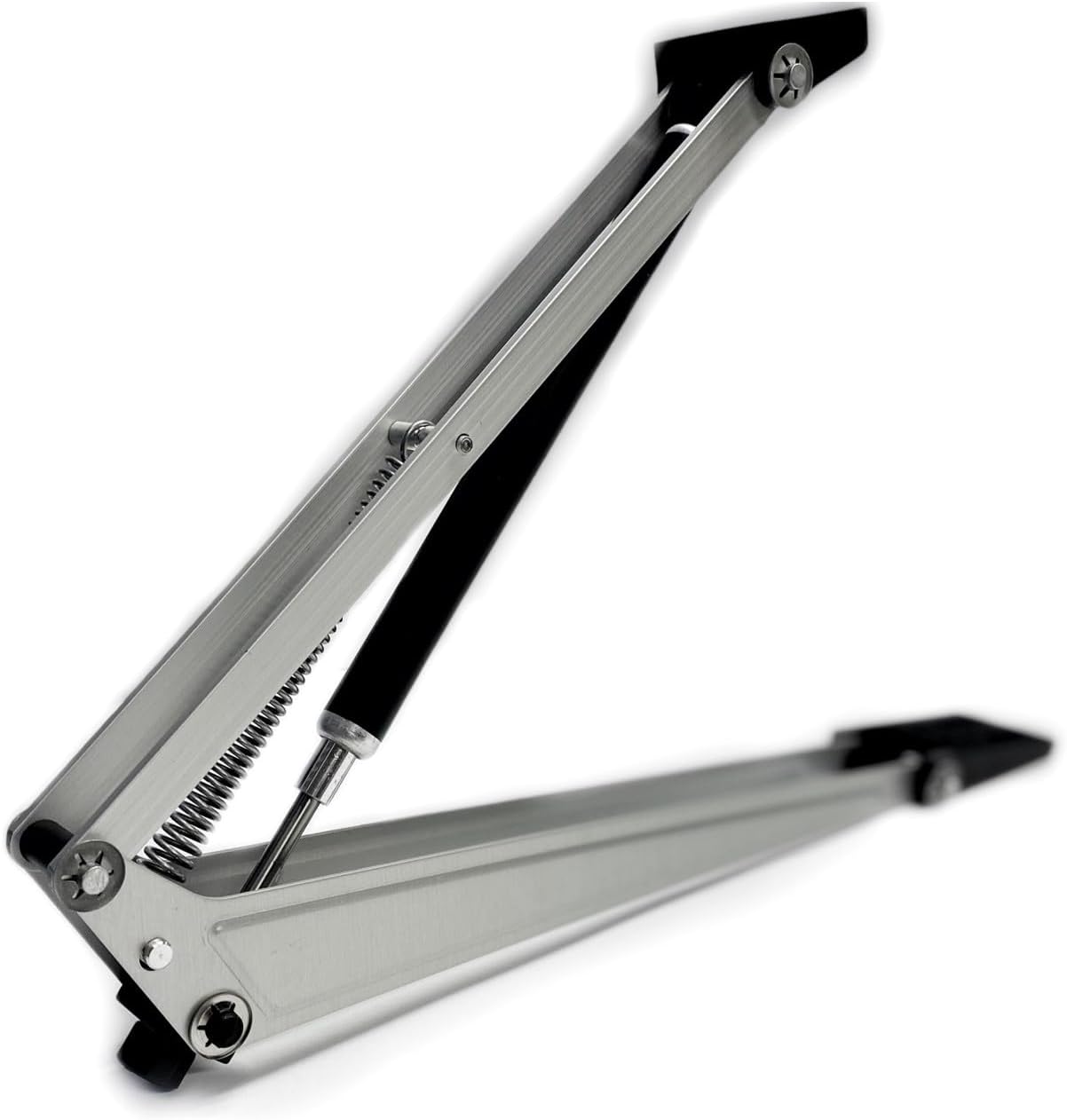
There is no plug on the Bayliss XL, and no battery either. Despite the words "solar vent opener" sitting in the product name, nothing on this unit generates a watt of electricity. The whole thing runs on a sealed cylinder of wax. When your greenhouse warms up, the wax expands, pushes a piston out of the tube and levers the roof vent open. When the air cools, the wax contracts and a coiled spring pulls the window shut again. That is the entire mechanism, which is why some of these have sat on greenhouse roofs for the best part of two decades with nothing to service.
All of which matters more than usual when the greenhouse is small. A 6x4 or a 6x8 has almost no thermal buffer. It heats fast on a bright morning, carries on heating while you are at work, and by the time you get home in July your tomatoes have had a rough day of it. What you want is a vent that opens before you would have got round to it, and shuts before the night chill arrives.
So we read the hundred most recent UK reviews to see whether this one does that. What came back is a good deal sharper than the 4.4-star headline suggests, and the thing that decides whether you keep the Bayliss or return it has very little to do with how well it ventilates. It is almost entirely about the first fortnight.
It Opens On Melted Wax And Closes On A Spring
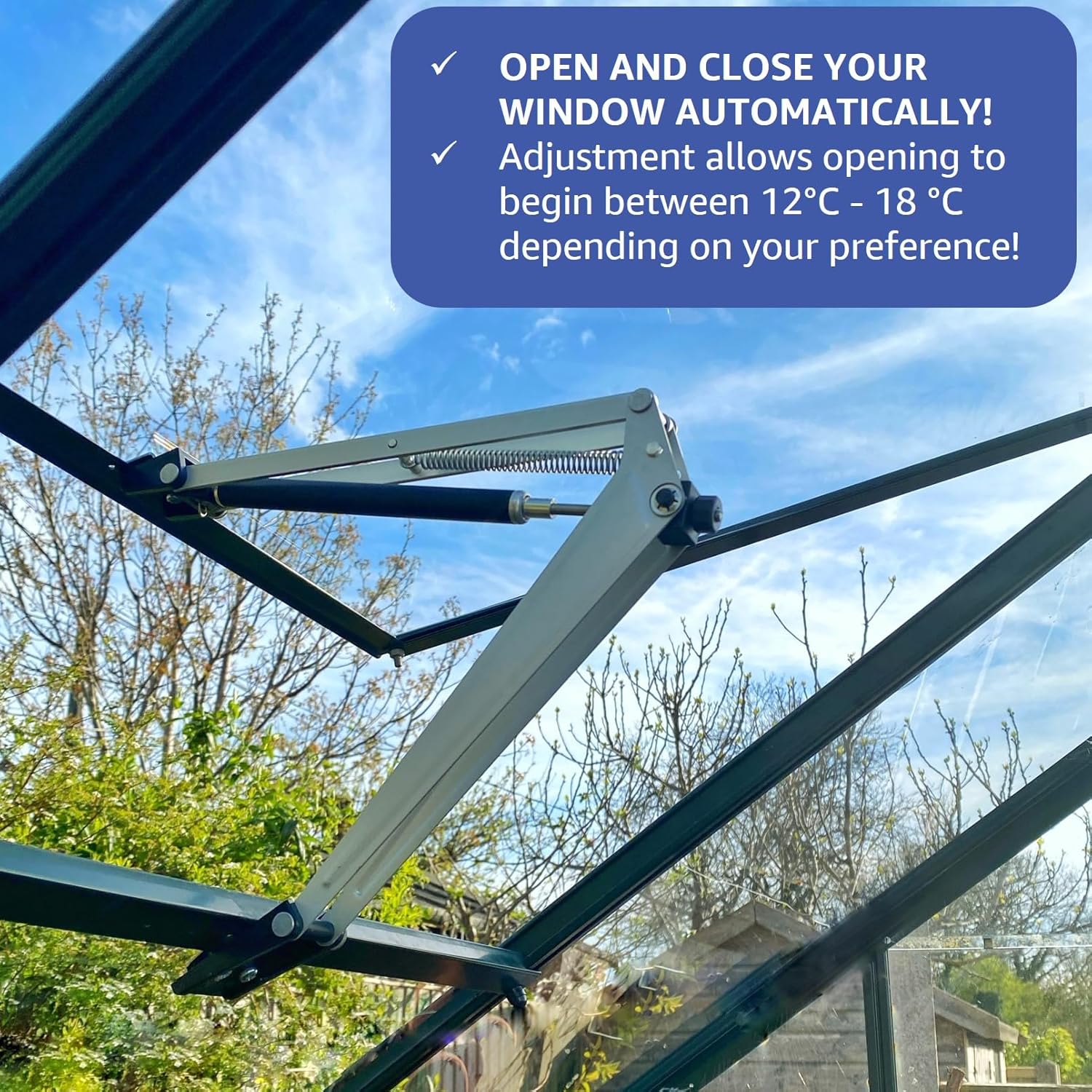
Here is the number that decides whether this unit suits you, and you will not find it anywhere in the Amazon listing text: the opening point is adjustable, and it can be set to begin anywhere between 12°C and 18°C. That figure is printed on the product photographs and nowhere else. The written listing runs to a single bullet point, which is not a lot to go on when you are trying to work out whether a device will keep your seedlings alive in August.
In practice the vent does not snap open at a set number. The wax softens progressively, so the window creeps open as the temperature climbs and creeps shut as it drops. denis alder, a five-star reviewer, actually tracked it: "It opens when the internal temperature goes above about 20°C and is closed when it has dropped to 16°C." That gradual behaviour is what you want in a small greenhouse. A vent that flung itself wide at a fixed threshold would dump heat you wanted to keep on a changeable British afternoon.
The adjustment is where the marketing and the reviews part company. The photos promise "Easy to Adjust". A number of buyers found otherwise. Carslaw, who left four stars and rated the build, warns that "The screw for adjustment is very tight even when you take the weight of the window - definitely not possible with fingers alone." Mrs. C. M. Coomber, a one-star reviewer, hit a worse version of the same fault: "when you try to turn the plastic nut to change the temp at which the vent opens the whole hydraulic arm turns", which left one window stuck "open at 12 degrees regardless of my trying to adjust". If you need the vent closed in the evening to hold overnight warmth for young plants, that is a serious complaint, and it is the strongest one in the negative reviews.
One footnote worth filing away. Philip Oates, two stars, found that his "opens too early.letting all the heat out" (sic), reported it to Bayliss, and says they "recommended the orchid wax tube", which they told him opens at higher temperatures. He was still waiting for it to be delivered when he wrote the review, so we cannot tell you whether it solved anything. But if your vent opens earlier than you would like, an alternative wax tube appears to be the route Bayliss will point you down.
What A Small Greenhouse Needs From An Automatic Vent Opener

Stand in a 6x4 and your head is roughly a foot beneath the roof vent, with a shelf of pots directly under it. So the thing that separates a good automatic vent opener for a small greenhouse from an irritating one is not lifting power. It is where the mechanism ends up when the window swings open.
The Bayliss XL keeps its piston tucked inside the aluminium arm assembly instead of hanging below it, and two reviewers picked that out, unprompted, as the reason they chose this one over a rival. Discerning Shopper, five stars: "Perfect for my setup as rod is contained within mechanism. Previous rod fowled tomato tie rail when opening." (sic). M.Saman, also five stars, rates it because "the cylinder is not touching your eyes when you walk in to the greenhouse and its in proper position and not like others" (sic). Anyone who has caught their forehead on a vent arm while carrying a tray of seedlings will understand why that is worth something.
How many do you need? One per opening roof vent, which for most small greenhouses means exactly one. Owners of bigger roofs buy in multiples: Mr. S. J. Clark bought four, "to keep the ventilation balanced across the whole roof", and Pat T bought a pair, then another pair for a daughter's greenhouse. A 6x4 with a single roof vent needs one unit and nothing more.
On build, the product photographs claim anodised aluminium arms and recycled plastic bracketry, hand built in the UK. Nothing in the reviews contradicts that, and the longevity reports back it up. One five-star buyer has "4 others that have worked for almost 20 years without any problems". Another mentions that an older unit's "partner still fine after 7 years" (sic). Mr D fitted several in 2023 and reports "they have never failed to open, no problems," (sic).
Now the two specs Bayliss does not give you. There is no published lifting force for the XL, and no published dimensions for the arm. Neither figure appears in the listing text, and neither appears on any of the six product images. So if your roof vent is unusually heavy, you are buying on the strength of reviewer reports rather than a manufacturer's figure, and Edwin Larkey's one-star verdict, "Returned it was too weak not good enough", is the risk that comes with that. We are not going to invent a number Bayliss has chosen not to print.
Bayliss XL Autovent - Automatic Greenhouse Window Opener
UK-made, wax-powered roof vent opener with an adjustable 12°C to 18°C opening point. No wiring, no batteries, and no drilling on most aluminium and wooden greenhouses. All fittings included.
No Drilling Required, Unless Your Greenhouse Is A Palram
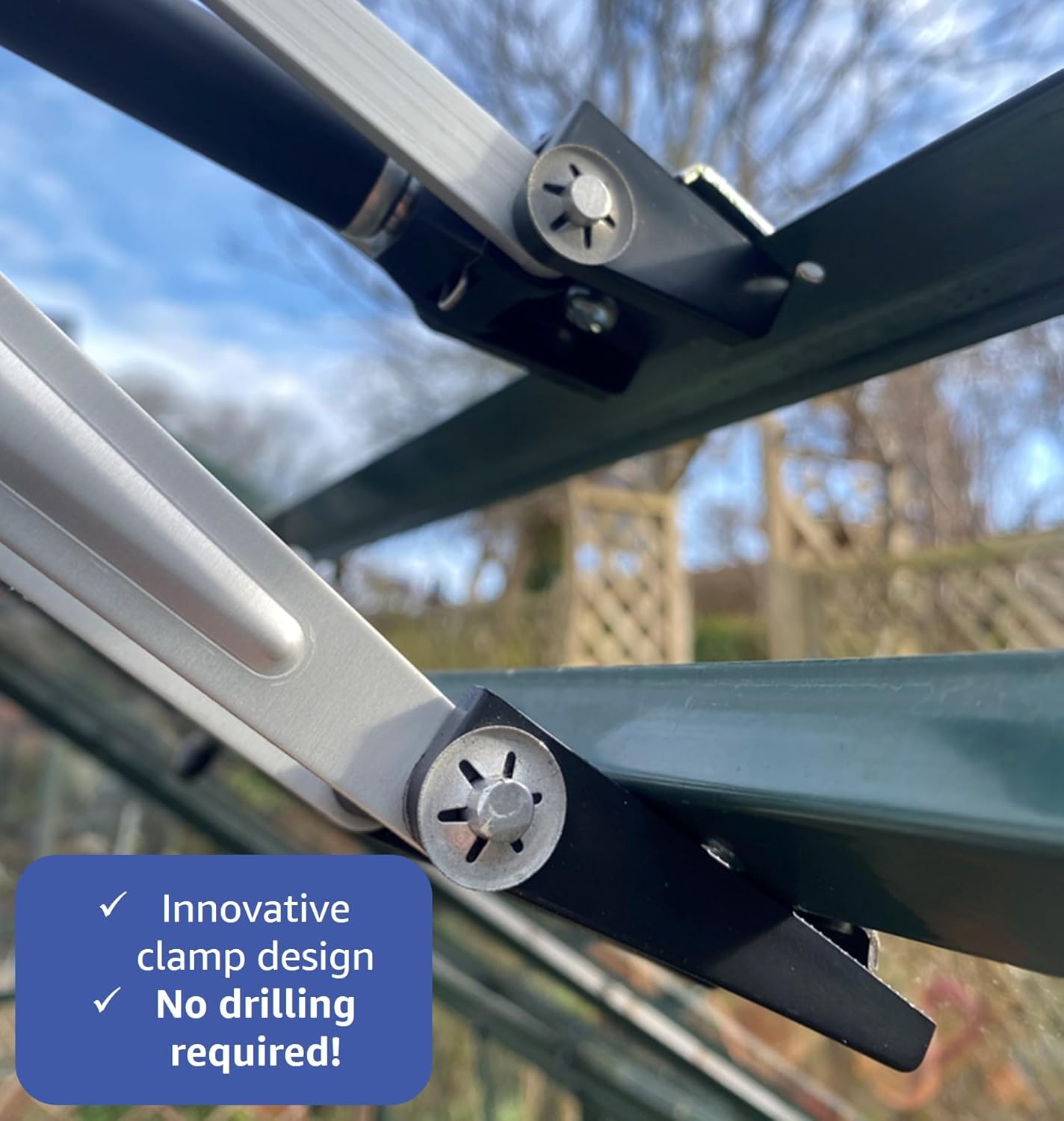
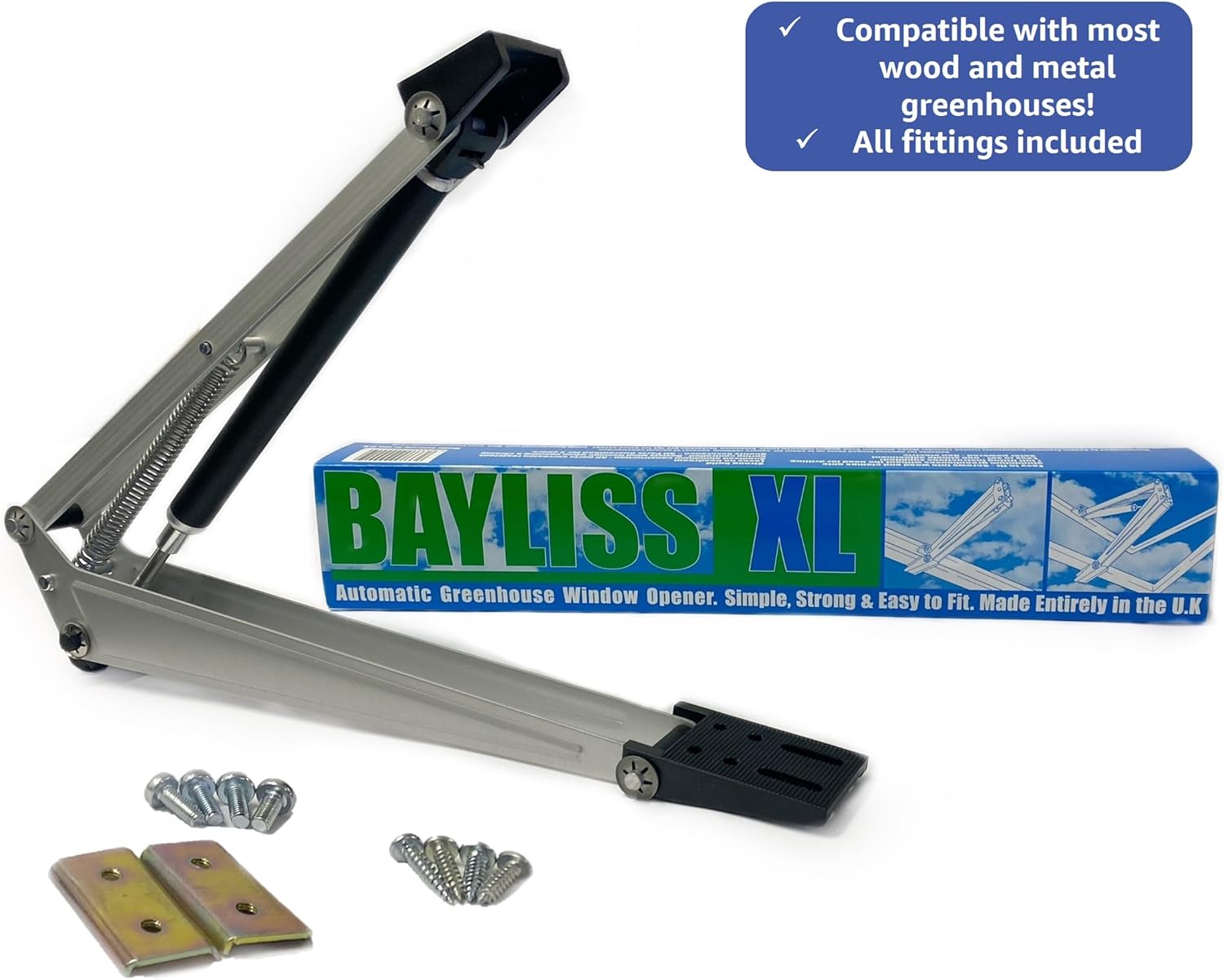
The clamp is the XL's headline fitting claim. The product photos say "No drilling required!" and "Compatible with most wood and metal greenhouses!", with all fittings included. Open the box and you get the mechanism, a handful of bolts and screws, and two metal backing plates.
On a standard aluminium greenhouse, it works exactly as advertised. denis alder's install went smoothly precisely because "the greenhouse is modern, aluminium, and has frames well suited to what the device needs". Mandy Hall fitted one to an old aluminium greenhouse and says it "works perfectly". Jo cook's greenhouse is "40 + years old" (sic) and it went straight on. And one five-star buyer who had been put off by all the fitting complaints found the fuss overdone: "I tried a test fit at first and the thing just worked. This was with an ill fitting window and no additional fixtures."
Wooden greenhouses are easier still, because you skip the clamps altogether and drive the screws into the frame. Diddy: "I have wooden greenhouse so no need for any brackets, so easy to fit took about ten minutes," (sic).
Polycarbonate-panelled greenhouses are where the promise breaks down, and this is the most useful thing we can tell you before you click buy. jac, three stars, reports that "It looks well made but it didn't fit my polycarbonate greenhouse window so i'm going to have to get creative to make it work" (sic). Mr. N. E. Hogan, one star, hit the worst version of it on a Palram: "Had to drill mounting holes in the brackets to fix to Palram greenhouse, as brackets do not fit, so cannot return." Read that final clause again. Drilling the brackets to force a fit meant the unit could no longer be sent back when the piston turned out to be dead on arrival. KEN TOPPING, four stars, got there in the end on an aluminium and polycarbonate greenhouse, but only by improvising: "I HAD TO USE FIXING RAIL SYSTEM ON MY NEW ALUMINIUM/POLYCARBONATE GREENHOUSE TO GET IT FITTED USING NUTS I HAD THAT FITTED THE SUPPLIED BOLTS." Martino, two stars, puts it more shortly: "Fittings needed adjusting to fit greenhouse."
So check your glazing bar before you order. If it is a conventional aluminium extrusion of the sort most British domestic greenhouses have used for decades, the clamps grip it and you will not touch a drill. If your greenhouse is a polycarbonate-panel type, budget for some improvisation, and whatever you do, do not modify the brackets until you have proved the unit actually works. Modify them first and you have given up your return.
Put The Wax Tube In The Fridge Before You Touch A Screwdriver
This is the trick that turns a frustrating afternoon into a ten-minute job, and it lives in the reviews rather than on the box. At room temperature the wax has already expanded, so the piston sits extended and will not line up with its mounting. You have to chill it to make it retract.
lor2ie, five stars, found this out the hard way and passes it on: "keep it outside in a shed until ready to use as I had to put the piston in the fridge until it retracted before I could attach it to the unit". denis alder did it deliberately after watching the fitting video, "I put the tube in the fridge (not freezer!) as soon as the package arrived", and had the whole thing mounted a couple of hours later in about ten minutes.
Carslaw disagrees about the freezer, and Carslaw's four-star review is the single most useful document in this entire review pool. "You absolutely have to cool it before fitting. I cooled 30 mins in the fridge as stated, but that wasn't long enough. After an hour I still couldn't get the pin to go far enough in. I had to put it in the freezer for 15 mins." Carslaw also flags the things nobody warns you about: fit the back plates before you offer the unit up to the greenhouse so there is one less thing to hold; expect to be working above your head throughout; and mind the edges, because "the aluminium arms on mine were very sharp and I cut myself a couple of times".
The instructions take a beating generally. KEN TOPPING captures the split in a line: "5 STAR PRODUCT BUT 3 STAR INSTRUCTIONS". David Hall, four stars, got a box with "no installation instructions" in it at all. ALEX HERON's one-star review calls them the "worst instructions ever". The remedy that keeps surfacing is the video. As denis alder puts it, "the printed instructions are pretty unclear about how to clip the device to the greenhouse frames, but the video makes this very clear". Watch it before you go up the ladder, not after.
Two last practical notes. M. E. Nagle, five stars, points out that "two pairs of hands are helpful if you have arthritic fingers, but we got there & very pleased with results" (sic), so rope someone in. And denis alder's parting observation is worth acting on: "I notice the clamp screws on the frame need to be pretty tight, and I'll revisit these in a few weeks in case heating-cooling cycles loosen them." Put a reminder in your diary to go and nip them up.
When It Fails, It Fails By Leaking
Now the part the affiliate roundups tend to skate over. The lifetime score on this listing is 4.4 stars from 4,012 reviews, which is a strong record for a garden accessory. But the hundred most recent reviews average 4.25, and twelve of those hundred are one-star. On a product this well liked that is a fat tail, and it is not random noise. Six of those twelve one-star reviews describe precisely the same failure: the wax cylinder losing its oil.
Mark, one star: "Installed as per instructions, but the seal failed on first operation resulting in the oil leaking out." Mr. David Yau, one star: "Bought 2nos, and 1 failed after only 4 month, with waxy oil leaking out and after removal, I found the piston fell out." (sic). Jordan S, one star, walked in one morning to find "plants covered in wax- piston and arms both failed" (sic). Mrs. C. M. Coomber came back to update a review a year later to report that "the hydraulic piston has now failed (fluid leaked out onto the greenhouse floor)". A fifth put it as plainly as it can be put: "Started off working ok, failed after a month. Oil leaking from cylinder." And a sixth had it fitted for two days before coming home from work to find the oil gone and the window shut.
Read the timings in those reviews and a shape emerges. Two days. First operation. The first day. A month. Four months. A year. The cylinder failures land early, and they land hard.
Then set that against the other end of the sample. A five-star buyer has four of these that have run "for almost 20 years without any problems". Another reports an old unit's "partner still fine after 7 years" (sic). Mr D's have been up since 2023 without missing a day. Nobody in these hundred reviews describes a Bayliss that worked beautifully for five years and then slowly got tired. They either fail near the beginning, or they run for a very long time indeed.
That is early-life failure in the wax cylinder, not wear-out, and it should change what you do when the parcel arrives. Fit it, then watch it like a hawk through the first fortnight of warm weather. Look at the tube, and look at the floor underneath it for oil. If it is going to go, that is when it will go, and that is while you can still send it back.
The Tube Is A Consumable, And Bayliss Seems To Know It
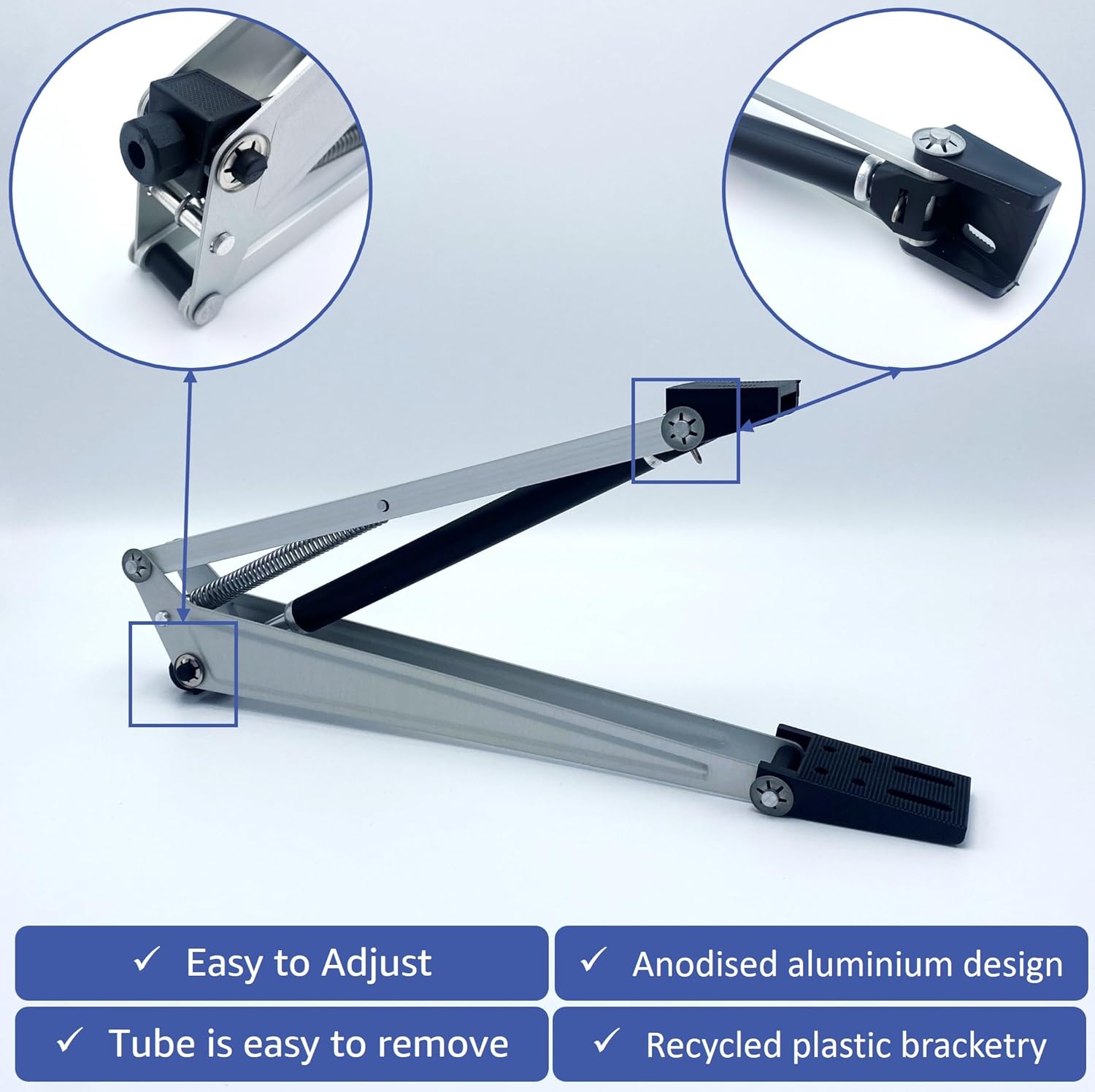
What rescues all of the above, and the reason we would still put one on a small greenhouse, is that the wax cylinder is a serviceable part. One of the four callouts Bayliss prints on its own product photography is "Tube is easy to remove", and the tube is sold separately. The company is telling you, in its own marketing, which component is the one that goes.
The reviews show what that means in practice. Three buyers in our hundred had a cylinder fail on them and still left five stars, because the replacement sorted it out. Richard: "Had an issue with it closing but was sent a replacement piston and works fine now". Andy Kiy's "first one leaked after7 days" (sic), and the replacement has been working well ever since. Henryfrombg contacted the seller through Amazon after a unit stopped working, had a reply within hours, and reports that "within 3 days the manufacturers have supplied a replacement gas strut free of charge. I fitted it in 5 minutes this morning". Five minutes, and the window was open again.
The replaceability is not guaranteed, though. Tony, two stars, went to swap just the cylinder when his stopped working and could not, because of "the fixing screw mechanism being completely jammed and effectively threaded". He bought a complete unit in the end, having found that the whole assembly cost only a little more than the cylinder on its own, so he took the easy route rather than wrestle with seized parts. Tony is fair about the failure itself, mind: "It stopped working after a year, which is understandable due to the heat etc it's had to endure."
The useful way to hold all this in your head is to treat the cylinder as a consumable, like a mower blade or a strimmer line. It sits in a baking greenhouse roof opening and closing every day of the season, and one day it gives up. Budget for a new tube every few seasons and the whole thing stops looking like a design fault and starts looking like ordinary maintenance.
So Should You Fit One To Your 6x4?
Yes, with your eyes open.
If you have a standard aluminium or wooden small greenhouse with one opening roof vent, the Bayliss XL does the job it sets out to do. No power, no wiring, no attention. It goes on in roughly ten minutes provided you chill the tube first and watch the video, and PCul's five-star summary is what the majority experience: "Fit and walk away, works as it should without question". Peter Pearson's reads much the same: "Fitted within 10 minutes easy to fit good value for money , its a simple thing but looks very durable" (sic). Set the adjustment towards the low end through a cold spring, wind it back for high summer, and your seedlings stop cooking while you are at work.
Three things to be clear about before you order. It is temperature-controlled, not humidity-controlled, and hebridian's five-star review names the consequence exactly: "they won't close when it rains on a very hot day as they are temperature controlled not humidity controlled". In a gale you will want it off the window, which the design allows for, as Lesley confirms: "Easy to disconnect when window requires secure fixing when high winds are expected." And if your greenhouse has polycarbonate panels rather than glass in an aluminium frame, check the bracket fit properly, and drill nothing until you know the unit works.
The one-star tail is real and we are not going to talk you round it. But it has a shape: it is the wax cylinder, it shows up early, and it is a part you can replace for less than a new unit. Fit it, watch it hard for a fortnight, and if the tube holds, there is a fair chance you will still be using it when the greenhouse needs re-glazing.
Bayliss XL Autovent - Automatic Greenhouse Window Opener
UK-made, wax-powered roof vent opener with an adjustable 12°C to 18°C opening point. No wiring, no batteries, and no drilling on most aluminium and wooden greenhouses. All fittings included.