
Baby Bio Houseplant Food Review: The 70-Year-Old Bottle Your Gran Probably Used
We earn commission from qualifying Amazon purchases. It costs you nothing and does not affect what we recommend.
Baby Bio has been quietly feeding British houseplants for over seven decades, outlasting fads and formula reshuffles. We read through 100 verified reviews to see whether the £2 concentrate still deserves its place on UK windowsills in 2026.
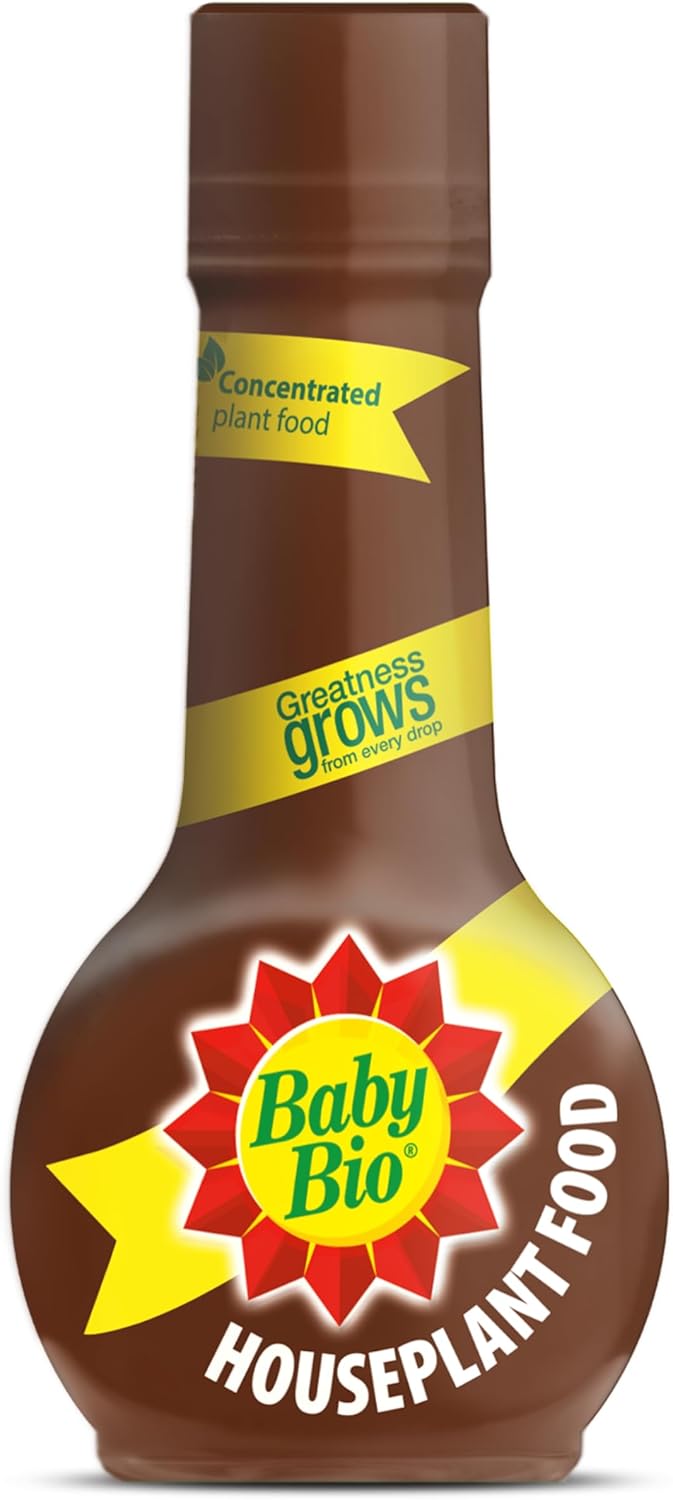
There is a specific type of brand loyalty that only makes sense when you trace it back through three generations of British living rooms. Baby Bio is one of those brands. It has been sitting on UK kitchen windowsills since the mid-1950s, and if you grew up anywhere in Britain, there is a reasonable chance your mum, your gran, or both kept a small brown bottle next to the watering can for as long as you can remember.
That might sound like marketing sentimentality until you read through the reviews. One verified buyer, sulkycat, wrote: "I remember my mum always using BabyBio on her plants, many decades ago. I've tried several more expensive versions, but I've come back to this trusted brand. It's cheaper and seems more effective." That comment picked up 5 helpful votes. It is not an isolated voice either. Charlie-B, a buyer with 4 helpful votes, says simply: "Have used Baby Bio for decades and it's a great plant food for indoor plants."
At £2.00 on Amazon, with 21,112 ratings averaging 4.6 stars and over 10,000 bottles shifted in the past month, this 175ml concentrate is currently ranked #2 in Multi-Purpose Fertilisers. We read through 100 verified reviews to see whether the 70-year-old formula still holds up for today's UK houseplant owners, and to flag the one practical gripe that kept coming up.
The Heritage Holds Up Under Scrutiny
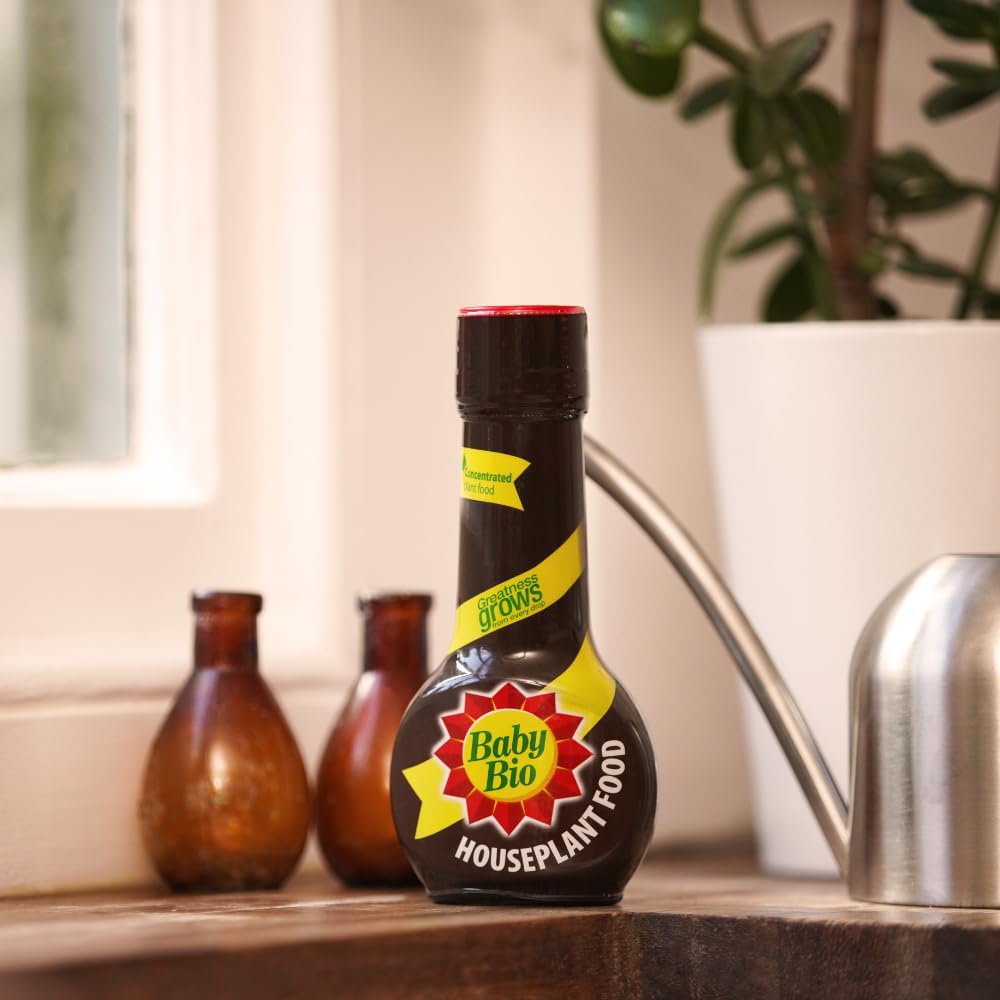
Plenty of garden brands claim heritage. Baby Bio happens to be one of the few where the buyers actively volunteer the story themselves. Browse any page of reviews and you will see phrases like "old friend," "old trusty," "my go-to fertiliser for ever," and the very common "have used this for years and keep coming back."
The brand has been feeding British houseplants for over 70 years, and it is now owned by SBM Life Science. What matters more is that the formula has not been messed with. One reviewer, who simply goes by Amazon Customer, noted: "Exactly the product I was expecting with same great formula." That consistency is unusual. Most household products get quietly reformulated every few years to trim costs, and longtime buyers tend to notice immediately. With Baby Bio, the loyalty holds.
There is also a practical reason behind the sentimentality. If something has kept your mum's peace lily alive through three decades of UK winters, you tend to trust it with your own.
How Long Does 175ml Actually Last?
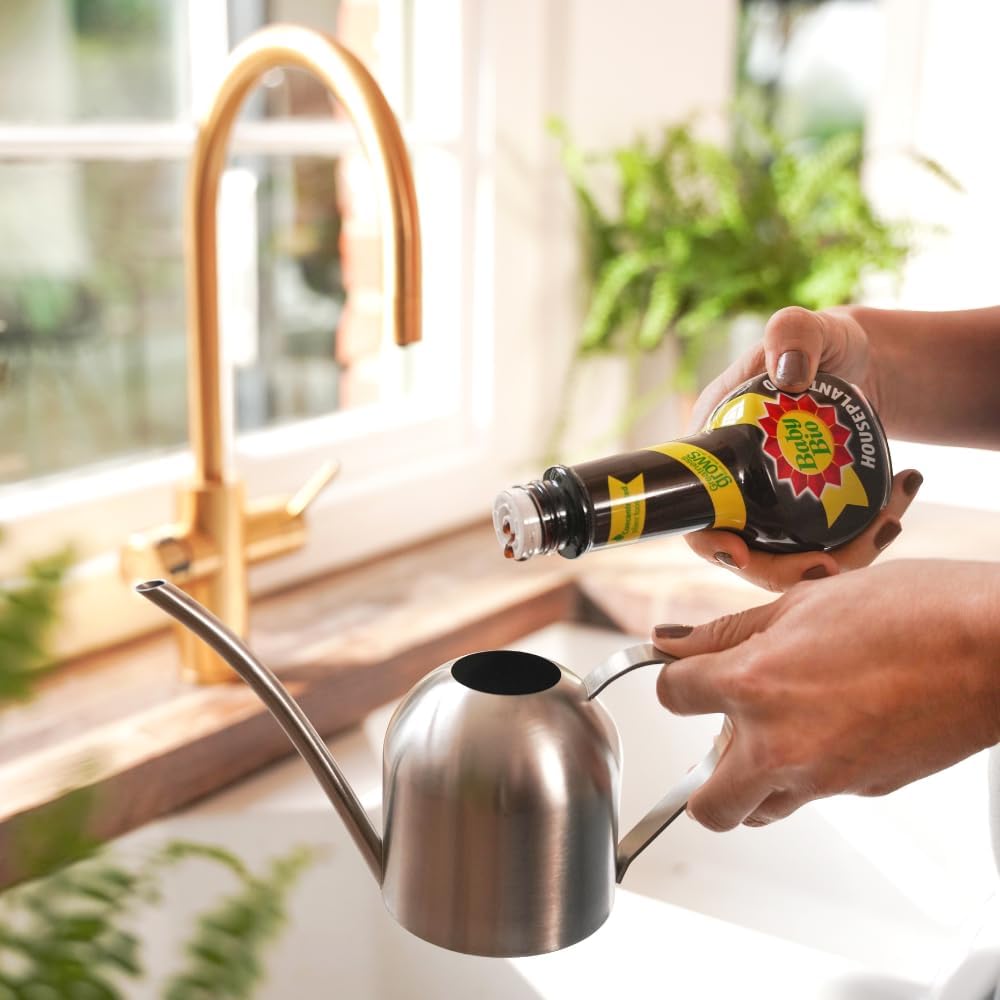
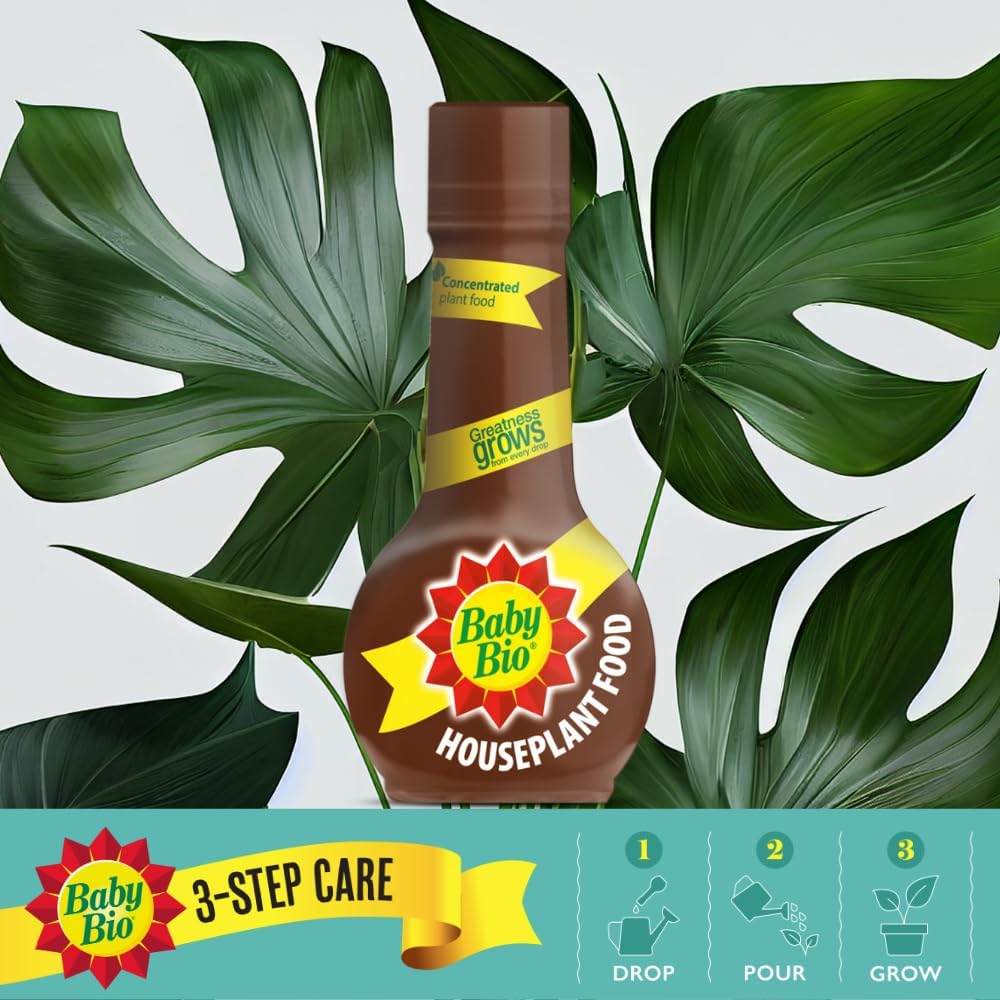
This is where the value case really clicks into place. The dosage is 5 to 10 drops per half litre of water, or one capful per litre if you prefer to measure that way. Baby Bio's own packaging claims the 175ml bottle makes up to 70 litres of plant food. That sounds like a marketing number until you see real buyers reporting the same thing.
Gra, a reviewer with over 50 indoor plants, summed it up: "Last ages I got over 50 indoor plants and 10 drops in 1 liter it make it last ages. Love it!!!" Jaydee was slightly more measured: "An old reliable favourite. I can definitely say that if I stop using it then my plants don't look quite as happy. It seems a little expensive at first but does last a long time."
For a typical UK flat with 5 to 15 houseplants, feeding once every two weeks during the growing season, a single £2 bottle should comfortably cover you for most of a year. If you keep your plants on a stricter winter feeding schedule (which you should, given how slowly they grow under low UK winter light), the bottle stretches even further. On a cost-per-litre-of-feed basis, you are looking at something around 3p. For a product that 4.6-star reviewers keep buying on repeat, that is remarkable running-cost territory.
What the NPK Numbers Tell You
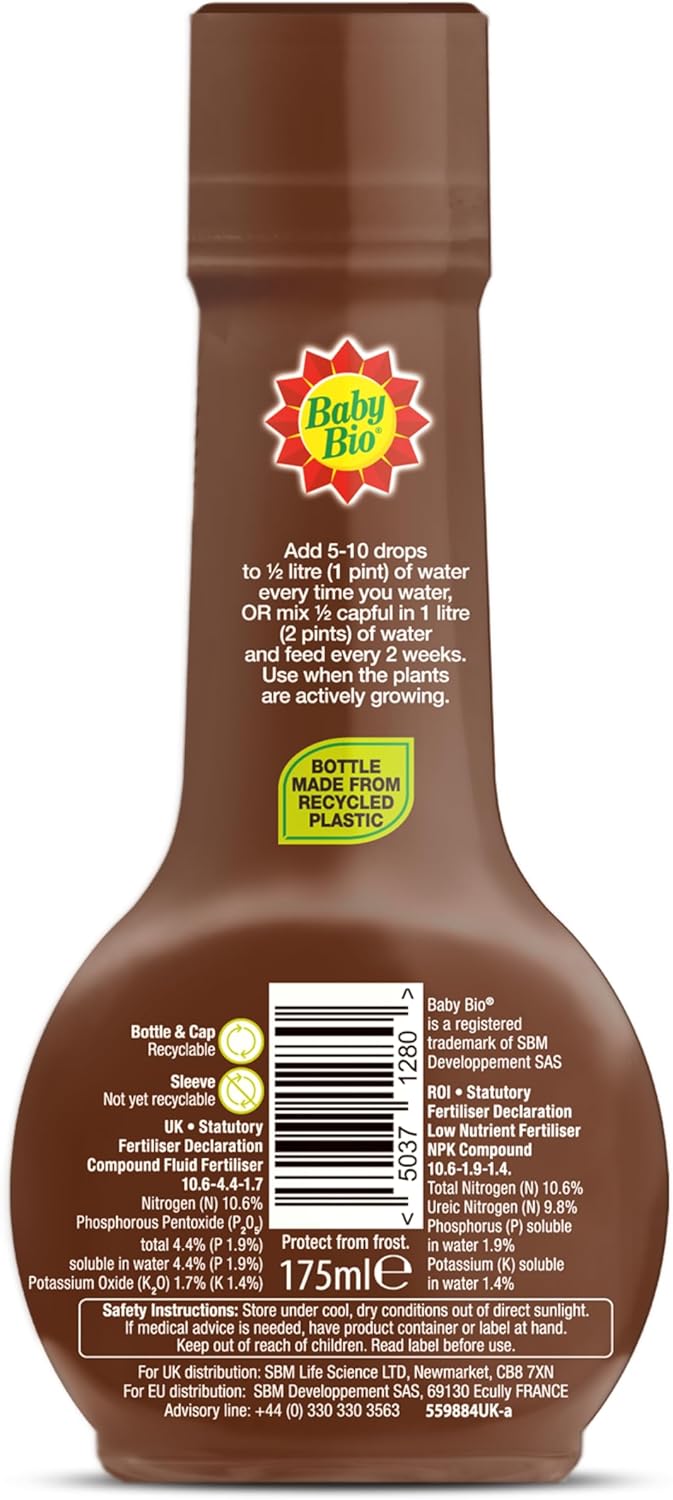
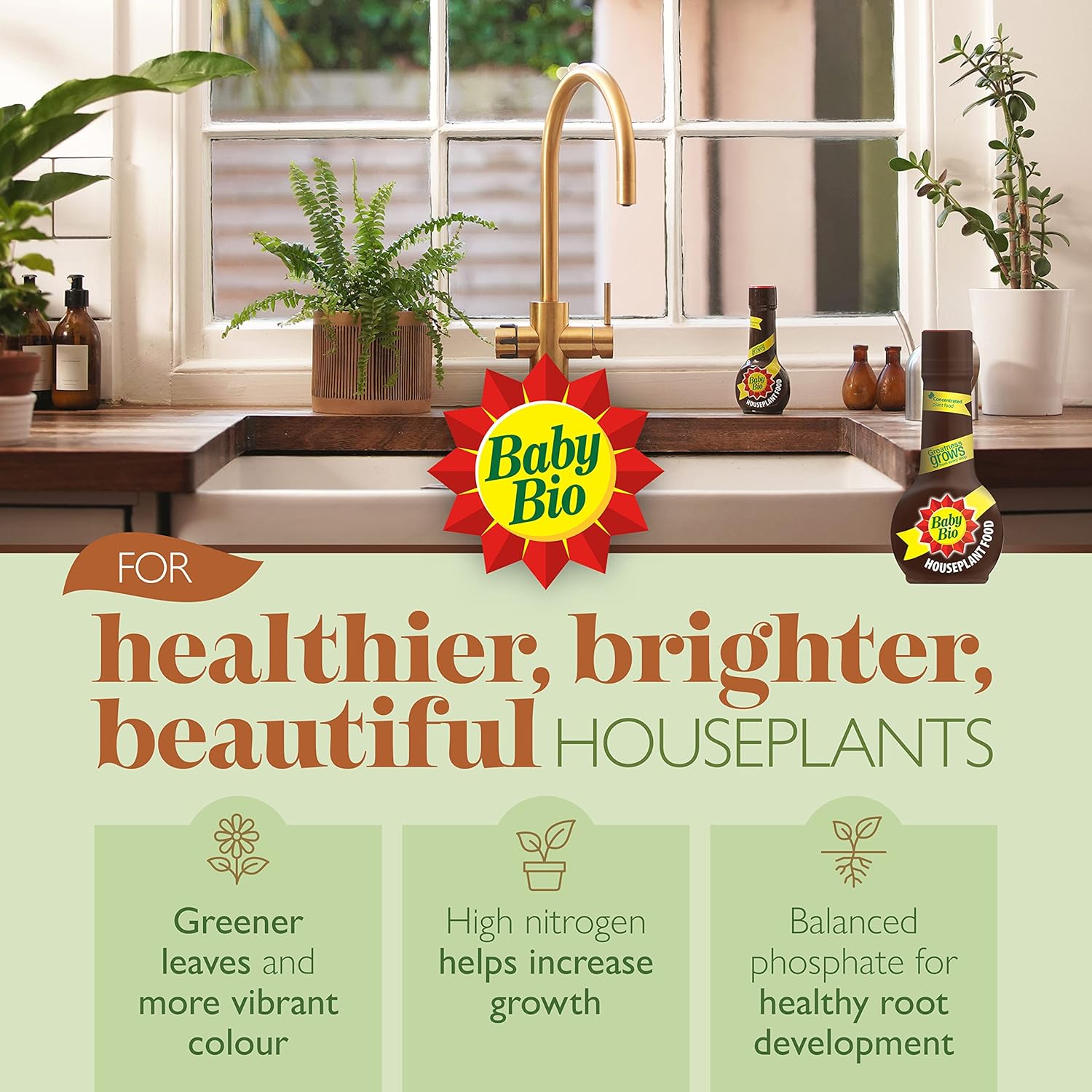
If you flip the bottle and squint at the back label, you will find the NPK ratio: 10.6 nitrogen, 4.4 phosphorus, 1.7 potassium. In plain English, this is a nitrogen-heavy feed designed to push lush green foliage and strong root growth, with moderate support for flowering and minimal potassium top-up. That is exactly the ratio most leafy houseplants want during spring and summer.
It is worth understanding what this means in practice:
- Nitrogen (10.6): drives leaf and stem growth. This is why Baby Bio users consistently describe their plants as greener and more vigorous after a few weeks of use.
- Phosphorus (4.4): supports root development and helps flowering plants like orchids and peace lilies set blooms.
- Potassium (1.7): modest here, which keeps the formula focused on foliage rather than fruiting.
For the majority of UK houseplants (pothos, monstera, philodendron, spider plants, peace lilies, ferns, rubber plants), that balance is almost exactly what you want. If you are growing something that specifically needs high potassium, such as fruiting chilli plants or flowering cacti, you might supplement with a specialist feed. But note what Elizabeth wrote in her 5-star review: "It has revived the chilli plant which was almost leafless and hadn't seemed that there was hope but it is looking much better. I did not use the feed that is pertinent to chilli plants but I don't think the plant minds."
In other words, even on plants where a specialist feed would technically be better, the Baby Bio formula still delivers. It is a multi-purpose product and it behaves like one.
Baby Bio Houseplant Food, 175ml
The 70-year-old concentrate that feeds up to 70 litres of plant food per bottle. Balanced NPK formula (10.6-4.4-1.7) for lush foliage and strong roots across all houseplants. Made in the UK from recycled plastic.
The Peace Lily Effect
One plant comes up more than any other in the reviews: the peace lily. UK houseplant owners tend to struggle with getting them to flower, partly because of low winter light and dry centrally-heated air. Baby Bio appears to be something of a specific remedy for this.
Mrs Lesley Brown, a first-time buyer of indoor feed, wrote: "Never used indoor feed before but seems to have perked up my peace lily." Another reviewer, whose peace lily had refused to flower in years, bought Baby Bio as a last-ditch attempt and wrote: "Peace lily hasn't flowered yet as too soon but that will be the real test as it hasn't flowered in years." Kindle Customer went further: "Great pick me up and a history of success in plant maintenance. My plants all have a new lease of life and my Peace Lilly has more flowers on now than it has ever produced."
The phosphorus content (4.4) is doing the work here. Flowering houseplants need phosphorus to set buds, and many generic feeds skimp on it in favour of pushing nitrogen. Baby Bio strikes a better balance for plants that are meant to bloom indoors but tend to sulk under UK growing conditions.
The same pattern shows up with other flowering species. Money plants, orchids, chilli plants, coffee plants, and even herbs are all mentioned positively in the reviews. R. J. Harries wrote: "I have a little coffee plant that really struggles, before using this it only had 2/3 leaves on it, since using it the plant is now blooming with 8/9 leaves."
The One Real Complaint: That Red Safety Cap
If there is one criticism that comes up repeatedly, it is about the red plastic safety cap. Several reviewers found it difficult to open. Denise Barnes wrote: "My herb plants were delighted with Baby bio, thanks. The bottle was very difficult to open, I had to cut it off." Jules rated the product 3 stars largely because of the cap, noting: "very difficult to remove the lid, for me any way. My son did it in no time."
CobWeb flagged the same issue but took a more pragmatic view, noting that getting the perforated brown wrapper off the top and the red safety cap open is not the easiest, but still described it as a repeat purchase for the household because the money plants were clearly profiting from the extra care.
This is a fair criticism. A child-safety cap is sensibly a good thing on a concentrated plant fertiliser, but the design does seem to trip up some users on first opening. If you have grip issues or weaker wrists, it is worth knowing in advance. Running the cap under warm water or using a grippy kitchen cloth usually sorts it.
Beyond the cap, there were only a handful of negative notes across 100 reviews. One 1-star reviewer reported that it killed their plants (picked up 2 helpful votes, but stood out as isolated against thousands of positive reports), and a couple of users had delivery issues with third-party carriers that had nothing to do with the product itself.
Concentrate vs Ready-Mixed: Why the Format Matters
If you have been reading houseplant reviews lately, you will know that ready-mixed bottles have taken over a big chunk of the market. The appeal is obvious: no measuring, no drops, no dilution. You just pour.
But concentrate still wins on three fronts. First, it is dramatically cheaper per litre of actual feed. At roughly 3p per litre of diluted solution, Baby Bio is a small fraction of the cost of ready-mixed rivals on a like-for-like basis. Second, concentrate stores longer without degrading, since you only mix what you need. Third, you control the strength. If you have a sensitive plant that reacts badly to full-strength feed, you can simply use fewer drops.
The trade-off is the 30 seconds it takes to count drops into a watering can. For most buyers, that is a trade they will take. RyanReviews, a self-declared beginner, wrote: "I'm new to looking after houseplants, but this has made it simple. Just... the bottle lasts ages and feels like good value."
Baby Bio's bottle design helps. The dropper tip releases one drop at a time without guesswork, and the squeezable brown plastic (now made from recycled material, according to the badge on the label) is forgiving. Charlie-B explained it well: "The squeezable bottle lasts for ages and is well designed so that the liquid comes out a drop at a time, so no guesswork required."
Who Should Buy It (And Who Probably Shouldn't)
Baby Bio is a strong match if:
- You have a mixed collection of leafy houseplants (pothos, monstera, peace lilies, ferns, rubber plants) and want one bottle that handles everything.
- You are new to feeding houseplants and want a simple, proven formula with clear instructions.
- You want something that will last most of the year for under £3.
- You appreciate buying from a UK-produced brand with a recyclable bottle.
- You have had a peace lily refuse to flower and want to give it a serious nudge.
You might want something else if:
- You grow specialist plants (orchids, cacti, succulents, carnivorous plants) that want bespoke NPK ratios. Baby Bio will keep them alive but a specialist feed will get better results.
- You have dexterity issues that would make the red safety cap a genuine barrier.
- You want a ready-mixed pour-and-feed format and are willing to pay significantly more per litre for the convenience.
For everyone else, at £2.00 for a bottle that feeds dozens of plants for most of a year, the case is straightforward. This is the default answer when someone asks what to feed their indoor plants, and it has been the default answer for seven decades for good reason.
Baby Bio Houseplant Food, 175ml
The 70-year-old concentrate that feeds up to 70 litres of plant food per bottle. Balanced NPK formula (10.6-4.4-1.7) for lush foliage and strong roots across all houseplants. Made in the UK from recycled plastic.