
Three Stars Is The One Rating This Max Min Thermometer For Greenhouse UK Never Gets
We earn commission from qualifying Amazon purchases. It costs you nothing and does not affect what we recommend.
A small plastic box that either runs for five years or dies in three weeks. We counted every one-star review to work out which of those you are likely to get, and what to check before your return window shuts.
- A Hundred Reviews, And Not One Person Sat In The Middle
- The One-Star Reviews Are Not About Temperature At All
- Both Two-Star Reviews Say The Same Thing: It Reads High
- Two Reviewers Tell You To Keep It Out Of Direct Sun
- The Same Two Or Three Years, Rated One Star And Five
- The Overnight Minimum Is The Number People Actually Buy This For
- Reading the Overnight Low From the Doorway, Without Your Glasses
Line up a hundred reviews of almost any garden gadget and you get a slope. A pile of fives, a decent run of fours, a soft middle of threes where people are politely disappointed, then a tail of angry ones. This thermometer does not do that. Across the last hundred reviews, 83 people gave it five stars and 8 gave it one. Not a single person gave it three.
That missing middle is the most useful thing on the whole listing, because it tells you the decision here is not about whether the thermometer is any good. Nobody thinks it is mediocre. It either sits in your greenhouse for years doing exactly one job, or it goes dark and leaves you arguing with a return window. Working out which of those you are signing up for, and how to load the dice in your favour, is what the rest of the reviews are for.
A Hundred Reviews, And Not One Person Sat In The Middle
Here is the full breakdown of the most recent hundred reviews: 83 at five stars, 7 at four, zero at three, 2 at two, and 8 at one. All hundred are from the United Kingdom and 99 of them are verified purchases, which is a cleaner pool than most Amazon listings give you. The sample averages 4.55, and the listing's lifetime headline sits at 4.5 across 2,939 reviews. Those two numbers agreeing is worth noting, because it means the recent run is not quietly worse than the long-term record. What you see is what buyers have been getting for years.
The five-star reviews are almost comically brief. "It does the job" is the entire body of one. "Great !" is another. richard taylor's full review reads "it is a thermometer and it works perfect". That terseness is the finding, not a gap in the data: nobody has much to say about a thermometer that works, because a working thermometer asks nothing of you. It sits on a nail and shows a number.
The one feature people do bother to write about is the display. By my count, 18 of the hundred reviews specifically praise how readable it is, using words like clear, legible, large or easy to read. Dennis Sibson calls it a "large clear display". D K Gray says it is "Nice and clear display very easy to read and reset". For a greenhouse you squint into from the doorway on a grey March morning, that turns out to matter more than any spec on the box.
The One-Star Reviews Are Not About Temperature At All
This is the part that surprised me. You would expect the angry reviews of a cheap thermometer to be about the thermometer being wrong. Not one of the eight is. Every single one-star review is about the unit not working, not arriving in a fit state, or dying.
Six of the eight describe the same thing: it stopped. The timings are the striking bit. Angela Wools got less than a day out of hers: "Was initially very happy with item. But less than 24 hours in the screen went blank and eventually git a screen which appears to indicating an error. Grrrrr!" (sic). Juliet's title says it all, "Unreliable .. stopped working after 21 days". ytf37 got about a month. A Eastes got three: "Broken after only 3 months disappointing". sg got under a year. Ward Family (UK) got three years before the readout went illegible.
Two of those six went out of their way to rule out the obvious culprit. sg writes: "Lasted less than a year. Screen completely dead even with brand new batteries." ytf37 writes: "I replaced the battery but still no response." So when these fail, a fresh AAA does not bring them back. The unit is simply done.
The remaining two one-stars are not really about longevity. Mr. H. seems to have been sent a unit that had already been round the block once: "This thermostat does not work. Obviously someone else’s return as box has been opened and still has a battery in it. Going to return it as someone else did." That reads as a fulfilment problem rather than a design one. The last is a single line from an Amazon Customer, "Not fit for Purpose so returned for refund", with no detail to work with.
ytf37's review is the one I would read twice before buying, because it is the only one that follows the failure all the way through: "it was exactly what I required and worked very well for about one month and then died. I replaced the battery but still no response. Rang ETI product support and they declined to help and referred me back to Amazon. Amazon advised 30day return policy had expired end of January." Worked, died, no help from either end. Hold that thought, because it changes how you should buy this.
Both Two-Star Reviews Say The Same Thing: It Reads High
The accuracy complaints exist, but they live entirely in the two-star bracket, and there are exactly two of them. Both say the same thing, and both point the same direction.
Hopefully helpful did proper homework before complaining: "now in June, it says there had been over 40° C in the room. I became curious and compared it to two different thermometers plus BBC weather forecast. Result: It says 2 degrees more than 3 others." They were fair about it too, adding "Well maybe if this is consistently the case the recording function can still be useful. A bit disappointing though." artifice went further and sent theirs back: "Nice design but the temperature was 10 degres higher than the correct temperature" (sic).
Against that, 8 reviewers describe it as accurate, and one of them is the only person in the pool who checked it against a calibrated gauge. JG writes: "Very pleased with this. I checke it against a calibrated temperature gauge and it was within 0.2 degC which is good enough for a garden" (sic). Within 0.2°C of a calibrated reference is a good result for something this cheap. Janet Robb deserves credit for a rare piece of self-awareness, declining to take a side at all: "I cannot vouch for its accuracy as I don't have anything to compare it with". That caveat is quietly true of most of the people calling it accurate, who are comparing it against nothing.
So the score is two reviewers saying it reads high against eight saying it is fine, including the one person who measured it against a calibrated reference. But notice the direction. A failing sensor drifts both ways, and you would expect roughly as many people complaining it reads cold as hot. Nobody in a hundred reviews says it reads low. Every accuracy complaint is high, and a thermometer that only ever reads high is usually a thermometer that is being warmed by something.
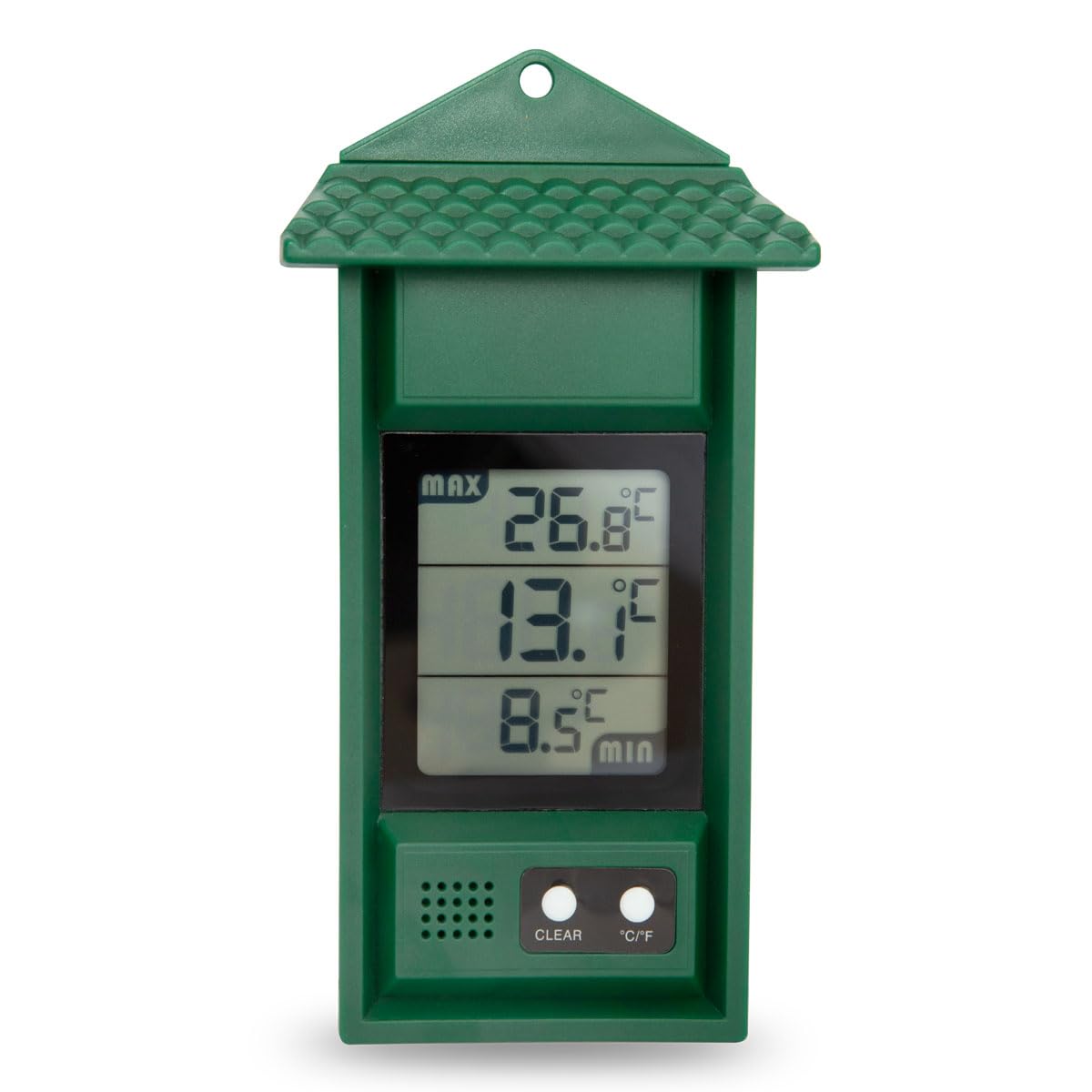
Digital max/min Thermometer for conservatories, greenhouses & Grow Rooms (Green)
Max, current and minimum temperature on one screen, from -20 to 69.9°C. The overnight low for your seedlings, recorded while you sleep, in a case that hangs on a single nail.
Two Reviewers Tell You To Keep It Out Of Direct Sun
The most recent review in the pool is also the one that explains the most. Angela B, writing on 14 July 2026 under the title "Not for full sun facing walls", gave it four stars: "It was in the garden (UK) for an hour and the screen came up with what I can only describe as error messages. I emailed the company who makes them ( not the seller) but they declined to respond. I reset it and moved it out of direct sunlight and it works ok now . Don’t put it in full sun and it will work ok ." An hour in full sun was enough to throw errors. Out of the sun and reset, it has been fine.
One other reviewer, don, skipped the explanation and just made the advice the title: "Just place it out of direct sunlight". The body is seven words long, "Works well, good value for the money".
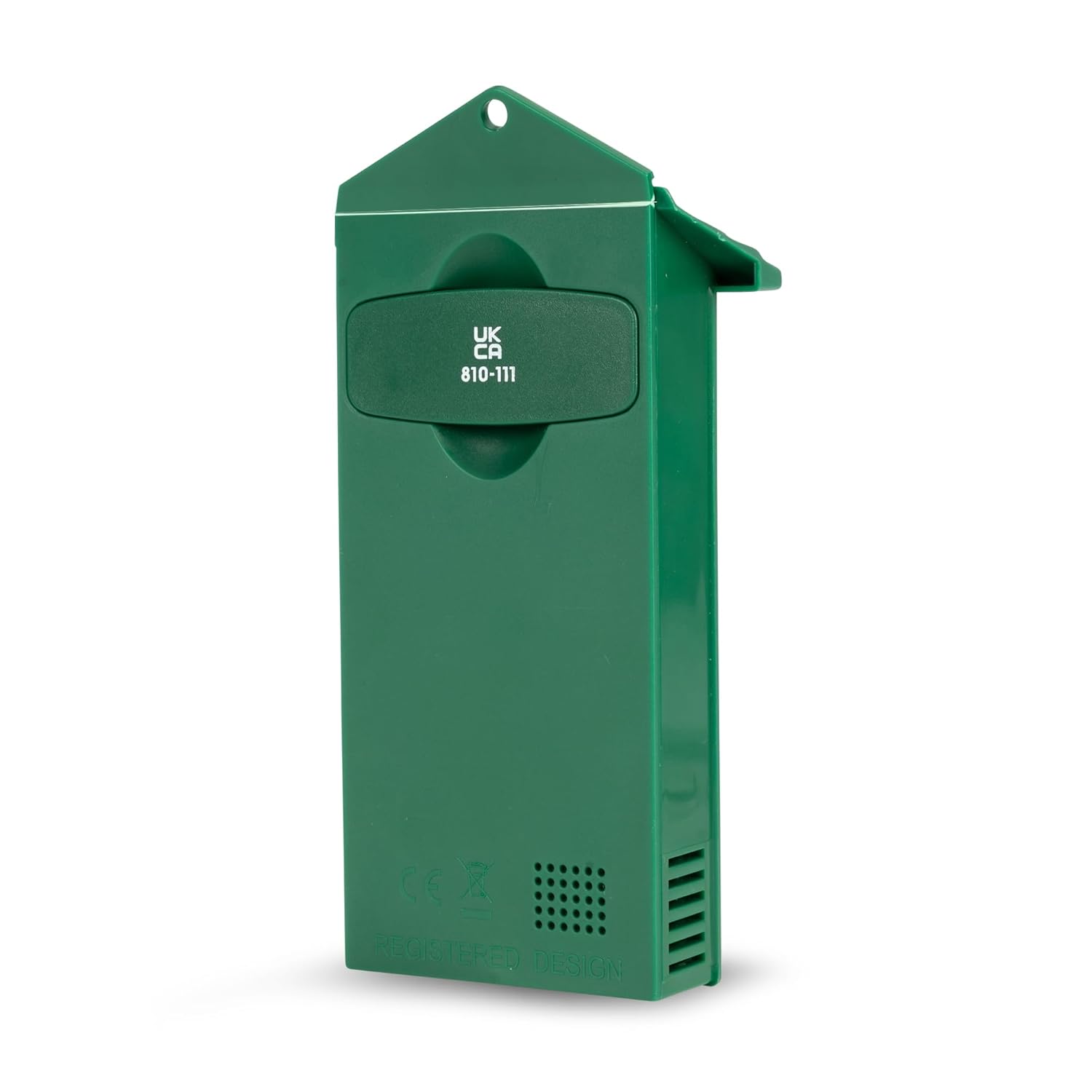
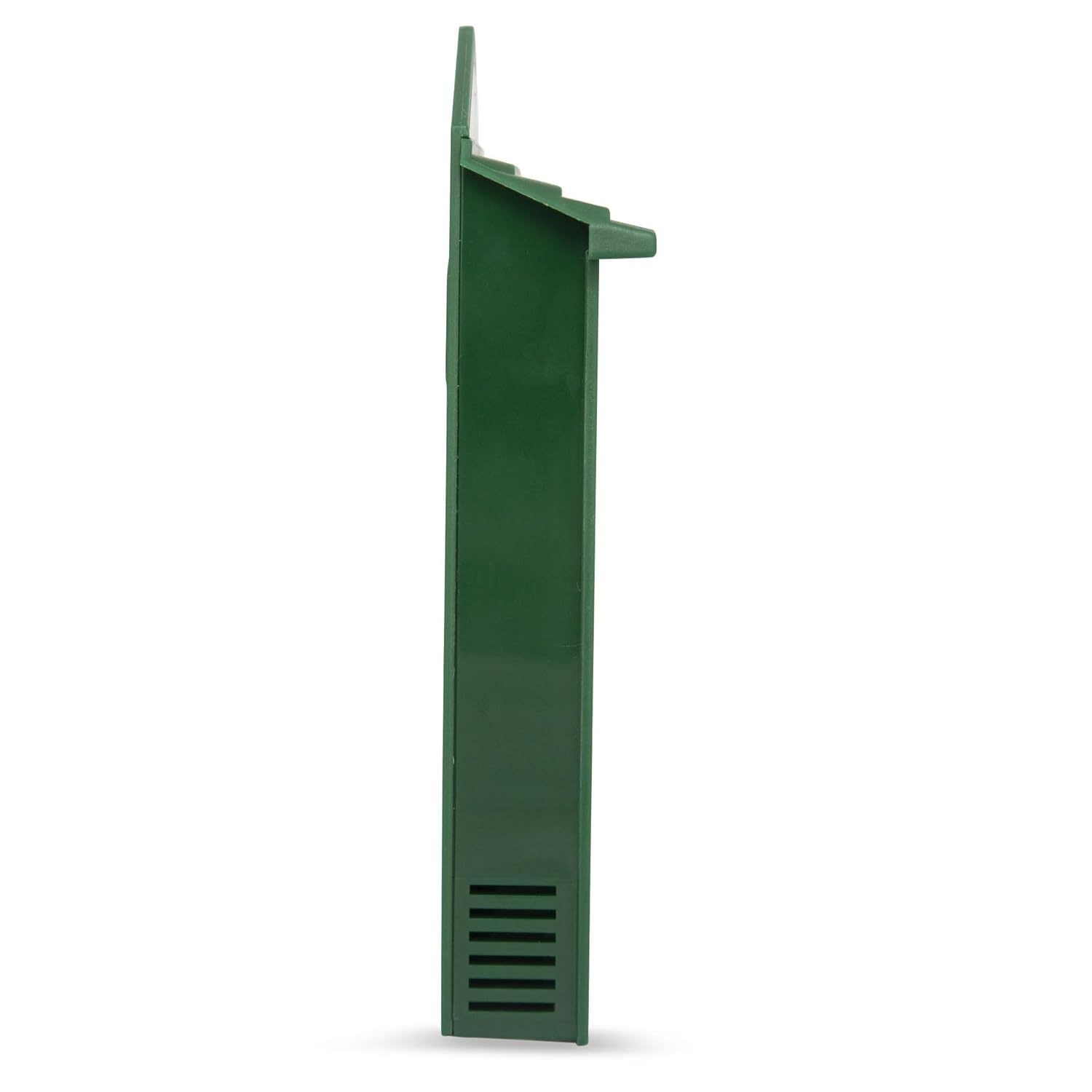
That is two reviewers out of a hundred, so it is a whisper rather than a drumbeat, and I want to be straight about the limits here: neither two-star reviewer said where theirs was hanging, so the link between the sun and the high readings is my read of the evidence, not something either of them claimed. But it fits. Look at the product photos and you can see what this thing is. It is a plastic case with a sensor sitting behind moulded vent slots. There is no radiation shield, no white louvred housing, none of the kit a weather station uses to measure air rather than sunshine. The moulded roof overhangs the display by a few millimetres, which shades it from light coming straight down, and does nothing at all about low morning or evening sun coming in sideways through the glass.
In a UK greenhouse that is remarkably easy to get wrong, because the entire building exists to let light in. Hang it on the sunny end and you will measure the sun. Hang it at shoulder height on a shaded upright, away from the glass and away from any heater, and you measure the air your plants are actually sitting in. Worth saying that Monica Thorpe's five-star note that the "very clear figures" "will not fade in the sun" is about the LCD not bleaching, which is a different question from what the sensor reads.
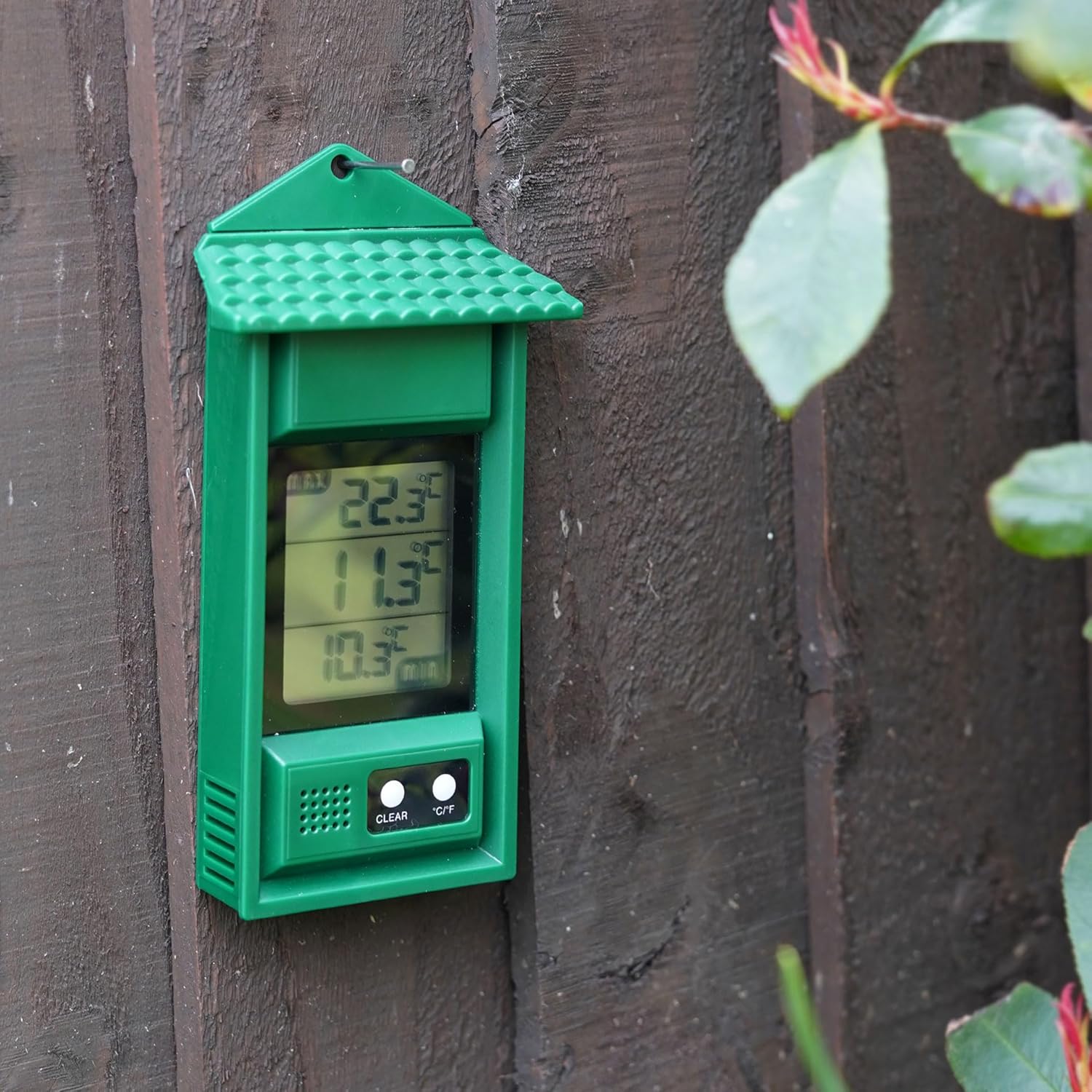
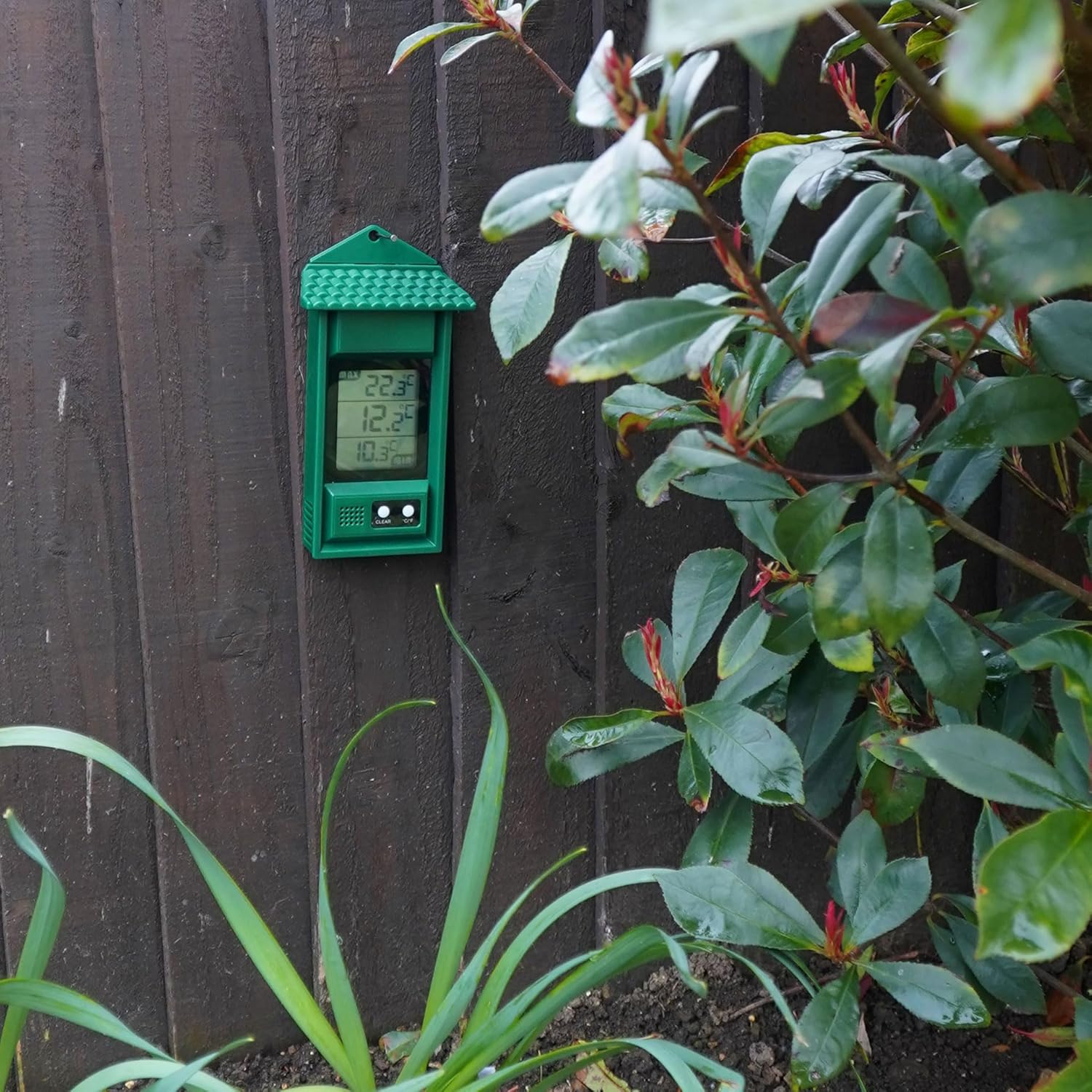
One more placement caveat. The listing bullets only ever claim greenhouses, conservatories and grow rooms, all sheltered spots, yet the listing's own photographs show it screwed to an outdoor fence panel. No waterproof or IP rating appears anywhere in the bullets, and two reviewers spotted the gap. artifice returned theirs partly because "I also read that it s not fully waterproof" (sic), and Jill Hart, five stars, hedged with "So far so good, yet to see how rainproof it is". Nobody in the hundred actually reports water killing one. But hang it in the open and you are going beyond what the listing promises, and you are on your own if it drowns.
The Same Two Or Three Years, Rated One Star And Five
Now put three reviews side by side and the missing middle starts to make sense.
Ward Family (UK) gave it one star, titled "Was good while it worked!": "Had this and the lasted well for 3 years. Since then readout is now illegible. See photo. Recommended if you only want it for a year or two" (sic). ruth goodman gave it five stars, titled "Not bad for the money": "Good thermometer for the money.Records minimum,current,and highest temperatures. This is a replacement for our previous one which lasted 2 years." (sic). G. Merrick gave it five stars and put the whole story in the title: "I have had one previously for about 5 years used outside, it has only now strated to fail." (sic), with a body reading "Works well, great value".
Three reviewers. Roughly the same outcome, a unit that gives you somewhere between two and five years and then the screen goes. One star, five stars, five stars. The product did not change between those three reviews. The expectation did.
That is the whole ballgame with this thermometer, and it is why there are no three-star reviews to be found. There is no lukewarm opinion available. You cannot think it is fine-but-flawed, because there is nothing to be flawed about: it shows three numbers or it shows nothing. So the rating you would give it is decided before you buy, by what you think a cheap plastic thermometer owes you. Ward Family wanted an instrument. ruth goodman and G. Merrick bought a few seasons of knowing the overnight low, got them, and shrugged when it ended.
Four of the hundred reviewers mention owning one of these before, which is a solid loyalty signal at this price. Fizz: "Had same one before and it lasted years". Charles Halliwell is on his third, though he is careful to point out the first two never actually failed: "This is the 3rd one I have bought and it super. The first 2 were left, by mistake, at previously owned houses!" (sic). People who have been through one of these keep coming back, which tells you the ending is not a nasty surprise to them.
So set your expectations at the till. Treat it as kit that runs a few seasons and gets replaced when the LCD gives up, and you will almost certainly be one of the 83. Buy it expecting a decade of service and you will eventually write Ward Family's review.
The Overnight Minimum Is The Number People Actually Buy This For
Strip away the max and the current reading and the min is what earns this a nail in your greenhouse. You are not there at 4am when it drops. Your seedlings are. An unheated greenhouse can sit at a pleasant 18°C when you lock up at eight on an April evening and be down at 2°C by dawn, and the only way to know whether your tomatoes took a hit is a number that got recorded while you were asleep.
That is exactly what the reviews describe. jill osborne: "Excellent thermometer- shows minimum and maximum temperature which can be reset whenever you wish. Use it to check overnight temps for my seedlings- works a treat." Peter Thomas uses his in a cold frame: "Very useful thermometer for my cold frame. Gives the previous night's temperature as well as the present temperature. Recommended." Gareth Davies: "Works well as described , nice to know the night time temperature of the poly tunnel." Joy has taken it off-label entirely and it still works: "Supplied with a battery. Works well and great to check the temperatures for my rabbits that go in the shed at night."
This is not a niche use either. 30 of the hundred reviews name a greenhouse, poly tunnel, cold frame, glasshouse or conservatory outright, so this is bought overwhelmingly for precisely the job the name suggests.
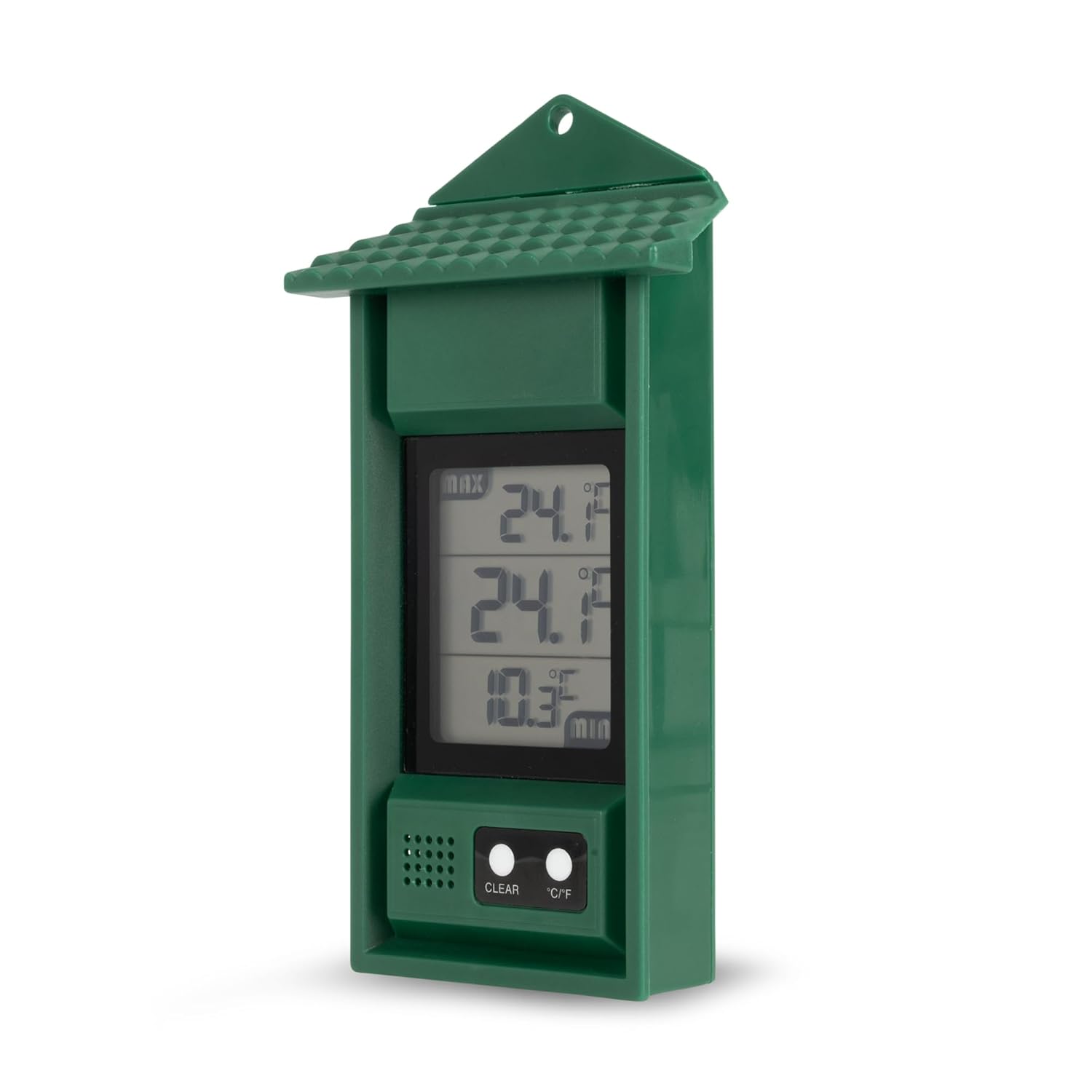
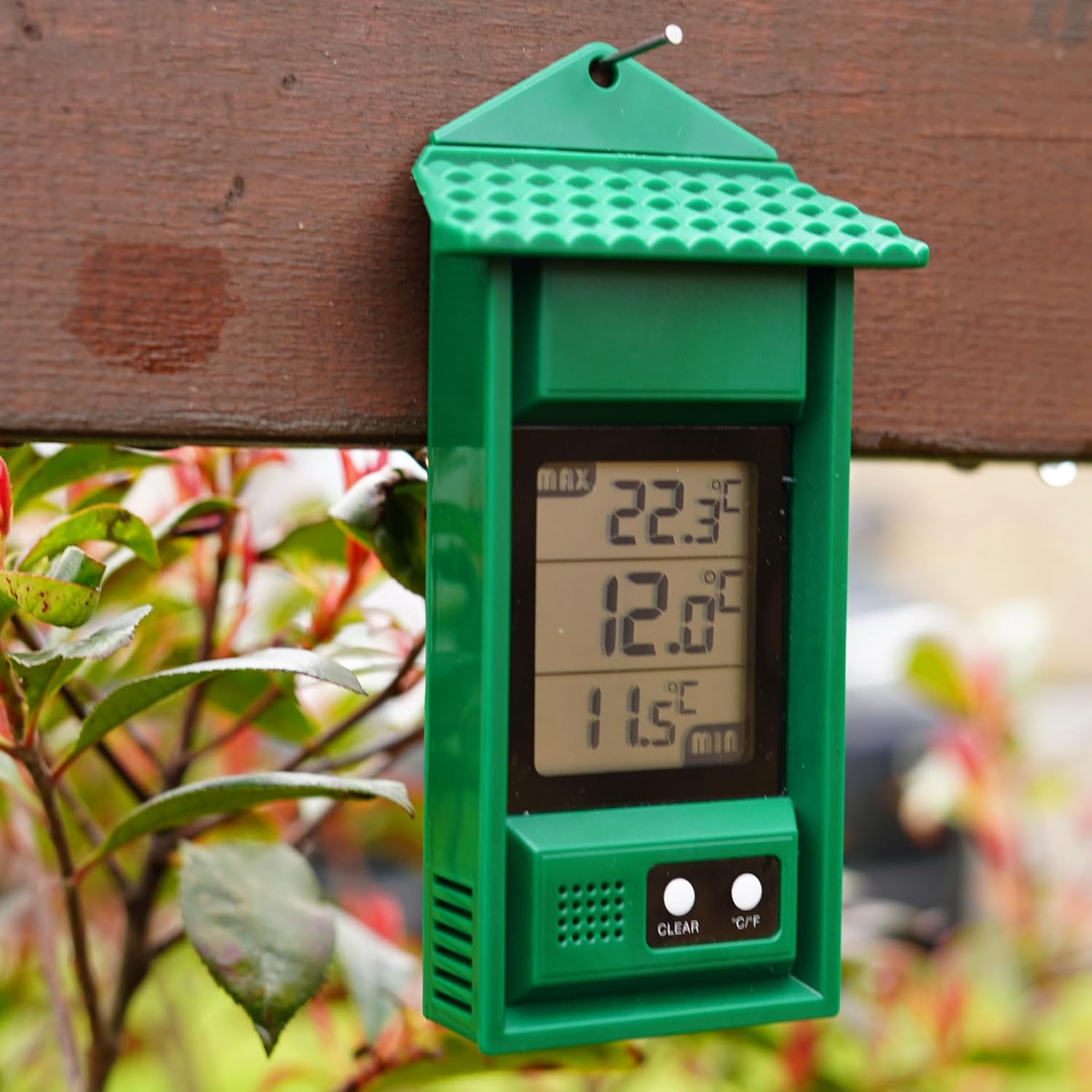
The mechanics are about as simple as they come. All three lines show at once, max on top, current in the middle, min at the bottom, so there is no button-cycling to find the number you want. The listed range runs from -20 to 69.9°C at 0.1°C precision, which covers a British greenhouse at both ends with room to spare, including the 40°C-plus summer spikes that Hopefully helpful was seeing. Two buttons underneath, CLEAR and °C/°F, and that is the entire interface. Peter Bateman: "Clear display. Easy to operate and reset. Concise and very clear."
The one habit to build is resetting it. A max and min only mean something if you know when the clock started, so clear it each morning when you open up and the numbers describe last night rather than last fortnight. One four-star reviewer flags that the button wants a firm hand: "The reset button needs hard push." And on batteries, Lixwmjen notes it "Only uses 1 AAA battery so not sure yet how often will need replacing", while Joy confirms one comes in the box, so you are not hunting through a drawer on day one.
Reading the Overnight Low From the Doorway, Without Your Glasses
Buy this one if you want the overnight low in an unheated greenhouse, poly tunnel or cold frame, you want to read it from the doorway without hunting for your glasses, and you can live with a device that gives you a few good seasons rather than a lifetime. On that brief it is very hard to beat, and 83 people out of a hundred agree.
Look elsewhere if you want temperature history, phone alerts or logging, because this records two numbers and forgets them the moment you press CLEAR. Same if you need humidity alongside temperature, or if you want something rated to live outdoors in the rain, which this is not sold as.
Then there is the one piece of advice that comes straight out of the one-star pile, and it is worth more than any spec on this page. Five of the six failures happened inside the first year, and at least two happened inside the first month. Amazon's standard return window is 30 days, and ytf37 found out the hard way what sits on the other side of it: ETI declined to help and referred them back to Amazon, who pointed at the expired window. So buy it at the start of the season rather than in the depths of the winter you are worried about, hang it the day it arrives instead of leaving it in the shed until March, and pay attention to it for that first month. If this thermometer is going to fail early, you want to find out while you can still hand it back. Get through the first month and the reviews suggest you are looking at years, not weeks.
And keep it out of the direct sun. Two reviewers go out of their way to tell you so, and one of them found out the hard way.
Digital max/min Thermometer for conservatories, greenhouses & Grow Rooms (Green)
Max, current and minimum temperature on one screen, from -20 to 69.9°C. The overnight low for your seedlings, recorded while you sleep, in a case that hangs on a single nail.