
Squirrels Give Up On This Squirrel Proof Bird Feeder For Seed UK Gardens. Starlings Do Not.
We earn commission from qualifying Amazon purchases. It costs you nothing and does not affect what we recommend.
Grey squirrels are beaten here, and the reviews are emphatic about it. Starlings are not, and all four reviewers who turned the adjustable spring down to its lightest setting were still overrun by the birds they wanted shut out. Which pest you have decides whether this is the right buy.
- The Shroud Does The Work, And You Can Watch It Happen
- Squirrels: Where You Hang It Decides Everything
- Starlings Are The Test It Fails
- The Adjustable Spring Should Fix Exactly This
- Pigeons, Jackdaws And The Seed That Ends Up On Your Lawn
- Wet Seed, Rust And A Slow First Fortnight
- The 4.4 Stars Are Pooled Across Feeders You Are Not Buying
- Buy It For Squirrels. Think Again If Your Problem Is Starlings.
Squirrel proof is the wrong thing to shop for. The better question is which animal is actually emptying your feeder, because the Jacobi Jayne Squirrel Buster answers one of those questions brilliantly and another one not at all.
Grey squirrels? Beaten, and beaten convincingly. Starlings? They will strip it while you stand at the kitchen window. That split runs straight through the 100 most recent UK reviews, and it is why a feeder carrying a 4.4-star lifetime average from 3,316 ratings has been running at 3.80 across those latest 100. Same feeder, different pest.
So this review is organised the way you actually shop: by the animal you are trying to shut out. Along the way there is an adjustable spring that only seven of the 100 reviewers mention, a review pile that turns out to contain eight reviews for feeders you are not buying, and one piece of hanging advice that decides the entire outcome.
The Shroud Does The Work, And You Can Watch It Happen
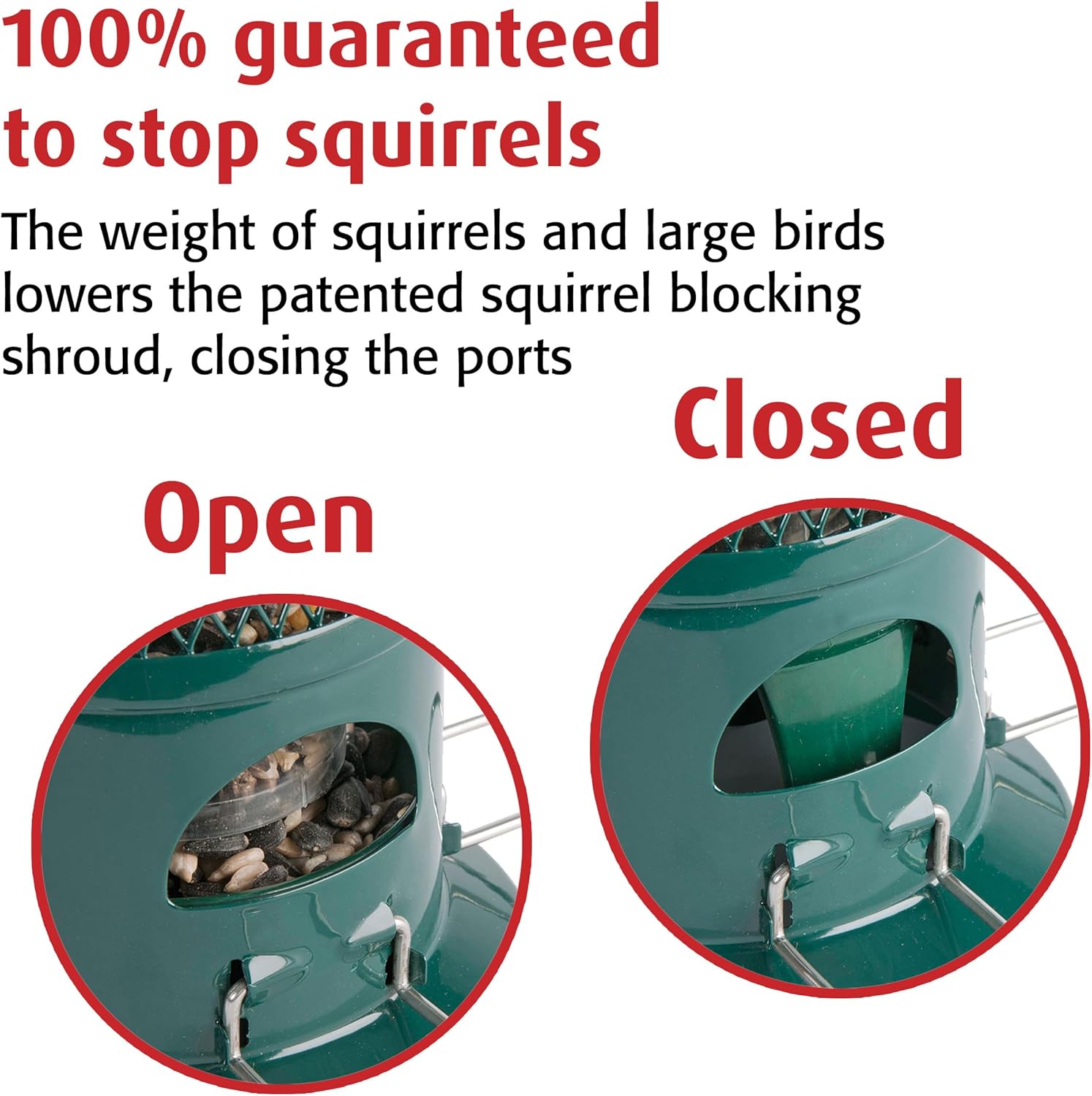
The mechanism is the whole product, so it is worth understanding before you spend anything. The seed sits in a clear plastic tube inside a stamped steel mesh sleeve. That sleeve is not decoration: it hangs on a spring, and it is the moving part. When something heavy lands on the wire perches at the base, its weight drags the sleeve down and the shroud slides over the four feeding ports. Seed access closes. When the weight lifts, the spring pushes the sleeve back up and the ports reopen. The listing calls it a patented squirrel blocking shroud, and photographs it in both states, open and closed, which tells you how central it is.
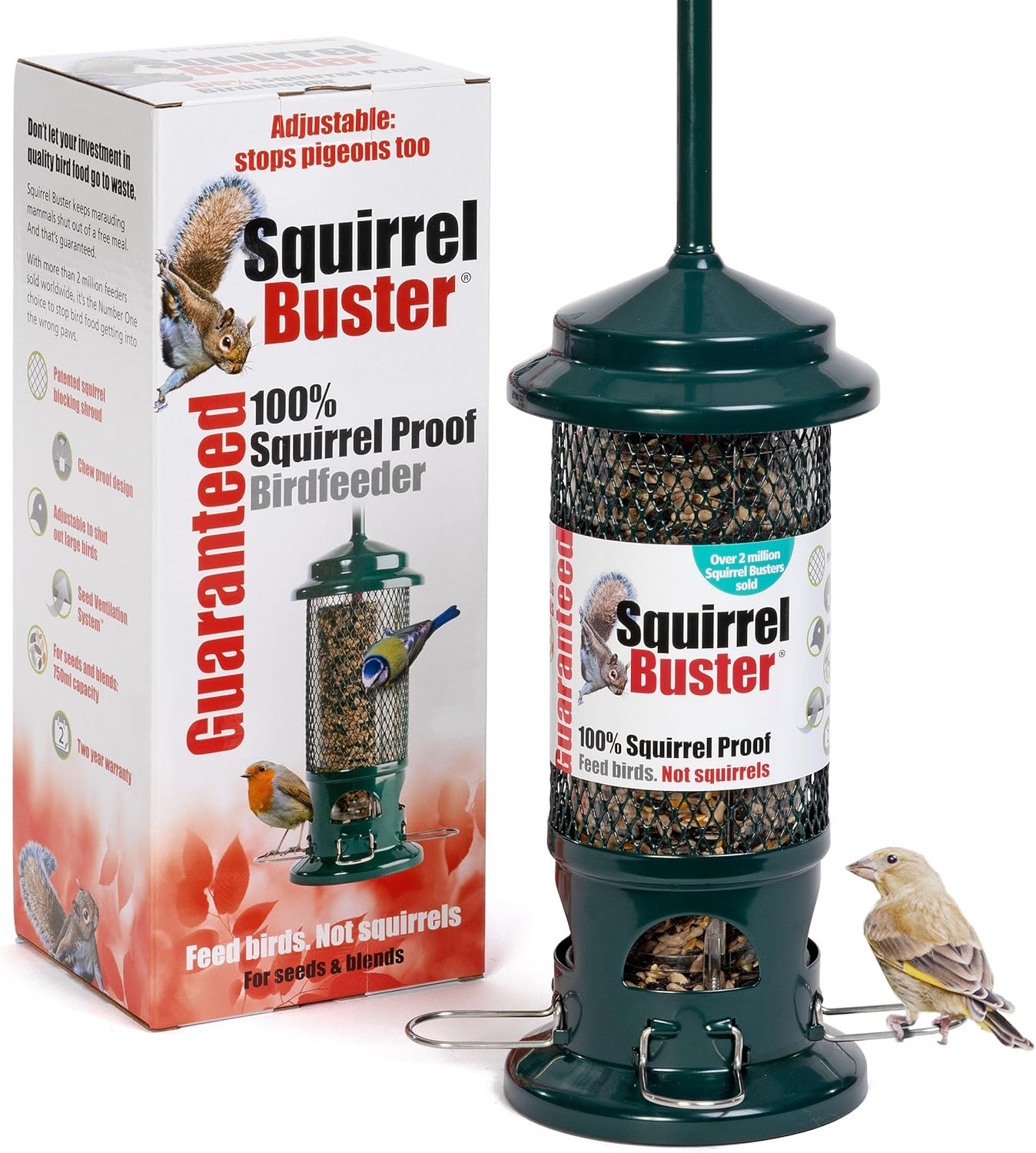
The rest of the specification is modest and sensible. The tube holds 750ml of seed or seed blends, there are four ports with four wire perches, the metal is finished in dark green, and the box carries a two year warranty alongside a chew proof design claim and something the brand calls a Seed Ventilation System.
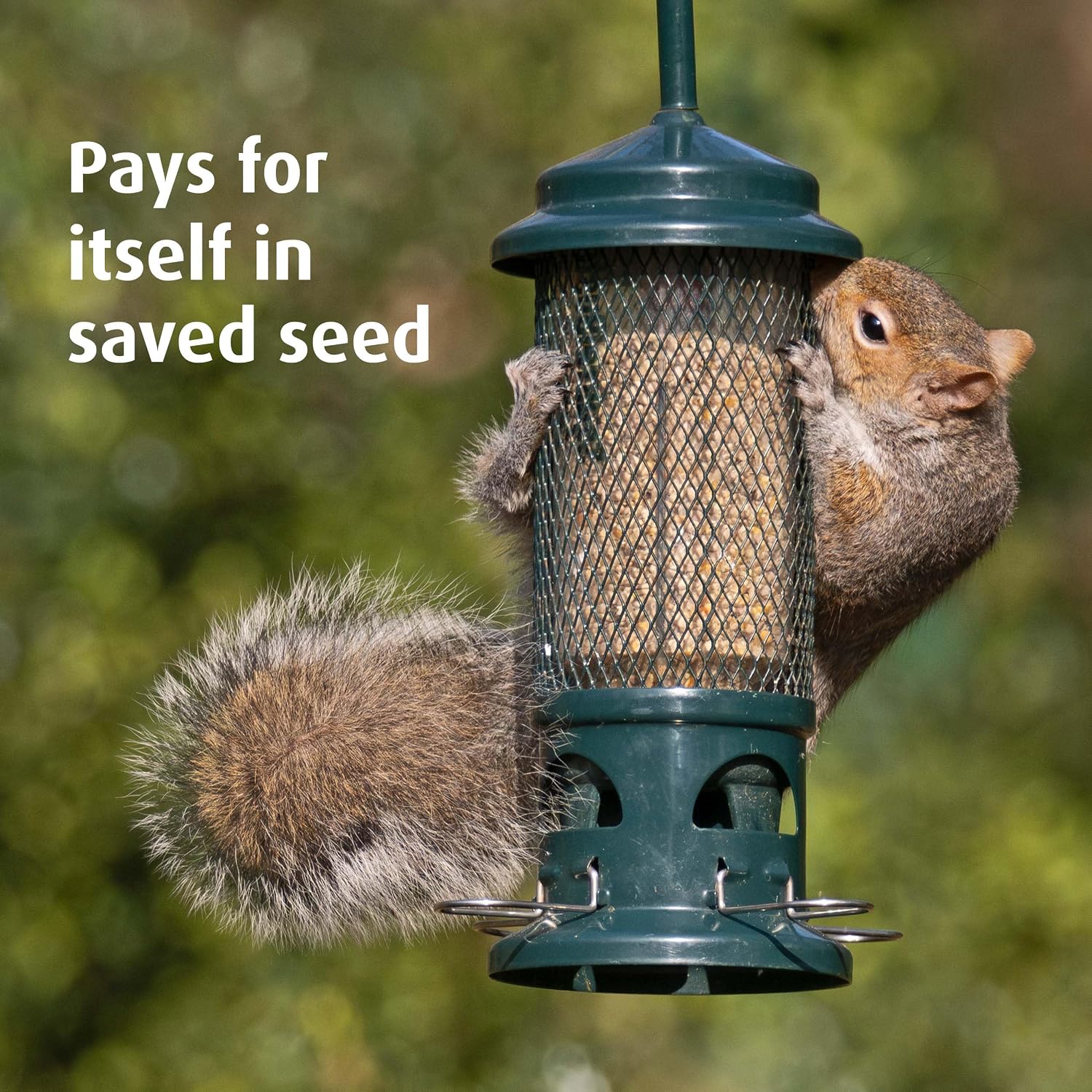
Does the shroud work? On squirrels, overwhelmingly yes. Of the 54 five-star reviews in our sample of 100, 42 mention squirrels, and the picture they paint is of an animal that tries once and retires. Primetastic, a five-star reviewer, describes the moment precisely: "I watched the squirrel jump onto the feeder, the outside sleeve was carried down by his body weight and he just gave up straight away." The same review notes that "The mesh is not flimsy wire, it is stamped out steel mesh." Miss paterson, also five stars, reports a "squirrel sat underneath it today looking up awaiting any droppings from birds but has given up trying to hang on it".
Filling and cleaning draw consistent praise too. Ian Hayward, five stars and reviewing after a full year of use, says "it's very easy to fill up - just unhook the hanger and lift off the outer sleeve", with the inner container standing on its own base so you have both hands free to pour.
Squirrels: Where You Hang It Decides Everything
Fifteen of the 100 reviews describe squirrels getting seed out of it anyway, so the 100% squirrel proof line on the box is doing some optimistic work. What is interesting is how those fifteen failed, because the reviewers themselves keep pointing at the same cause, and it is not the feeder.
Twelve reviewers tie the squirrel result directly to where the feeder is hung. Cheryl Borkowski, five stars, spells out the failure mode: "Make sure u place it far enough away from a tree trunk, other branch or your metal bird stand, or the clever Squirrel will use the length of his body to lean across to your seeds without putting weight on this hanger." (sic) That is the trick. A squirrel that can brace its back legs on something solid never loads the spring, so the shroud never closes. Greggster, another five-star buyer, admits to exactly that mistake, reporting that "the squirrels worked out how to brace themselves using their hind legs, so as not to weight the feeder" and that the fix was to move the bracket further from the tree. Gone Girl, at two stars, describes the same thing from the losing side: "The squirrels can still get at the seed by clinging to the pole and not putting pressure on the feeder."
MS S E MORTON, five stars, is blunter than we would be: "Anyone still having problems with squirrels haven't left enough gap around the feeder" (sic). We would not go that far, because some failures are clearly the feeder's. Kelly M, at three stars, watched squirrels and rats defeat it on the hardware alone: "They can easily find another way to feed by just gripping on to the tube and feeding upside down to avoid the weight of the perch shutting it off." Nicola Fenn, one star, had squirrels that "have now chewed through the plastic internal parts of the lid so that it no longer connects to the main body", which is a straight contradiction of the chew proof claim. And three reviewers report squirrels simply shaking the feeder until seed falls out, which no weight mechanism can prevent.
The practical upshot is unglamorous but it is the single most useful thing in this review. Hang it from a long wire or chain, in open air, well clear of the trunk, the fence, the shed roof and the pole itself. One five-star owner hangs it 28 inches out from a summer house on a long pole and reports no losses at all. Hang it off a bird table arm two feet from a tree and you have bought an expensive squirrel restaurant.
Starlings Are The Test It Fails
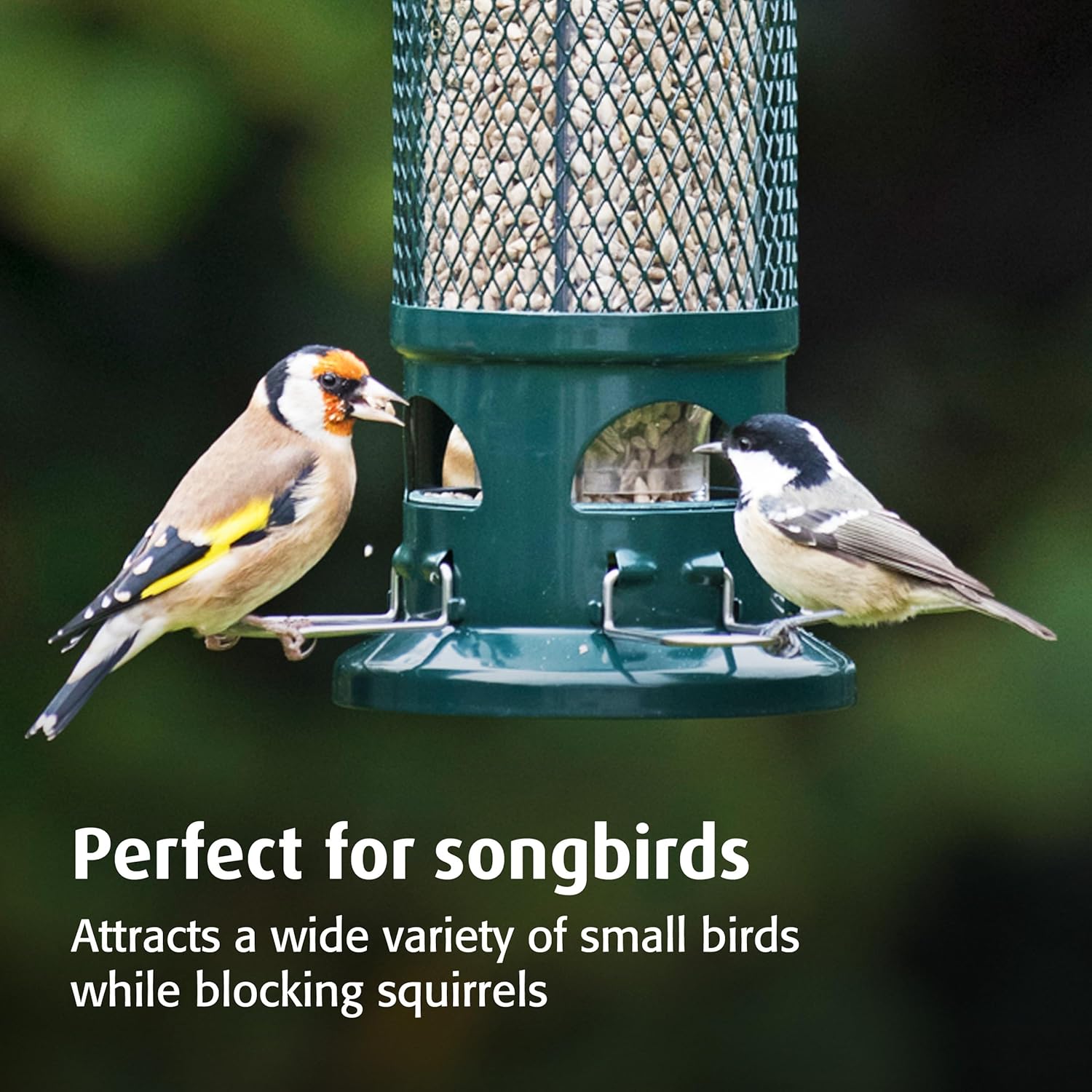
Now the bad news, and it is the reason this feeder's recent scores have slipped. Nine of the 100 reviews mention starlings. Eight of those nine say the starlings win.
V S Hardwick, two stars, is unambiguous: "They will empty the contents in minutes and make a huge mess depriving smaller birds." Ms P. Young, one star, explains why the mechanism never engages: "Totally useless as starlings don't trigger the mechanism." Bob Moody, four stars and otherwise happy on squirrels, says "the starlings shake it and empty the seed onto the ground in seconds". Kelly, three stars, watched the same thing and called the amount of seed on the ground ridiculous. Only one reviewer, Irene Mackay at five stars, reports the opposite, celebrating that she no longer has "bullying starlings, pigeons and crows frightening off the small, pretty garden birds!"
Ring-necked parakeets, an increasingly familiar problem in London and the Home Counties, produce the same story on a smaller sample. Five reviewers raise them; four say the parakeets win, although one of those four is describing the smaller Mini model rather than this one. Matthew H., who still gave it five stars because it defeated his squirrels, describes an outright hack: "The clever parakeets have found a way of jamming the mechanism with their feet so even on the smallest bird setting they can empty the feeder quickly." Peaco, one star, reports the parakeets learning to "put their weight on the food platform inside (the bit that doesn't move)".
In fairness to Jacobi Jayne, the box never promises starling proofing. It says adjustable to shut out large birds, and it pictures a pigeon. Lucy, at two stars, makes that point better than the manufacturer could: "It doesn't advertise itself as parakeet proof, so I can't really hold it against the company, but it does advertise itself as preventing birds over a certain weight from being able to use it." That is where the manufacturer's promise actually stops. The trouble is that most people searching for a squirrel proof feeder are really searching for a small-bird feeder, and a starling flock will hollow this one out just as fast as it hollows out a plastic tube.
Jacobi Jayne Squirrel Buster Bird Feeder
The weight-activated seed feeder that shuts its ports the moment a squirrel climbs on. Steel mesh sleeve, 750ml capacity, four ports and an adjustable spring, backed by a two year warranty and UK phone support.
The Adjustable Spring Should Fix Exactly This
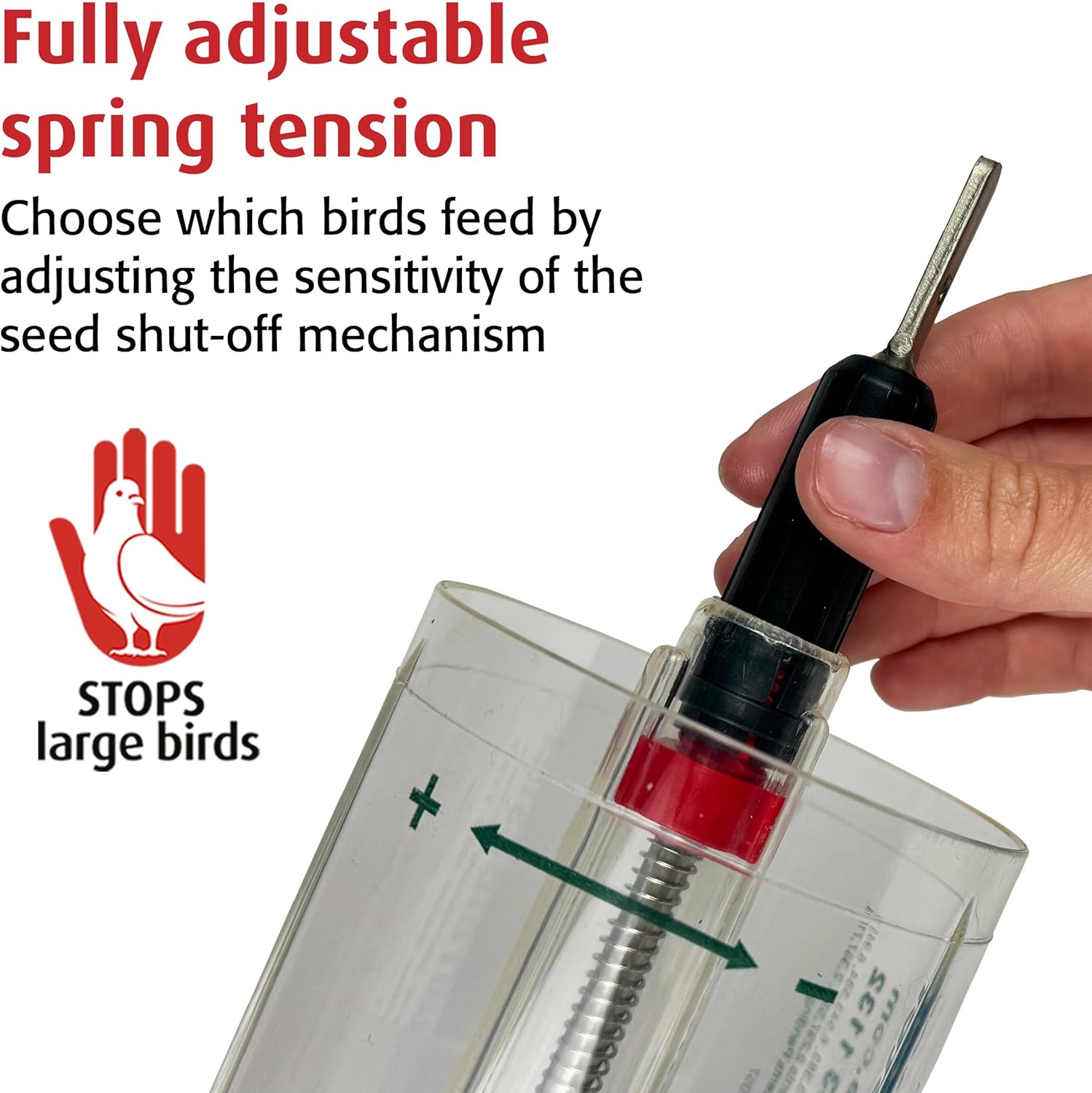
Here is the part the rival pages miss entirely, and it is the reason we went looking at the listing images rather than just the bullet points. This feeder has an adjustable spring tension. A red collar inside the clear tube turns with a screwdriver, marked plus and minus, and the listing image states its purpose plainly: choose which birds feed by adjusting the sensitivity of the seed shut-off mechanism. Alongside it sits an icon of a pigeon in a raised hand and the words STOPS large birds. In other words, the manufacturer's own answer to the starling problem is sitting inside the tube.
So does turning it down work? Four reviewers say, in plain terms, that they ran the mechanism at its lightest or most sensitive setting and the unwanted birds fed anyway. ShopperPY72, three stars, reports that starlings "will feed from it as they're not heavy enough even on the lightest setting to shut the feeder off". GSM, four stars, reports starlings and magpies scattering seed "even though it is set at the lightest weight". Lucy, two stars, went by the book and lost: "Even on its most sensitive setting, which according to the instructions should be enough to prevent parakeet use based on their weight, they are still able to land on it and engorge themselves on sunflower hearts at the behest of all the smaller birds." And Matthew H.'s parakeets, quoted above, jam the shroud with their feet on the smallest bird setting, which is a failure the spring cannot address at any tension.
Sarah M, one star, goes further and says the adjustment is oversold. The brochure, she writes, included a list of birds and squirrels by their approximate weight, and then: "What the brochure failed to mention was that the mechanism settings were only effective for squirrels!"
We are not going to blame the reviewers here. The people who turned the dial and still lost are the strongest evidence we have, and their conclusion is consistent: the shroud is a weight gate, and a bird light enough to sit under the gate stays under it no matter how you tune the spring. A bird that grips the mesh instead of the perch, or braces on the fixed platform, bypasses the gate altogether.
That said, only seven of the 100 reviewers mention the adjuster at all, and two of those seven are simply describing it approvingly. Jas, five stars, notes that "There's some adjustability in the spring tension at the core of the feeder, so you can set it to be balanced, easier for larger birds to use, or tight enough to shut them off entirely, leaving only smaller birds able to feed", and adds "I'm currently running it on the default setting for now." If you buy this feeder, take the screwdriver to it on day one rather than a month in. It is free, it takes a minute, and on jackdaws and pigeons it plausibly helps. Just do not expect it to solve starlings, because the buyers who tried that are unanimous.
Pigeons, Jackdaws And The Seed That Ends Up On Your Lawn
Pigeons come up in thirteen reviews and the verdict splits three ways. Six say the feeder shuts them out, and jerry King's five-star report is typical of that group, watching pigeons and other large birds try and fail. Three say the pigeons beat it. The remaining four describe the outcome in between: the pigeons cannot use the feeder, so they wait underneath and eat what the small birds spill.
That spillage is a real design weakness, and ten of the 100 reviews raise it. The ports are large. I. C. Johnston, three stars, measured the problem by eye: the four openings are two to three times the size of a conventional feeder's, so "when the birds peck in you can get seeds flying everywhere, even out the opposite opening", with the result that "So pigeons and squirrels just eat off the grass." Gone Girl, two stars, watched "two great tits that just sit at the ports throwing copius amounts of seed on the ground" (sic) and emptied a full tube in a day and a half. Mr. R. Mumford, two stars, found a fault nobody else mentions and it is a good one: "the pigeons land on it, when they take off the internal spring catapults the food everywhere thus emptying the feeder".
Corvids get a mixed result. JEC, three stars, found that "larger birds, jackdaws, magpies etc can hang on the outer grid cage and reach down to the seed tray", and fixed it with a sheet of rigid PVC and stainless cable ties. Pauline W, four stars, gave the local rooks and jackdaws three weeks before they cracked it: "It has taken approximately 3 weeks for them to extract the food overriding the weight related design".
If your garden's problem is that seed disappears rather than that squirrels chew through plastic, be clear-eyed. This feeder does not stop seed leaving the tube. It stops squirrels eating it out of the ports. Those are different problems, and the reviews that go badly are almost all from people who bought it to solve the first one.
Wet Seed, Rust And A Slow First Fortnight
Three durability themes come up often enough to matter, and one of them is a British problem specifically.
Six reviewers say seed gets wet in the feeding ports and clogs. Philip Brookes, two stars, diagnoses it carefully: "the seed slot has inadequate weather protection, so when the seed in the feeding tray gets wet it clogs up and prevents fresh seed from falling down the tube", which meant a daily trip out to clear it. Jeffrey Seedhouse, three stars, wastes food "clearing the wet seed out". Sherry59, three stars, found "the seeds were a mushy mess at the bottom after it rained". Two reviewers say the opposite, and one of them credits the ventilation system by name, so this is not universal. But six complaints against a 750ml tube in a wet climate is a pattern, and a rain guard or dome over the feeder is a sensible pre-emptive buy.
Rust is rarer than the internet folklore suggests. Only three of the 100 mention it, but the serious one is worth reading. Low Energy, three stars and reporting on two feeders after five and three years, describes rust on the internal slider and the spring around it, "causing the feeder to jam up and down at times", with pitting that returns after cleaning because the part is mild steel. Ian Hayward, five stars after a year, reports only cosmetic damage where squirrel teeth have stripped paint. Jenny, five stars, retired her first one after many years when it "eventually became a bit rusty and more difficult to clean properly", then bought this one to replace it, which is about the best endorsement a worn-out product can get.
Finally, expect a lull. Five reviewers report the birds ignoring the feeder, and one of those five later changed their mind in print: Sherry59, three stars, took it down and put it in the shed, brought it back out months later, and updated the review to say the birds had got used to it and would now rate it four stars. Two more owners describe the same lag from the happy side, and MS S E MORTON's note is the one to hold on to: "The birds took a couple of weeks to get used to having to use the levers at the bottom but now visit regularly." If your tits and finches snub it in week one, that is normal. Give it a fortnight before you conclude anything.
The 4.4 Stars Are Pooled Across Feeders You Are Not Buying
One thing to know before you read the reviews on the listing yourself, because it changes how you should weigh them. Amazon pools the ratings across the Squirrel Buster range, so the 4.4-star lifetime average and the review pile beneath it are not all about the seed feeder in front of you.
Eight of the 100 reviews we read are describing a different model. A Young, five stars, is reviewing the nyjer version and says so: "the finch feeder only has tiny feeding apertures so it is only really for nyger seed eating finches". J. Starling, three stars, is reviewing the peanut model, complaining that "the nuts get stuck and don't flow so I need to shake it every so often to keep the peanuts flowing". A second reviewer is on the nyjer feeder as well, one is describing a suet feeder, one a mealworm feeder, one the smaller Mini, and one the Evolution model bought in a garden centre, whose complaint about a missing perch does not apply here at all, because the feeder on this listing has four wire perches and they are clearly visible in the listing photographs.
The sharpest illustration is Debbie, who gave five stars and titled the review Not squirrel proof. Read it and the contradiction resolves: "Peanut one is great and stops the squirrels. Unfortunately the seed feeder is not so great, our squirrels have learned to shake the feeder which knocks out the seeds." A five-star rating, from a buyer whose verdict on the seed feeder is negative, sitting in the average of the seed feeder's listing.
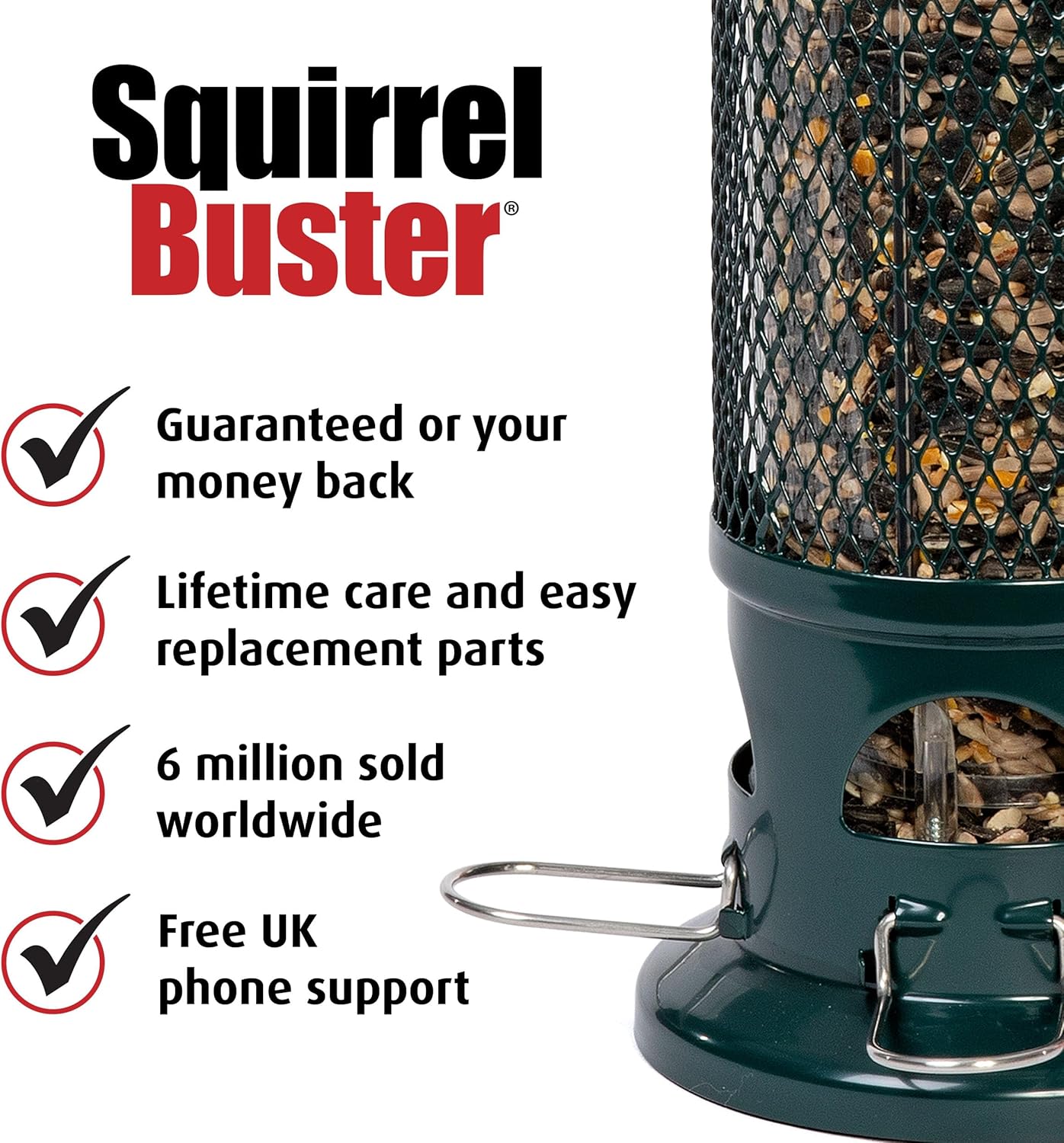
None of that is Jacobi Jayne's doing, and the brand's aftercare looks real: the listing images promise a money-back guarantee, lifetime care with easy replacement parts and free UK phone support, and Helen, five stars, confirms it in practice, saying "the makers are so helpful in sending out replacement parts" for a feeder over six years old. The listing also carries a sales figure that appears as two different numbers in two different images, so we would not put any weight on that one. Read the reviews with the pooling in mind, and the 4.4 makes more sense: it is the range's score, not this feeder's.
Buy It For Squirrels. Think Again If Your Problem Is Starlings.
It depends entirely on which animal you are fighting, and after 100 reviews we can be specific about it.
Buy it if grey squirrels are your problem. On squirrels this feeder is as good as the category gets. Forty-two of the 54 five-star reviewers raise squirrels, nearly all of them to describe an animal that tried once and gave up. Twelve reviewers tie the squirrel result to where the feeder is hung, which is the one mistake you can avoid on day one, and the steel sleeve ends the annual ritual of replacing chewed plastic tubes. Thirteen reviewers call it expensive, overpriced or steep, and four of those thirteen still gave it five stars, which tells you how much they value not feeding squirrels. Kimberly G9's verdict, at five stars, is the fairest summary of the price: "Eye wateringly expensive but worth it for me". Ken, five stars, is buying a second one "despite the atmospheric price".
Do not buy it if starlings are your problem. Eight of the nine reviewers who mention starlings say the birds feed freely, and two of those eight had already turned the spring down to its lightest setting. A starling flock will empty this as quickly as it empties anything else, and you will have paid a premium for the privilege. The same caution applies if you have parakeets: four of the five reviewers who raise them say the parakeets win.
Think twice if your real complaint is seed cost. The ports are generous, ten reviewers describe seed being flicked or shaken onto the ground, and one three-star owner concluded it uses more seed than the squirrel-friendly feeder it replaced. It stops squirrels eating from the ports. It does not stop seed reaching the lawn.
Set up properly, hung well clear of anything a squirrel can brace against, adjusted with a screwdriver on the first afternoon and given a fortnight for the birds to work it out, this is a very good piece of kit with one specific job. Just be sure that job is the one you actually need doing, and check today's price on Amazon before you commit, because it moves.
Jacobi Jayne Squirrel Buster Bird Feeder
The weight-activated seed feeder that shuts its ports the moment a squirrel climbs on. Steel mesh sleeve, 750ml capacity, four ports and an adjustable spring, backed by a two year warranty and UK phone support.