
When to prune roses in autumn in the UK (and what to leave until February)
Autumn is not the month for the main rose prune. Here is the one cut worth making before the winter gales, which roses should not be touched now, and what waits until February.
We earn commission from qualifying Amazon purchases. It costs you nothing and does not affect what we recommend.
Quick answer
Late October to mid November, once growth stops, push a tall bush or modern shrub rose with a flat hand. If the base pivots and the soil opens, take a third off the longest stems. If nothing moves, leave it. Climbers are tied in, ramblers untouched, standards staked, and the structural prune waits for February.
Ask when to prune roses in autumn in the UK and you get two answers, because two jobs share the word pruning. One is a defensive cut that stops a tall bush working itself loose in a gale. The other is the structural prune that sets next summer's shape, and that waits for late winter.
A rambler over a shed, an English rose in a border and a standard in an open front garden want three different things this month.
Which rose you are looking at
You do not need a plant label. What settles it is how the flowers were carried this summer, whether the plant is tied to a support, and how tall it is.
Bush roses: one flower to a stem, or a cluster
Hybrid teas carry one large flower on each stem, floribundas carry them in clusters. Both are upright, stiff-stemmed bushes, usually knee to chest high, flowering in flushes until the frosts. These are the roses the autumn cut is aimed at, tall enough to lever their own roots in a gale.
Modern shrub roses, including English roses
Rounder and looser than a bush rose, often shoulder high, flowering on and off from June onwards. David Austin English roses belong here. In autumn treat them like bush roses and shorten them if they are tall and the site is open.
Patio, miniature and ground cover roses
Low plants, usually knee high or less, or spreading sideways rather than reaching up. Most have too little leverage to rock loose, so autumn asks nothing beyond picking up fallen leaves.
The exception is anything planted in the last two years: a new rose of any size can work loose in its hole, so firm and stake it. Compact ones get a light prune in late winter; trailing ground cover roses, which the RHS says run to 3m or more, are pruned in summer after flowering.
Climbers: stiff stems on a permanent framework
Climbers repeat through summer and hold a woody framework against a wall, fence or arch. The RHS prunes them between December and February, once the leaves are off; its climbing rose guide also names autumn, when long whippy shoots can be shortened or tied in so wind cannot damage them.
Ramblers and once-flowering old roses: not this month
A rambler makes one enormous flush around June on long, flexible stems, often up a tree or over a shed. Old shrub roses, the gallicas, albas and damasks, do the same on a freestanding bush. Both flower on wood made last summer, so they are pruned straight after flowering, and cutting them from late September onwards removes next June.
Rugosas sit in the same pruning group and want the same light touch, but they repeat flower into autumn and often carry hips and flowers at once, so fruit settles nothing on its own. A rambler thrashing about on an exposed site gets its stems tied in, not cut.
Standard roses: a head on a bare stem
Grafted on a clear trunk, a standard is the most exposed rose you can own, and its head can be a bush or a rambler. Prune it like whatever the head is: thin a bush head now, and leave a weeping standard's rambler wood uncut. Check the stake and ties either way, which the RHS treats as the real defence against wind-rock.
Month by month, September to March
The dates below are a frame, not an instruction: read the plant first. Growth stops weeks earlier in an inland Aberdeenshire garden than on the Cornish coast, where the sea often keeps autumn frosts off altogether, and a mild year shifts it again. It has stopped when no soft red shoot tips appear and the leaves yellow; the main prune is due when the buds fatten and redden.
Not every authority agrees this cut is needed. The RHS guides for bush and shrub roses do not mention autumn at all, while the climbing rose guide names it directly and the rambler guide keeps late autumn for renovation. Gardeners' World tells you to shorten tall bush roses against winter gales.
Charles Quest-Ritson, who wrote the RHS Encyclopedia of Roses, argued in Country Life that pruning shrubs including roses is not compulsory and that over-pruning kills more roses than anything else. We sit between them: cut a tall, top-heavy rose in an open garden, and skip it everywhere else.
September
Nothing to cut yet, with one exception. A rambler or once-flowering old rose whose post-flowering prune was missed in July or August can still be done in the first half of September; after that, leave it, because by then you are cutting off next June. Neither type ever gets the autumn wind cut.
If you want hips for the birds, stop deadheading and take only the petals so the hip behind can swell. Hips do not make a repeat-flowering rose once-flowering, so judge by how it flowered this summer, not by what it carries now. Feeding is over: nitrogen this late pushes soft growth that will not harden before the frosts.
October
In much of the UK the first serious gales often arrive before the first hard frost, which gives this job a deadline. Late October suits exposed sites, where most Scottish, northern, coastal and hilltop gardens sit. Start clearing fallen leaves as they drop, especially from any plant that carried black spot.
November
Sheltered southern and mild western gardens catch up here, usually in the first half of the month, when bare-root planting starts too. If a rose is still pushing new shoots in mid November, leave it a fortnight; if it is still growing at the end of the month, skip the cut and stake and firm it instead.
December and January
Climbers can be pruned from December, once the leaves are down. Bush and shrub roses are better left standing: pruning a frozen stem damages it, and treading a saturated border compacts the soil around the roots you spent the autumn protecting.
February and March
The structural prune, the one that decides next summer. The RHS prunes in mid February in the south and waits until March in northern and colder areas, cutting as growth is just resuming.
Hybrid teas go hardest, to four to six buds at 10 to 15cm from the base, floribundas are left taller at 25 to 30cm, and shrub roses lose up to a third of their strong new growth. A standard is pruned now if its head is a bush type, and patio and miniature roses need only a light tidy.
Making the autumn cut, step by step
Pick a dry, still, frost-free day. On a border of half a dozen roses the job takes under an hour, mostly clearing up.
Step 1. Put long gloves on before you touch anything
Rose thorns go straight through fabric gloves, and the scratches land on the forearm, from reaching into the bush, not the palm. A pair of thorn-proof gauntlet gloves that cover to the elbow is the answer, and our notes on choosing a long-cuffed pair cover what to look for.
Step 2. Confirm the type before you cut
The test is the flowering pattern, not the fruit, because hips settle nothing on their own. One flush around June and nothing after means a rambler or an old once-flowering rose, and this job is not for it. Flowering on and off into autumn means a bush, a modern shrub or a climber, and anything small and low can be left too.
Step 3. Rock the bush and watch the soil, not the stems
Push the top of the plant over with a flat hand and look at ground level. If the stem pivots and the soil opens into a hollow ring around it, the rose is working loose and needs both the cut and firming. If nothing moves at the base, even a tall rose on a sheltered site may need no cut.
Step 4. Take a third off the tallest stems, and no more
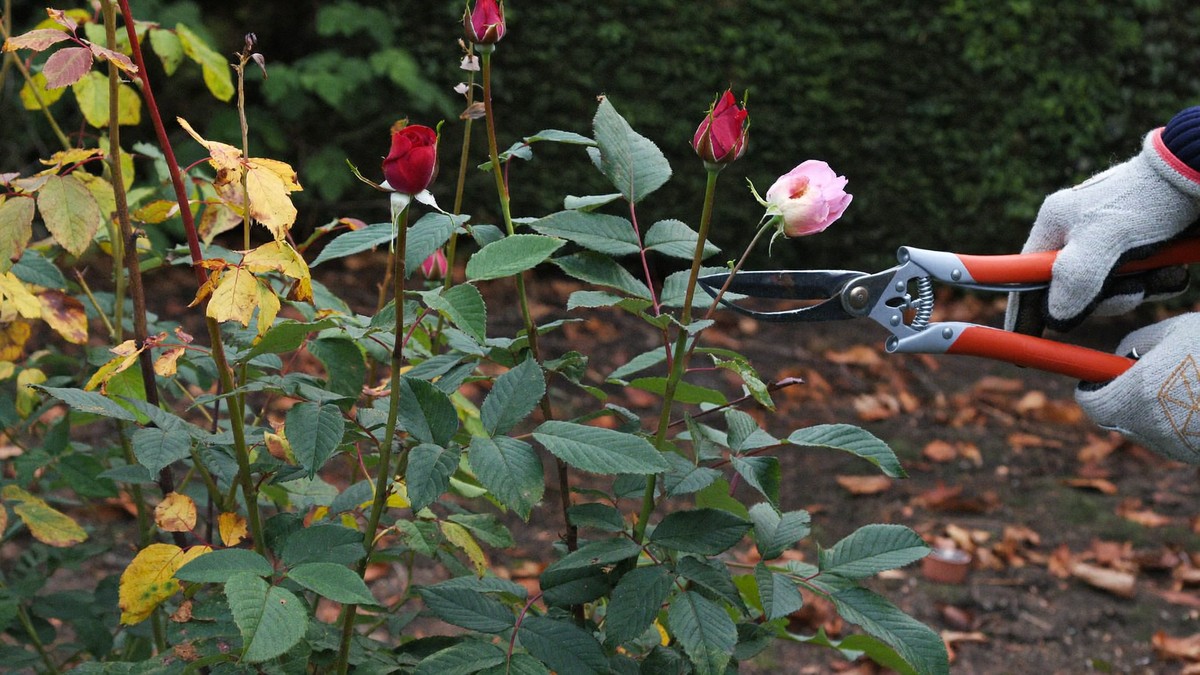
On bush and modern shrub roses, shorten the longest stems by about a third of their height. A third takes the leverage out of a gale, and going further wastes wood you will want in February. Cut to an outward-facing bud, no more than 5mm above it, sloping the cut so rain runs off.
Live rose wood wants a slicing cut, which is what a sharp pair of bypass secateurs gives you; anything that crushes leaves a ragged wound going into a wet winter.
Step 5. Tie in climbers and check the standards
On climbers, tie new shoots along the framework rather than cutting them, shortening only the long whippy ones waving free. Thin a bush-headed standard so wind passes through, but leave a weeping standard's rambler wood alone. Check the stake is firm and the ties are not cutting in.
Step 6. Clear the leaves and clean the blades
Rake up every fallen rose leaf, including those lodged in the crown. If the bush moved when you rocked it, tread the soil back with your heel while the ground is neither frozen nor waterlogged. Leave feeding until spring, and wash the blades afterwards, using a garden disinfectant if you cut anything diseased.
What goes wrong, and how to recover
Cut too hard, too early. A heavy October cut in a mild autumn wakes the plant up, and the first real frost blackens the soft shoots. There is no autumn fix: cut back to healthy white pith at the late winter prune.
Pruned a rambler or an old rose by mistake. Next June's flowers were on the wood you removed, and that year is gone. Do not cut again to even it up; let it rebuild and it flowers normally the year after.
The rose is already rocking. A funnel of open soil around the stem lets water and frost straight down to the roots. Firm it back with your heel, shorten the top, and stake anything planted in the last two years.
Ragged, crushed cuts. Crushed stems die back from the wound. Anvil blades cut against a flat plate, right for dead wood and wrong for live stems, so keep anvil loppers for the dead stumps and bypass blades for everything living.
Black spot back in May. The autumn sweep is only half the job: the fungus overwinters on fallen leaves but also in dormant infections on young stems and buds, so prune out stem lesions in spring before the leaves appear. The RHS itself notes that clearing up alone has limited value, because spores blow in on wind-driven rain anyway.
Collect the leaves anyway, and either bury them 30cm deep or send them to council green waste, which gets hot enough. A cold leaf mould heap will not kill it, but Garden Organic is clear that spotted leaves can still go in one.
Frequently asked questions
Can I prune roses in October?
Yes, from late October, though exposure decides it rather than the calendar. David Austin ties mid to late October to windy, exposed sites, where most northern, coastal and hilltop gardens sit. Take a third off tall bush and modern shrub roses and stop there; the structural prune waits for February.
Is it too late to prune roses in November?
Not at all: November is the normal month for this job in mild southern and western gardens. What matters is whether growth has stopped, not the date. If soft shoots are still coming in mid November, leave it a fortnight; if it is still growing at the end of the month, skip the cut and stake it.
Do I have to prune roses in autumn at all?
No. This cut is insurance against wind, not maintenance the plant needs. A rose that stayed small and low, or one in a sheltered courtyard, can go through to February untouched. Push the top over with a flat hand: if the base pivots and the soil opens, it earns the cut; if nothing moves, skip it.
Should I deadhead roses in autumn?
Take off soggy, rotting flowerheads, because they hold damp against the stem. If the rose makes good hips, remove only the petals and leave the hip for the birds. Repeat-flowering roses can be deadheaded properly until the flowers stop.
Can I cut my roses right back in autumn to tidy the border?
This is the one instinct worth resisting. A hard cut during a mild autumn triggers soft growth that the first real frost kills, and you cannot yet tell which buds will break in spring. Take a third off for wind, and save the reduction for late winter.
Can diseased rose leaves go in the compost or the leaf mould bin?
Keep them out of the ordinary compost bin, because a home heap rarely reaches the temperature that kills black spot. Leaf mould is different, a cold fungal process by design, and Garden Organic says all fallen leaves can go in it, black spots included. Council green waste gets hot enough, and burying them 30cm deep also works.