When to prune buddleia in the UK (and why the autumn cut is only half the job)
Two cuts, six months apart, and they do different jobs. Which buddleja you have decides the timing, and getting that wrong costs a whole year of flower.
We earn commission from qualifying Amazon purchases. It costs you nothing and does not affect what we recommend.
Quick answer
For the common butterfly bush, Buddleja davidii, the hard prune is early spring: late March to mid April, once severe weather has passed and the buds are swelling. A tall plant on an open site can also have a third off in autumn to stop it rocking loose. Weeping alternifolia is cut after it flowers, and globosa barely needs pruning.
Which buddleja are you actually looking at
Ask when to prune buddleia in the UK and two different jobs answer to the same word. One is the hard prune that builds next summer's flowers. The other is a defensive cut that stops a tall shrub levering its own roots loose in a winter gale. They sit six months apart and neither replaces the other.
Before either of them there is a bigger fork: buddleia is not one plant, and the timing inverts depending on which one you have. Run the three checks below first. All three still work on a plant whose flowerheads have already been cut off.
Check one: how the leaves sit on the stem
Run a finger along a young shoot. Leaves in opposite pairs, facing each other across the stem, means Buddleja davidii or one of its relatives; the GB Non-Native Species Secretariat describes davidii's leaves as opposite, lance shaped, "deep green above and white-tomentose below", so the underside feels pale and felty. Leaves running singly and alternately up the shoot means Buddleja alternifolia, which the RHS lists as the alternate-leaved butterfly bush. In midwinter with the leaves down, the buds and leaf scars keep the pattern: paired on davidii, staggered on alternifolia.
Check two: the last time you saw it flower
A memory test, so nothing you have already cut can spoil it. Answer it for the last time you saw the shrub in flower, which need not be this calendar year, and answer on when the flowers finished rather than when they started.
- Finished by midsummer, with nothing left by late July. It flowers on last year's wood, so neither takes the spring hard prune: alternifolia is cut after flowering, globosa barely needs cutting.
- Still flowering in August or later. It flowers on this year's wood: davidii or Buddleja x weyeriana, both taking the early spring hard prune.
Check three: the size and surface of the leaf
The one to use when there is no flowering season to remember: a plant bought last autumn, or inherited with the house. A globosa leaf is big and deeply veined, up to 20cm long. A davidii leaf is narrower and lance shaped, deep green above and pale and felty underneath. Size and veining are what separate a globosa from the davidii group, which is the split that changes the pruning. On a bare plant in midwinter, last year's leaves usually still lie under the shrub where they fell, so look there before deciding you cannot tell.
What each type looks like, and what it wants
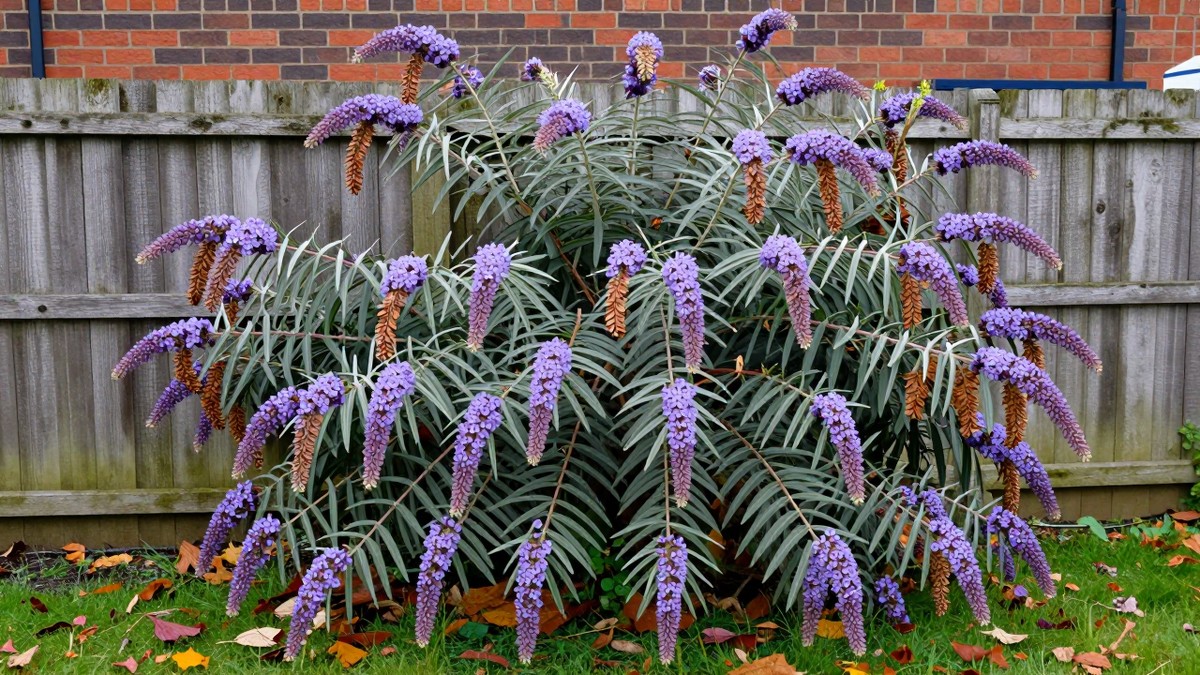
- Buddleja davidii. Upright, carrying long tapering cones of purple, lilac, white, pink or crimson from July onwards, which the NNSS describes as dense pyramidal panicles. Hard prune in early spring, dated by the RHS as late March to mid April, and take a third off in autumn only if it is tall and exposed.
- Buddleja x weyeriana. Round orange-yellow balls carried through summer and into autumn, on a davidii and globosa cross. Pruned exactly like davidii.
- Buddleja alternifolia. Weeping, with small scented lilac-purple clusters borne, as the RHS puts it, along the previous year's shoots, and over by midsummer. Prune straight after flowering. Cutting it back in spring, in Gardeners' World's words, "would remove the flower buds".
- Buddleja globosa. The Chilean orange ball tree: round orange-yellow balls at the branch tips in early summer, on deeply veined leaves up to 20cm long. It needs little pruning. When it does, Gardeners' World takes out a few of the oldest branches in midsummer; the RHS shortens overly long branches in late winter, at the cost of some flower. We would take the midsummer option, because the late winter one spends flower you do not need to spend.
Globosa and weyeriana are the pair that catches people out, and check two settles it. A davidii lollipop standard has its head cut hard back to the top of the trunk in early spring, an alternifolia standard is trimmed after flowering, and the RHS groups the less common B. fallowiana, B. salviifolia and B. crispa with the spring hard prune.
If none of the three checks settles it, do nothing this spring. Let the shrub flower once, note the month it started and the month it finished, and prune it on next year's schedule. Waiting a season costs a davidii one year of shape, which it recovers. Guessing davidii on a globosa costs the flower, and there is no getting that back. Unless a section names another species, everything below assumes davidii.
Month by month, September to July
UK timings move by two or three weeks between Cornwall and Aberdeen, and by a fortnight between one year and the next. Shift these later as you go north or inland, and let the plant overrule the calendar.
September
Still flowering, still working. Butterfly Conservation records Peacock, Red Admiral, Small Tortoiseshell and Comma visiting in large groups through July and August, and says flowering can run into October in a mild year. Nothing structural now: deadhead the spikes as they brown and leave the rest.
October to mid November
The autumn window, and only if the shrub has earned it. A tall plant on an open site gets a third off; a compact one in a sheltered corner gets nothing. This is the cut most often blurred into the spring prune.
Late November to January
Leave it. Tidying the bare twiggy outline on a dry January afternoon buys nothing but frost damage in the cut ends. The one useful winter job is pulling seedlings, easiest to spot in gravel, guttering and wall bases.
February
The month this question gets asked most, and usually too early to answer with secateurs. The trigger is not a date: RHS pruning group 6 waits for severe weather to pass and the growth buds to begin swelling. In a mild south-western garden the buds can be moving by the last week of February and you can start. Further north and inland they will not be, and cutting early only opens wounds ahead of the frosts. So February is a looking month. Check the buds low down on last year's stems once a week, and while they are still tight and flat against the wood, leave the shrub alone. When they fatten, the window is open and the spring sequence below sets out the cut.
Late March to mid April
The real one, and the cut that decides how the shrub looks all summer. The RHS dates it late March to mid April, and inside it the signal is the same: severe weather past, buds swelling. Cut the previous year's flowering stems back to within one or two buds of the older woody framework, which on an established plant lands around 30cm above the ground, then take out at the base whatever is dead, floppy or crossing the middle. It looks brutal in April and has vanished by June. The full sequence is set out below, step by step. If you do one thing to a buddleia all year, do this.
May to July
May is a deliberate late option rather than a rescue: Gardeners' World notes that pruning as late as May can delay flowering until August, useful if you want nectar arriving with the late-summer butterflies. Past May, leave davidii and take the year as it comes. June and July are alternifolia's window, straight after its flowers fade, and the months to shape a globosa if it needs it. August has no cutting job on any of them: davidii is in full flower, alternifolia and globosa are past their windows, and the only thing worth doing is deadheading the spikes as they brown.
Making the two cuts, step by step
The authorities disagree here, and it is worth saying so. The RHS pruning guidance for buddleia contains no autumn cut at all: early spring, and nothing else. Butterfly Conservation says to "cut it back by half in autumn, after flowering has finished, to prevent strong winds from destroying the plant", then cut further in March or April. Gardeners' World keeps the hard prune for spring but lists buddleia by name among the shrubs worth shortening against wind-rock.
Our position is the middle one, with a threshold. Most buddleias do not need an autumn cut and are better left flowering. A tall shrub on an open, wind-funnelled site with nothing upwind is the exception, and a third off in October is cheap insurance. Height on its own is not the test. Half is more than we would take, because it costs late nectar to solve a problem the plant may not have.
The autumn wind-rock trim, October to mid November
- Autumn, exposed sites only: decide whether it needs the cut at all. Exposure decides it, not height alone. An open, wind-funnelled site with nothing upwind makes a tall shrub a candidate; a knee-high dwarf in a sheltered corner does not. Height alone qualifies nothing, because a correctly pruned davidii settles at 1.8 to 2.4 metres every year. Decide that before you look for damage, and if the answer is no, do nothing this autumn: go straight to the spring prune at step 4. The RHS describes the mechanism in its siting advice, writing about summer gales: long branches snap off and rock the whole bush, "opening up a gap in the soil around the base exposing the roots". The same leverage works in a winter gale on a plant that has not been shortened. A gap already opened at the base settles it, but its absence does not clear the plant.
- Take about a third off, no more. Gardeners' World puts buddleia on its wind-rock list and says to work systematically around the plant, "cutting all the stems back by about a third". It names autumn but no month; October to mid November is our judgement, not theirs. Start with the longest, whippiest stems, and do not go down into the old woody framework: that is the spring job.
- Cut to an outward-facing bud, then firm the base. Gardeners' World is specific: prune "to just above an outward-facing bud, making an angled cut so that winter rain runs off easily and doesn't cause rot". If the soil has opened around the stem, heel it back down, then leave the plant until spring.
It is the same job we set out for tall bush roses in our autumn rose pruning guide: shorten the lever, do not rebuild the plant.
The spring hard prune, late March to mid April
- Spring: wait for the signal rather than the date. Buddleja davidii sits in RHS pruning group 6, and the rule for that group is to prune "in early to mid-spring when severe weather is past and growth buds are beginning to swell". That is the trigger, and it can arrive in February in the mild south west and not until April further north.
- Cut the old flowering stems back to the framework. The RHS instruction is to "cut back the previous year's flowering stems to within one or two buds of the older woody framework", which on an established plant lands around 30cm above the ground, the height Gardeners' World gives. Leave up to 60cm of stem for a taller shrub.
- Take out the dead, thin and weak growth entirely. Anything that snaps dry, anything pencil-thin and floppy, anything crossing the middle: out at the base. What is left looks brutal in April and vanishes by June.
- Mulch, and clear the prunings. The RHS says that on a fertile soil no feeding is required and an annual mulch of well-rotted manure or garden compost will suffice; it reserves slow-release fertiliser or an April-to-September liquid feed for buddleja grown in containers. If you deadheaded last autumn, neither cut carries seed. If you did not, the stems you take off in April still carry last year's seedheads, so snap those off and bag them before the rest goes anywhere near a shredder or a heap.
The permanent framework on an old buddleia is thick and hard, which is where ratchet anvil loppers earn their place: our review names old buddleia as that tool's territory. The trade-off is real. An anvil blade presses down onto a flat plate rather than slicing past a second one, so it suits dry, thick wood and is wrong for the finishing cuts, where a bypass blade leaves a cleaner wound beside a bud. Loppers low, secateurs high. If grip strength is the limiting factor, read our review of ratchet secateurs sold for arthritic hands first, because it found the locking catch defeated a fair number of the buyers it was sold to.
Timing also decides what you can do with the prunings. Our review of an electric garden shredder is subtitled "Green Leaves Are the Sticking Point", and it found owners split over fresh leafy material: the ones who got it through had either fed it in small amounts or stacked the cuttings a fortnight to dry. Autumn buddleia prunings are leafy and green; April prunings are bare wood. If you shred at all, shred in spring, seedheads removed first.
What goes wrong, and how to recover
You hard pruned in autumn instead of spring
The plant will survive. A hard October cut opens wounds and can push soft growth just as the frosts arrive, which is why the RHS rule for this group waits for severe weather to pass. Leave it until the ordinary spring window, late March to mid April, then cut back to firm live wood. It will flower, a little later than usual.
You cut an alternifolia in spring
The expensive mistake, and there is no fix this year: the flower buds were on the wood you removed. Leave the shrub alone for the rest of the season so it can build new stems, because those stems carry next year's flowers. Prune it next summer instead, straight after the flowers fade.
It has gone leggy, bare-bottomed and flowers only at the top
That is what an unpruned davidii does, and why Gardeners' World's headline warns about a twiggy mess. The cure is the ordinary spring cut, taken without flinching, back to the permanent framework. The RHS notes that even with hard annual pruning davidii and weyeriana settle at roughly 1.8 to 2.4 metres, so a shrub cut to knee height in April is not being punished.
Seedlings are appearing everywhere
They will. The NNSS puts a standard plant at up to three million seeds a year, wind dispersed, staying viable in the soil for several years. Pull them small, and check walls, pavements and chimneys, the places the NNSS flags for structural damage. Deadheading before the seed sets is far less work than weeding after it.
Butterflies, seedlings and what the law actually says
Buddleia earns its nickname. Butterfly Conservation calls it "one of the best plants to grow for butterflies, moths and other pollinators" and "clearly a favoured nectar source", but the caveat sits in the same article: it is "less important as a caterpillar foodplant". It feeds adult butterflies; it does not raise many. Whatever you plant alongside it that does feed caterpillars is doing the other half of the work.
The conservation bodies do not agree. Butterfly Conservation would grow it and manage it, warning it "must be managed to prevent it from spreading across sensitive natural habitats" and putting it more bluntly elsewhere: "keep it in your garden!". The Woodland Trust says "we wouldn't recommend it as it is an invasive plant that spreads really quickly, often at the expense of other native plants". Both are defensible.
On the law, the short answer is that Buddleja davidii is not listed on Schedule 9 of the Wildlife and Countryside Act 1981. Schedule 9 Part II names Japanese knotweed, giant hogweed, Himalayan balsam, Japanese rose, Rhododendron, several cotoneasters and a long list of aquatic plants; buddleja appears nowhere in it. In England and Wales the section 14 offence for plants applies only to that list, so growing one, buying one or having one seed itself in is not against the law, and the position is the same in Northern Ireland. Scotland words it more broadly: there the offence covers planting or causing to grow any plant in the wild outwith its native range, and buddleja's native range is China, so tipping prunings onto waste ground north of the border is a different proposition.
None of which changes the practical rule both Butterfly Conservation and the government guidance on invasive non-native plants land on: do not let it out. Prunings stay inside your boundary or go into council green waste, never over the fence, and seedheads never into a cold heap or a leaf mould pile, which as our leaf mould guide explains is a slow cold fungal process with no heat to kill a seed. On a heap, the bare woody stems are not the problem.
Frequently asked questions
Can I prune buddleia in September?
Not the hard prune, no. September is for deadheading the spent spikes as they brown, which keeps the remaining flowers coming and stops the seed. If the shrub is tall and exposed, the wind-rock trim of about a third comes in October to mid November, and the structural cut waits for the buds to swell, which is late March to mid April in most of the country and can be late February in the mild south west.
Will pruning buddleia in autumn kill it?
No. Buddleja davidii is one of the harder shrubs to kill, which is why it colonises railway banks and walls. The risk of a hard autumn cut is a wasted year rather than death: fresh growth pushed before winter, dieback into the stubs, and a shrub you cut again in spring anyway.
How do I know if I have Buddleja alternifolia?
Look at how the leaves sit on the stem. On alternifolia they run singly and alternately up the shoot rather than in opposite pairs, which is why the RHS lists it as the alternate-leaved butterfly bush. It weeps rather than stands upright, and flowers lilac-purple in early summer along the previous year's shoots.
How far back can I cut a buddleia?
Harder than most people expect. The RHS says to cut the previous year's flowering stems back to within one or two buds of the older woody framework, and Gardeners' World puts that at around 30cm above the ground. Leave stems up to 60cm for a taller shrub.
Should I deadhead buddleia, and when?
Yes, and it does two jobs at once. Butterfly Conservation says buddleia "should be deadheaded immediately after flowering, when all of the many nectar-containing florets on each flowerhead have died", which is how you stop it seeding. The RHS adds that deadheading may promote a second flush of small flowers.
Can I put buddleia prunings on the compost heap?
The woody stems are fine, especially shredded. The seedheads are not. A cold heap and a leaf mould pile are slow fungal processes with no real heat, so buddleia seed comes through intact, and GOV.UK's guidance on invasive non-native plants makes the same point that most of them "will survive the composting process". Bag the seedheads for council green waste.