
When to sow broad beans for overwintering in the UK (and when to wait for February)
Deciding when to sow broad beans for overwintering in the UK is less about the date than about what your ground is doing. Here is how to read your own plot, and when a February sowing beats a November one.
We earn commission from qualifying Amazon purchases. It costs you nothing and does not affect what we recommend.
Quick answer
In most of the UK, sow overwintering broad beans between late October and mid-November, roughly four to six weeks before your first hard frosts. The signal that overrides the date is your soil: if a squeezed handful smears or leaves water on your palm, skip the drill and sow into modules under cover instead.
Reading your ground before you commit the seed
The autumn window gets quoted as late October to early November, and for most of the country that is about right. It is also the less useful half of the answer, because two allotments a mile apart can want a fortnight between them. What settles it is the ground you are standing on.
Start with drainage, because waterlogging kills far more autumn sowings than cold does. Dig a handful from roughly 10cm down and squeeze it. Soil that holds its shape and crumbles when prodded will carry a bean through winter. Soil that smears like putty, or leaves water on your palm, will keep that seed in a cold puddle until March. You are not chasing warmth: bean seed germinates slowly but willingly in cool ground, down to around 5C.
Then look at where the water went last winter. A corner that held puddles for two days after heavy rain will hold them again, and that corner is not an overwintering bed whatever the calendar says.
Exposure, and how much wind the site takes
Wind does the damage people usually blame on frost. A plant that has run up to 25 or 30cm before Christmas has enough sail area to be rocked loose at the roots in the first gale, and once the root plate opens up the cold finishes the job.
Hence the old rule of thumb: aim for plants around 8 to 10cm tall going into winter, no bigger. That is a target for size rather than a date, which is why it travels better than a date does. On a plot at the top of a slope, drop to a dwarf variety and plan to earth up the stems in the new year.
Working backwards from your first hard frost
The date worth knowing is not a sowing date, it is your own first hard frost. Sow about four to six weeks before the ground normally starts to freeze where you are: long enough for the seed to germinate and push up a short shoot, short enough to stop it becoming a liability.
Applied across the country it gives the spread you would expect. Cornwall, south Devon and the mild west can sow into the first half of November. The Midlands and the south east want the last week of October into the first week of November. In the north east, upland Wales and much of Scotland it is late October at the latest, and on many sites not at all. Two to three weeks between Penzance and Aberdeen is normal, and the same plot shifts a fortnight from year to year.
Three plots that behave differently
A sheltered, free-draining plot in the south or mild west is the easy case. Sow direct in the window above and expect it to work most years.
Heavy, wet or exposed ground is where the disappointment comes from. Direct autumn sowing into cold clay that sits wet all winter is a coin toss. If that is your plot, our advice is to skip the drill and sow into root trainers in February instead. Plenty of experienced growers on heavy soil gave up on autumn sowing years ago and crop better for it.
Mice and slugs, the two pests that decide autumn sowings
Mice find bean seed reliably, and a quiet allotment in November offers them little else. If you lost peas or beans to neat little excavations last year, assume it happens again and cover the drill.
Slugs are the other, and a mild damp autumn makes it worse rather than better. Emerging shoots are soft and there is almost nothing else competing for a slug's attention. If your plot runs slug-heavy, our guide to stopping slugs eating seedlings in autumn is worth reading before the shoots break the surface, not after.
Varieties hardy enough to stand a British winter
This choice is close to binary. Most beans on the seed rack are bred for spring sowing and will not survive a winter outdoors, so the wrong packet undoes everything else.
'Aquadulce Claudia' is the standard and deservedly so: the hardiest of the widely sold longpod types, and what most UK growers put in the autumn ground. It reaches around 1.2m, so it wants support anywhere windy. 'The Sutton' is the dwarf alternative at roughly 45cm, and on an exposed allotment it is the better bet because there is less plant for the weather to work on. Shorter pods and a lower yield is a fair trade if the tall ones keep going over.
Month by month, from early autumn to spring
September: nothing to sow, plenty to look at
Too early. Seed sown now germinates fast in warm soil and gives a plant far too big by December, the direct route to wind-rock. September is for reconnaissance: pick the bed, watch how fast it drains after the first downpour, and buy the seed, because hardy varieties sell out early.
October: the window opens in the second half
The first fortnight is usually still too warm. From the third week most of the UK comes into range, and colder or northern sites should sow before the month ends rather than gamble on November. If you are out there with a dibber anyway, the same fortnight is the usual window for planting garlic in the UK, and the two crops want much the same conditions.
November: the last of the direct sowings
The first ten days are the main window for the south and the mild west. After mid-month, direct sowing is a gamble anywhere, because the seed sits in cold wet ground rather than growing in it. If the bed is still sodden, stop and sow into modules under cover instead.
December and January: protect, do not sow
Nothing goes in the ground now. The work is keeping what is up in one piece: firming any plant the wind has loosened, drawing soil up around the stems, and throwing fleece over the row when a hard frost is forecast, which our guide to protecting plants from frost in the UK covers in detail. Expect the plants to look miserable and static. Blackened leaf edges are normal; what matters is whether the growing point at the centre is still firm and green.
February: the sowing that rescues a wet plot
This is the month that makes autumn sowing optional rather than essential. Sow into deep modules or root trainers in a cold frame from early February, or direct into soil that has spent two or three weeks under a cloche. Planted out in March, those sowings often crop only a week or two behind an autumn drill and skip every winter risk. On heavy ground this is the sowing we would make first.
March: the ordinary spring sowing
Direct sowing into ground that is warming and workable, running on into April without much penalty. You pick in late June or July rather than late May, but the plants are quick and the failure rate is low.
Sowing the bed, in order
Pick a bed that had something hungry in it last year rather than another legume, and skip the fresh manure: broad beans fix their own nitrogen, and rich ground pushes the soft growth winter punishes. Clear the weeds, rake level and firm gently. If the soil sticks to your boots, come back after a dry spell.
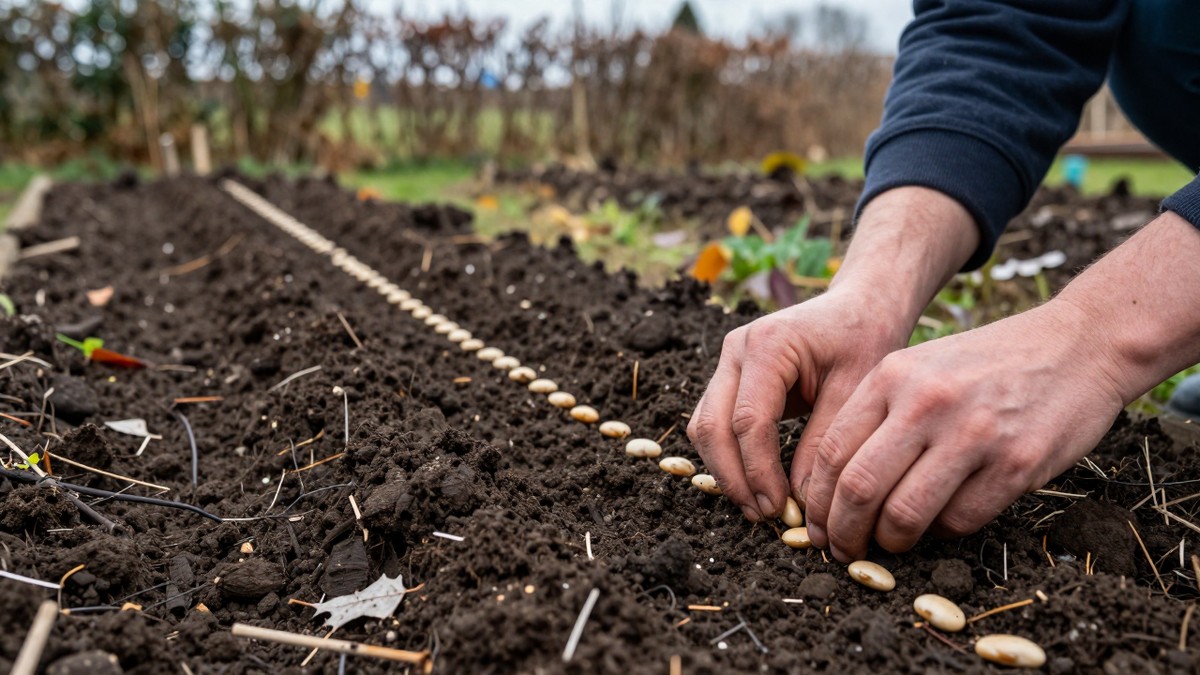
- Mark out a double row. Two parallel rows about 20cm apart, with roughly 60cm between each pair. The pairs shelter each other and the wide gaps give you somewhere to stand.
- Sow at around 5cm deep. Shallower and mice find it easily; deeper and cold wet soil slows germination to a crawl.
- Space the seed 20 to 23cm apart along each row, staggered so the plants sit in a zigzag rather than square opposite each other.
- Backfill and firm. Press the soil over each seed so no air pocket is left for water to collect in.
- Do not water. Autumn ground holds all the moisture the seed needs, and more only raises the chance of rot.
- Cover against mice. Fine netting pegged over the row, a cloche, or prickly prunings along the drill all work, until the shoots are through.
Sow a few spares at the end of the row, and label it. By January the bed is bare soil with a few green tufts, and easy to fork through while tidying.
The module alternative
Root trainers suit broad beans because the deep narrow cells match the way the plant roots and they open flat, so the root ball comes out without tearing. Sow one bean per cell at about 5cm, water once, then keep them barely moist and cold. A heated propagator only gives you leggy plants. Harden off for a week and plant at the same spacing once the ground is workable, usually late February into March.
What goes wrong, and what to do about it
The seed rots before it comes up
The commonest failure, and almost always waterlogging rather than cold: a row that never appears, and a dug-up seed that is soft, dark and sour. Fill the gaps with module-raised plants in February, and next year either raise the bed by 10 or 15cm, sow along a low ridge, or move to modules.
Mice dig the seed up
Neat conical holes along the drill and no seedlings is the signature, and they come back for the resowing. Re-sow under a cloche or pinned netting, or raise replacements in modules out of reach, the more reliable fix on a site with sheds and compost bins.
The plants are too big going into winter
A mild autumn after an early sowing gives knee-high plants in December, and those are the ones that flatten. Draw soil up around each stem and run canes and string along both sides of the double row. Pinching out the top of an oversized plant is a defensible last resort, though it costs some of the early cropping advantage.
Frost damage to the growing tips
Blackened, papery leaf edges after a cold snap look alarming and usually mean nothing. Pull one plant gently: firm roots and a green central growing point mean it will grow away in spring, a soft brown crown means it is finished. Two layers of fleece on the coldest nights is the cheapest insurance there is.
Chocolate spot on a wet plot
Reddish-brown blotches spreading over the leaves in late winter is chocolate spot, a fungus that thrives in the conditions that make autumn sowing marginal: damp, still, crowded and badly drained. Thin doubled-up plants for airflow, remove the worst leaves and keep water off the foliage. Mild cases still crop well.
Slugs take the shoots as they emerge
A mild wet autumn keeps slugs active into December, and a new bean shoot is one of the few soft things on offer. Check the row after dark with a torch for a couple of nights once the shoots break through: that tells you whether you have a real problem or a stray.
Frequently asked questions
Is autumn sowing worth it on heavy clay?
Often not, and there is no shame in skipping it. Waterlogged clay rots the seed before it germinates, and a bed that held standing water last winter will do it again. On that ground a February sowing in root trainers usually beats a November drill comfortably.
How deep and how far apart should the seed go?
Around 5cm deep, with seed spaced roughly 20 to 23cm apart. The standard layout is a double row, the two rows about 20cm apart, with a wider gap of around 60cm between each pair so you can pick without treading on the bed.
Do overwintered broad beans really escape blackfly?
They usually get off more lightly, which is one of the better reasons to try. Autumn-sown plants flower and set their first pods before blackfly build up in late spring, so the aphids arrive to find the crop largely made. Pinching out the growing tips once the lowest pods set removes the soft growth they prefer.
How much earlier is the harvest than a spring sowing?
Typically three to four weeks earlier, so late May rather than mid to late June in much of the UK. That gap is the point of the exercise, and it lands when very little else on the plot is ready.
What if I have already missed the autumn window?
You have missed one route to the crop, not the crop. Spring sowing runs from February under cloches or in modules through to April in the open ground, and it catches up faster than most expect. On cold or exposed sites it is the more reliable option anyway.