
Why Do Birds Empty a Feeder of RSPB Fat Balls Overnight? The 50-Ball Box Reviewed
We earn commission from qualifying Amazon purchases. It costs you nothing and does not affect what we recommend.
One buyer filled the feeder at 7pm; by 10am it was stripped bare. RSPB's 50-ball suet box has that effect on gardens, and the 100 most recent reviews explain why it happens, where the box falls short, and what quietly changed in the packaging.
- Soft Texture Is the Recipe, Not a Defect
- Four Kilograms, Fifty Balls, and What Goes Into Them
- Seventeen Buyers Report the Same Thing: Empty Feeders
- Starlings, Squirrels and the Case for a Caged Feeder
- The Shrinking Ball Question, and the Reviews That Go Against the Grain
- Our Verdict: 4.5 From Us, and One Tip Before You Order
How hard should a fat ball be? One buyer's previous brand only broke open under a hammer: "Fat ball are so hard I had to hit them with a hammer to break them! (sic)" That review sits in the 100 most recent for RSPB's Super Suet Fat Balls, and it points at the pattern running right through the set: these balls are soft on purpose, small beaks can actually work them, and feeders empty at a pace that catches first-time buyers out. We read all 100 recent reviews, every one of them from the UK, and they average 4.61 stars against the listing's lifetime 4.7 from 1,132 ratings. Below is what those buyers agree on, where the box goes wrong, the one measurement that has quietly shrunk since the old packaging, and whether we would order 4kg of suet in one go. You can check today's price on Amazon while you read.
Soft Texture Is the Recipe, Not a Defect
Eleven of the 100 most recent reviews mention how soft these balls are, and nearly all of them treat that as the reason the product works. Cheap fat balls can set like concrete, and a blue tit cannot chip pieces off concrete, which is how they end up hanging untouched for a month. These are the opposite: a firm outside with enough give for a small bird to peck fragments away. One of the most detailed five-star reviews, from seanx, describes them as "slightly soft/creamy BUT hold together great, no crumbly mess", and notes they arrive wrapped in greaseproof paper rather than dusty and loose. Several buyers report fledgling blue tits managing them without help, which matters in June and July when parent birds are ferrying food non-stop.
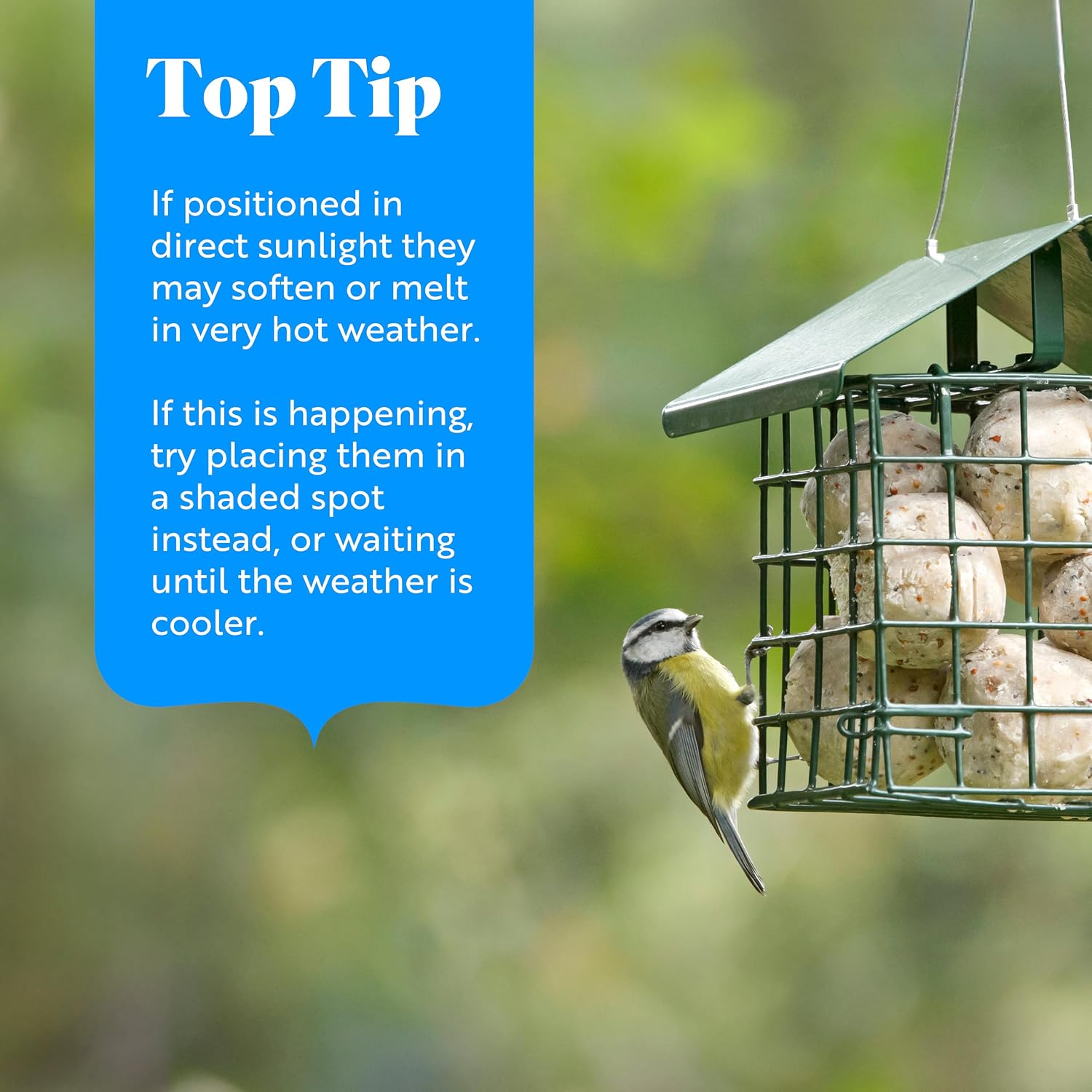
The trade-off shows up in hot weather. Michelle keeps hers cool: "the balls a a little soft so I keep a few in the fridge (sic)", and RSPB itself flags the issue in a Top Tip panel in the listing images: positioned in direct sunlight they may soften or melt in very hot weather, so hang them in shade or wait for cooler days. In a typical British summer that means the north side of a hedge or under a tree canopy rather than a south-facing fence post. Through autumn and winter, when birds need the fat most, the softness question disappears entirely.
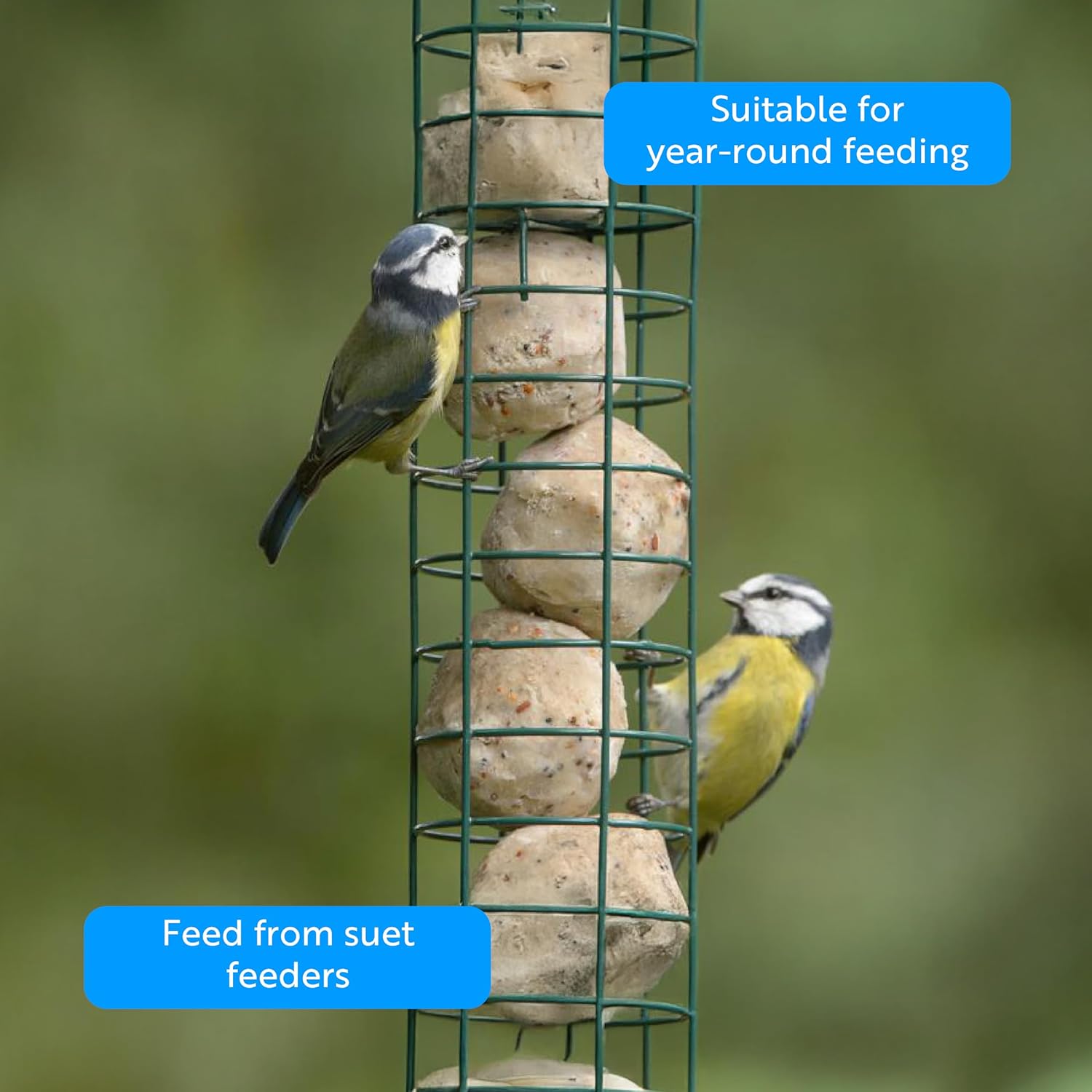
The consistency also lets you use them three ways: whole in a suet feeder, loose on a bird table, or crumbled on the ground for the species that will not cling to hanging feeders. Blackbirds and robins in particular feed far more happily on crumbled suet at ground level.
Four Kilograms, Fifty Balls, and What Goes Into Them
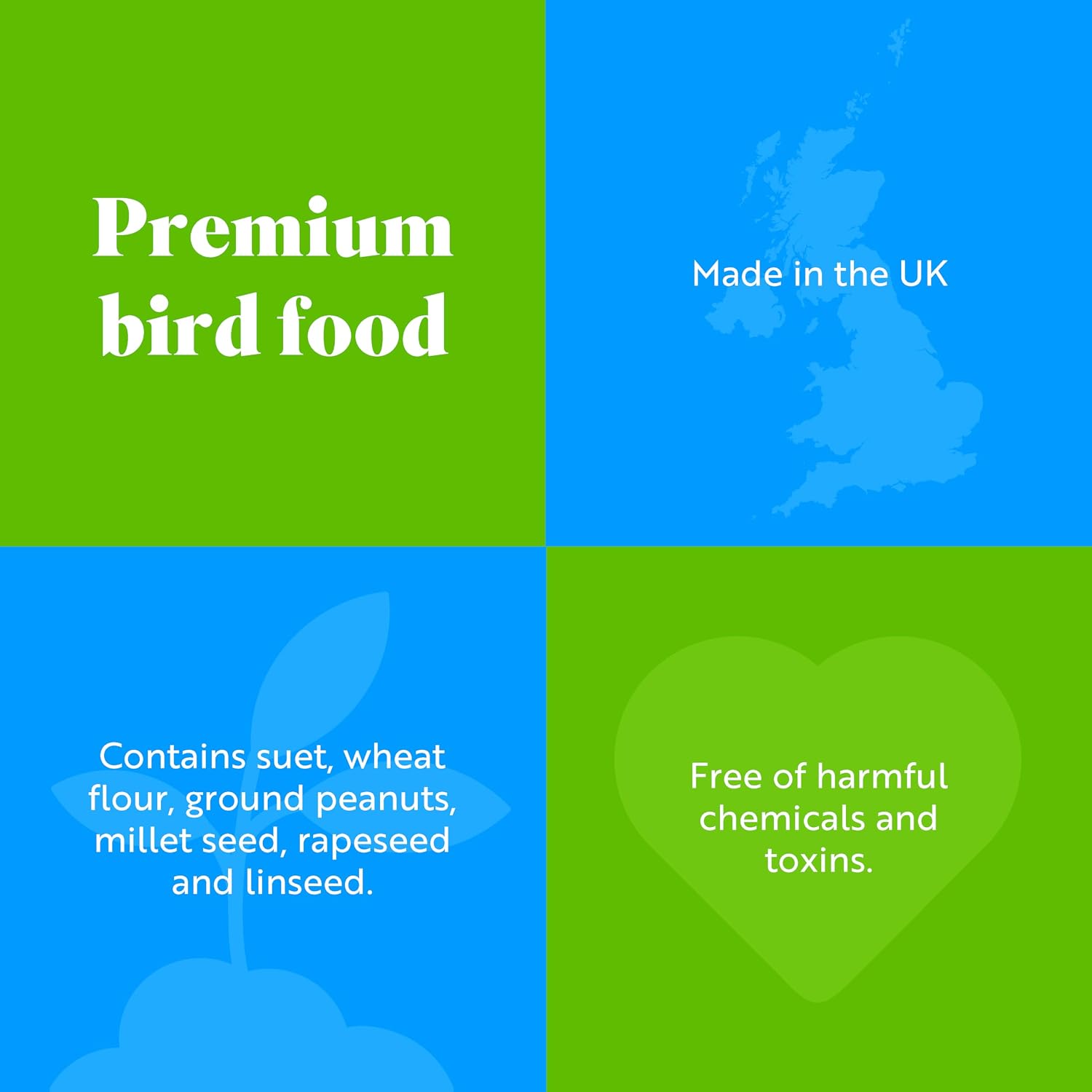
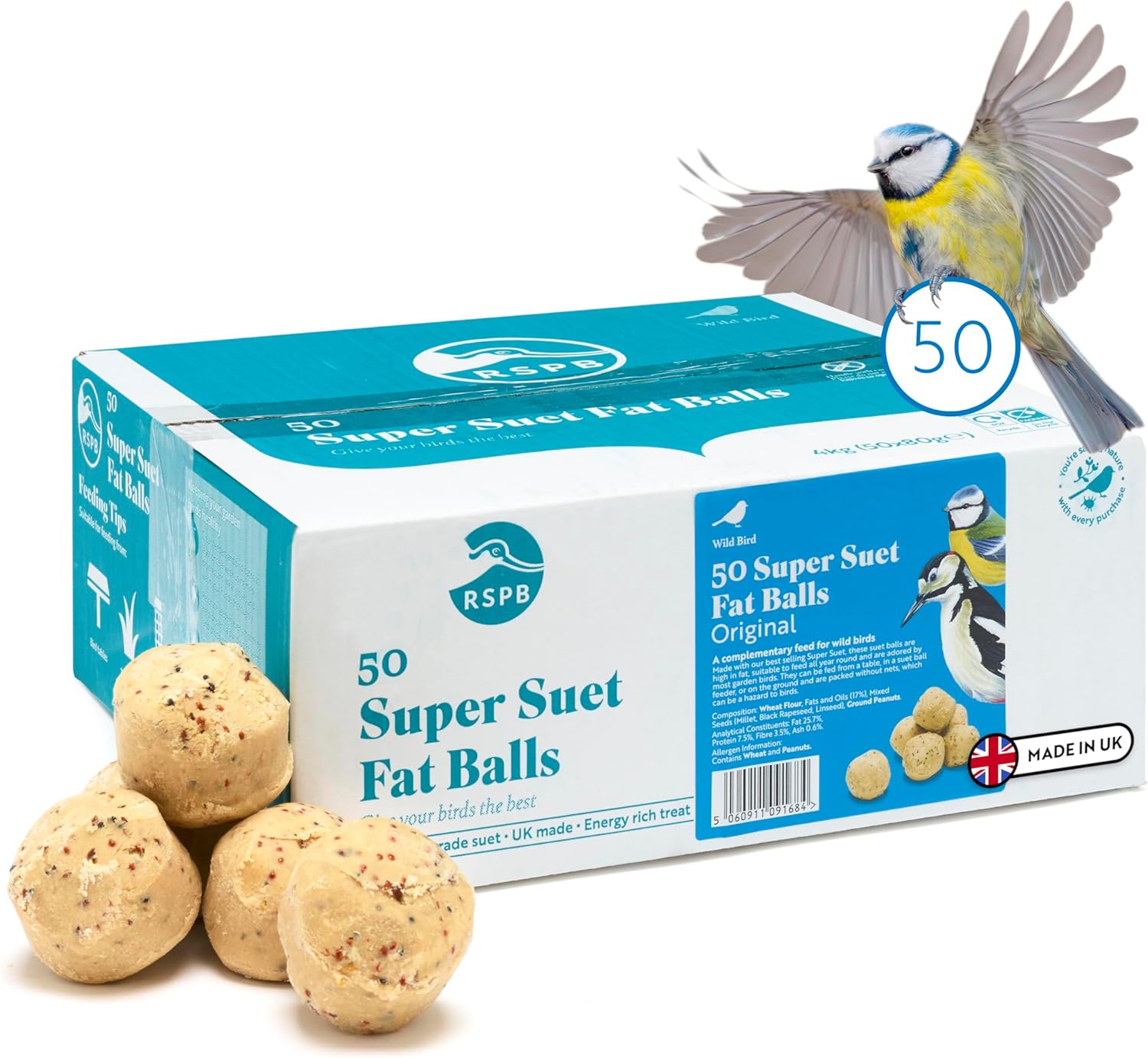
The box holds 50 balls at 80g each, 4kg of feed in total, so it is a properly heavy parcel when it lands on the doorstep. The composition panel on the box lists wheat flour, fats and oils (17%), mixed seeds (millet, black rapeseed and linseed) and ground peanuts, with analytical constituents of 25.7% fat, 7.5% protein, 3.5% fibre and 0.6% ash. That fat figure is the point of the product: a high-energy feed birds can convert quickly, which the listing says suits year-round feeding rather than winter only. The allergen note names wheat and peanuts, worth knowing if someone nut-allergic will be handling refills.
Two details separate this from bargain multipacks. First, the balls are packed without nets. RSPB deliberately avoids the netted format because birds can tangle feet and beaks in the mesh, and it says so on the box. Second, the brand angle is real: this is the Royal Society for the Protection of Birds, profits support its conservation work, and the recipe is made in the UK.
On species, the listing's own image names blackbirds, blue tits, great tits, long-tailed tits, robins and starlings. The recent reviews back that up and stretch it further: four of the 100 mention woodpeckers arriving, and others list coal tits, sparrows, magpies and one memorable garden with visiting parrots. If your feeder currently attracts nothing but pigeons, an 80g ball of 25.7% fat suet is about as strong a lure as you can hang out.
RSPB Super Suet Fat Balls, Box of 50
Soft, UK-made 80g suet balls that garden birds strip first, with profits supporting bird conservation.
Seventeen Buyers Report the Same Thing: Empty Feeders
The single most repeated experience in the recent reviews is speed of consumption. By our count, 17 of the 100 describe feeders emptying at a pace that surprised them. Lucy Irwin timed it: "I put these out 7pm last night, by 10am - completely gone!" KB paints the queue: "They literally queue up on my washing line to get to the feeders." Others put numbers on the habit their gardens have developed: Stoker gets through five balls a day, Ray buys two containers a month, and one buyer of the larger 160-ball size went through four of those boxes in under a month.
Read cynically, that is a running cost. Read the way most of these buyers read it, it is proof the birds rate the recipe, because several of the same reviewers mention cheaper balls that hung untouched until they were thrown away. A soft, high-fat ball that vanishes is doing its job; a hard one that survives six weeks in the feeder is not feeding anything.
If the pace worries you, the practical answer from the reviews is rationing. Put out one or two balls at a time rather than filling a five-ball feeder, and refill on a schedule you control. A box of 50 gives you room to do that: at two balls a day it is close to a month of feeding, and the box stores fine somewhere cool. A couple of buyers keep a handful in the fridge in summer, which firms them up for handling too. Feeding through a heatwave, as noted above, is the one time to hold back.
Starlings, Squirrels and the Case for a Caged Feeder

The heavyweights arrive fast. Twelve of the 100 recent reviews mention squirrels, starlings, magpies or other large raiders muscling in on these balls, and it is easily the most colourful thread in the set. GREEBO watches the takeover daily: the smaller birds get shoved aside by "the Starlings- or ' The Mafia ' as my late husband used to call them (sic)". Sal escalated her defences: "I had to buy an extra large fat ball cage as the squirrels were going crazy." One buyer's squirrel gets through seven balls in a single autumn day, another's dog keeps finding suet lumps the squirrels have buried in the lawn.
None of this is a fault of the product, but it changes what you should buy alongside it. If starlings dominate your garden, an open suet feeder becomes a starling buffet by 9am and the sparrows and tits wait their turn or go hungry, a frustration one reviewer describes watching happen. The fix that comes up repeatedly in the five-star reviews is a caged feeder: an outer wire guard that lets tits, robins and finches through while keeping squirrels, corvids and most starlings out. Buyers using squirrel-proof cages report the balls lasting sensible lengths of time; buyers with open feeders report feeding the entire neighbourhood food chain.
There is an upside to the raiders, mind. Several reviewers clearly enjoy the drama, woodpeckers included, and if your goal is simply a busy garden then an 80g ball out in the open will deliver more activity in a morning than a seed feeder manages in a week.
The Shrinking Ball Question, and the Reviews That Go Against the Grain

One four-star review raises something the listing images quietly confirm. A.N. OTHER, a repeat buyer, noticed: "My main feeder used to hold 4 of these. Now it takes 5 to fill up. ??" Look at RSPB's own "New Packaging, Same Great Taste" comparison image and the old box is labelled 4.5kg while the current one is 4kg for the same 50 balls. That is 90g down to 80g per ball, a 10g reduction nobody announces in the bullet points. It is still a big ball, but repeat buyers with snug feeders will notice exactly what this reviewer noticed.
Four of the 100 recent reviews report the opposite of the empty-feeder experience: birds ignoring the balls altogether. Victoria mckenzie found her usual crowds vanished with this multipack and blamed the small print, writing that the additional information described them as plant based and "I feel like I've been hoodwinked". Worth noting alongside that: the current box panel lists "fats and oils (17%)" without naming beef suet, while the Amazon listing text still describes a blend of suet. H had a similar rejection: "even the seagulls turn their noses up to them". Against 81 five-star reviews these are outliers, but they exist.
Arrival condition is the other weak spot: 4 of the 100 mention broken or crushed balls in the box, from a few damaged to Chriss's "Only 2 were intact. The rest were in bits". Jarge, more typical, found "probably about 20 were broken up" in hot weather and still rated the product. Soft recipe plus courier plus summer heat is the likely equation. Two further reviews report freshness failures, one rancid-smelling batch sent back for a refund and one box with four mouldy balls after damp transit. Broken balls still feed ground feeders; rancid ones go back.
Our Verdict: 4.5 From Us, and One Tip Before You Order
The numbers first. Of the 100 most recent UK reviews, 81 are five-star, 9 four-star, 4 three-star, 2 two-star and 4 one-star, an average of 4.61 against the listing's lifetime 4.7. That small slide is worth reporting but it is not a warning sign; 99 of the 100 are verified purchases and the biggest single failure cluster, balls arriving broken, runs at just 4 in 100. One note on the data: this listing pools reviews across pack sizes, so a handful of the 100 reference the six-pack or the 160-ball box rather than this exact one. We have flagged those where quoted.
We score it 4.5 out of 5. The half-step off comes from summer transit fragility, the quiet 90g-to-80g downsize against the old packaging, and a small tail of duds, rancid or mouldy boxes that should not get through. What keeps it high is the thing no marketing can fake: 17 recent buyers describing feeders stripped in hours, and multiple direct comparisons where birds abandoned cheaper hard balls the moment these arrived.
One tip before you order: a long-term buyer (the only unverified review in the set) says RSPB's own shop sells these cheaper than Amazon, so a quick comparison costs you nothing. If Amazon wins on the day, or you want it on your doorstep with the rest of your order, this is the easiest recommendation we have made in months for anyone who feeds year-round: check today's price on Amazon. Pair it with a caged feeder if squirrels or starlings run your garden, keep a few balls in the fridge come July, and count on refilling more often than you expect.
RSPB Super Suet Fat Balls, Box of 50
Soft, UK-made 80g suet balls that garden birds strip first, with profits supporting bird conservation.