
When to harvest parsnips UK: the signals that matter more than the date
Most people ask this in August, and August is almost always too early. Spring-sown parsnips are rarely worth lifting before the tops die back in October, and they taste better after a frost. Here is how to read the row.
We earn commission from qualifying Amazon purchases. It costs you nothing and does not affect what we recommend.
Quick answer
The honest answer to when to harvest parsnips UK-wide is October to February, once the foliage has yellowed and collapsed and, ideally, after the first hard frost has sweetened the roots. Lift them as you need them through winter and clear the row before new leaves appear in late February or March. In August, wait.
Most people typing this question are standing at a row of big, healthy parsnip tops in late summer, wondering whether the roots underneath are ready. They almost never are. A parsnip sown in April is still building its root in August, and the sweetness that makes it worth eating does not arrive until the cold does. The calendar frames the answer; what the row looks like settles it.
What the row tells you
None of these checks need anything beyond a fork and gloves. Read them together; any one on its own will mislead you.
The foliage has yellowed and collapsed
This is the one to learn. Through summer the tops are upright, deep green and often knee high. From late September into October they yellow, brown at the edges and flop over the row: the plant has stopped feeding the root. Until then, there is more parsnip still to come.
The first hard frost has been and gone
This turns an acceptable parsnip into a good one. Cold prompts the root to convert stored starch into sugar, which is why the same row tastes flat in September and sweet in December. A light air frost is a start; what you want is two or three nights that freeze the soil surface. In much of England that means November, in the south west it can be December, and in Scotland it may be October.
A test lift confirms it
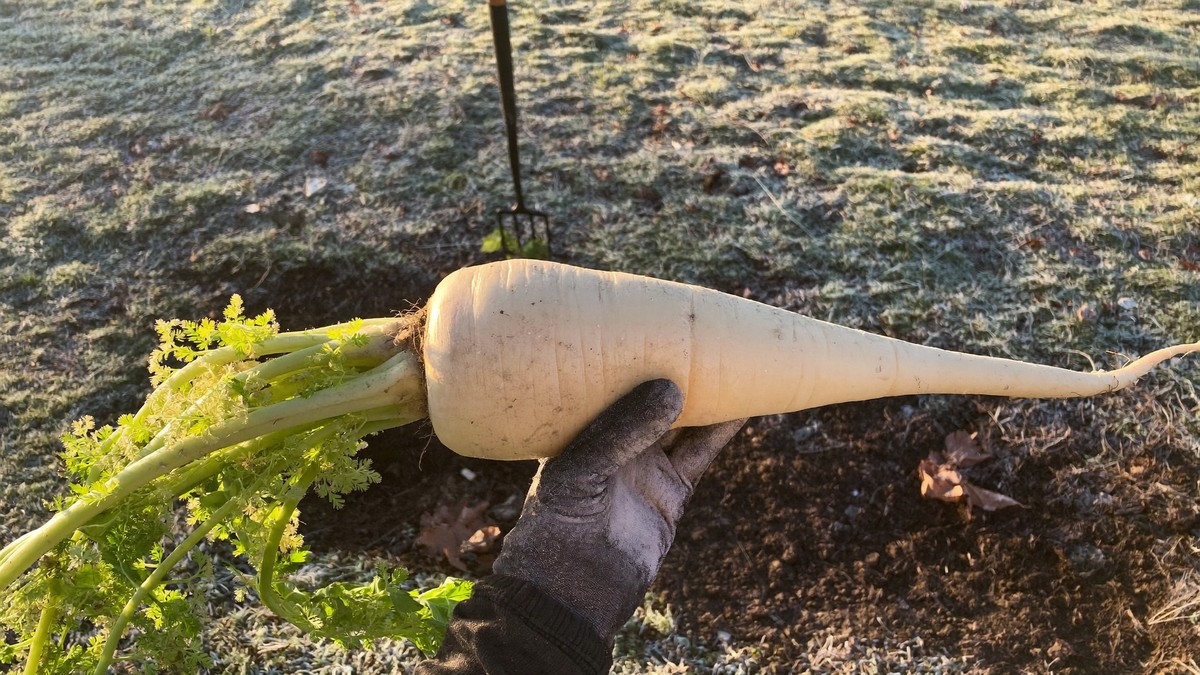
Scrape soil away from a crown first: a root that is ready has shoulders three to five centimetres across, and a crown thinner than your thumb means the rest is thinner still. When the tops have gone over, lift one root from the end of the row using the method below. You want a cream-white root at least as thick as a broom handle at the shoulder, tapering cleanly, with no orange rot at the crown. A thin, forked or spongy root tells you to wait, or that this row has a problem worth reading about before you lift the rest.
New green leaves in late winter mean stop
Parsnips are biennial, and when the crowns push out fresh leaves in late February or March the plant is preparing to flower. The root goes woody at the core within a few weeks. Lift everything that is left as soon as you see regrowth.
Varieties shift the timing a little, not a lot
Smaller types such as Avonresister and White Gem reach a usable size a few weeks ahead of long-rooted sorts like Gladiator F1, Tender and True or Hollow Crown. Sowing date matters more: a March sowing will be a month ahead of a May one. Either way, the foliage and the frost are still the signals that count.
Asking in August or September? Almost certainly wait
Interest in this question peaks in August and September, the two months when the answer is most likely to be no. Seed goes in from March to May, germinates slowly, and the root takes the whole summer to build. In August the tops are at their biggest, but the root underneath is still pale, thin and starchy. The one reason to lift in late summer is a row that is failing: leaves collapsing early with orange patches at the crown (canker), or roots tunnelled by carrot fly. Take what is usable before it gets worse. A healthy row wants leaving alone.
Month by month, August to March
Timings are for a typical spring sowing in the English Midlands. Move everything a fortnight earlier for the south coast, two to three weeks later for northern England and Scotland, and expect any given year to shift it a fortnight.
August
Nothing to harvest. Keep the row weeded, water in a long dry spell so the roots do not split when rain returns, and draw soil over any shoulders showing above ground to reduce canker later.
September
Still nothing for most rows. The lower leaves may start yellowing late in the month; if you sowed early and the tops are going over, lift one to see where you are, but expect thin roots. Get straw in now for covering the row later.
October
The first real lifting month. Tops yellow and flop, and a test lift shows roots worth eating. Lift what you need for the kitchen and leave the rest: the flavour is still improving, and a root in the ground keeps better than one in the fridge.
November
The main window opens. Frosts have usually arrived, the roots are sweetening, and you lift a few at a time whenever the ground is workable. Before the first prolonged cold snap, cover the row with a thick layer of straw or bracken so you can still get a fork in when the surface freezes. Lift a batch for storing now if your soil is heavy clay that waterlogs.
December and January
Peak eating. Pull back the straw, lift what you need, and cover the rest again. If slugs are working on the crowns, lift and store the remainder rather than lose it.
February
Last month of good eating. Watch the crowns for fresh green growth; the roots are still fine, but the clock is running.
March
Clear the row. Regrowth is under way and the roots go woody from the centre outward. Lift everything, use the best, compost the rest, and sow this year's crop elsewhere if canker was a problem.
Lifting a parsnip without snapping it
A good parsnip is 30cm long and sometimes more, and the last third is a thin tip that snaps if you rush. The job is mostly loosening, with the lift at the end.
- Cover up first. Gloves and long sleeves, every time, even in December. Parsnip foliage and sap contain compounds that react with sunlight to burn and blister bare skin (phytophotodermatitis), and the marks can last for weeks. A dull day is safer than a bright one.
- Trim the tops. Cut or twist the leaves back to a few centimetres above the crown so you can see each root and nothing tangles the fork.
- Pick a day the ground is moist, not sodden. Dry soil grips the root. If it is bone dry, water the row the evening before.
- Fork in well to one side. Push a garden fork straight down 15 to 20cm from the crown, as deep as the tines go, and rock it back gently. Do the same from the opposite side. Going in closer, or at an angle, is how a fork ends up through the middle of the root.
- Lift from the crown. When the root shifts freely, grip the shoulders and draw it up in a straight line, with the fork still supporting underneath. If it resists, loosen again rather than pull harder.
- Leave the soil on. Brush off the loose stuff. Roots for this week can be washed indoors; roots you are storing keep far better unwashed.
- Cover the rest of the row. Spread 15 to 20cm of straw, bracken, dry leaves or doubled fleece over the remaining roots and weigh it down. Mark the row ends with canes, because once the tops have rotted away a covered row is invisible.
If the ground has frozen and you forgot to cover it, do not lever hard. Wait for a thaw, or pour a can of water along the row an hour beforehand to soften the top few centimetres. A root with a snapped tip or a tine through it will not store, so eat it in the next few days.
Leave them in the ground or lift and store
Both work, and most of the time we would leave them where they are. The soil holds them at an even temperature, keeps them crisp and lets them go on sweetening. A lifted parsnip in the fridge softens within a couple of weeks; the same root in the ground is fine in March.
Lift and store instead when the ground is against you: heavy clay that waterlogs and rots the crowns, slugs hollowing out the shoulders under the straw, or a plot you cannot reach in bad weather. Lift a month's worth at a time once the frosts have done their work, twist off the tops, and pack the unwashed roots in boxes of barely damp sand in a cold, frost-free shed. Checked weekly, they keep for several weeks and often a couple of months.
Whichever you choose, the straw cover is the part that pays off: a bale and ten minutes is the difference between fresh parsnips on Christmas Day and a frozen row you cannot dig. If you are already fleecing beds for the cold, our guide on protecting plants from frost in the UK covers the materials and how long they last.
What goes wrong, and how to recover
Canker
The commonest failure by a long way. Orange-brown, reddish or black rotting patches appear on the crown and shoulders, often where the root sits above the soil or around carrot fly damage. It is worse in wet autumns, on heavy soil and on large early-sown roots. Cut out surface patches and eat the rest; compost anything soft. Next year, choose a resistant variety such as Gladiator F1, Avonresister or Palace F1, sow a little later, earth up the shoulders in summer and move the crop to fresh ground.
Forked and twisted roots
A tap root that hits a stone, a hard pan or a pocket of fresh manure splits into legs to get round it. The roots are fine to eat, just awkward to peel. Prevention is all in the soil: dig deeply, remove stones, and grow parsnips on ground manured for the previous crop rather than this one. On stony soil, a crowbar hole filled with sieved compost per plant is the old allotment answer and still works.
Carrot fly
Parsnips get it too: rusty tunnels just under the skin, usually in the top third of the root. Lift affected rows sooner rather than later, peel generously and use what you can. Fine mesh over the row from sowing is the fix for next year, and clearing all roots by March removes the overwintering larvae.
Woody or bland roots
Woody cores in spring mean you left it too late and the plant has started to flower; lift promptly once you see regrowth. Bland roots are simply too early: leave the rest of the row until after a hard frost and taste the difference.
Frequently asked questions
Can I harvest parsnips in August in the UK?
Usually not with any reward. A parsnip sown in April is still filling its root in August, and lifting one gives you something thin and bland. Wait for the tops to yellow in autumn and for a frost, and the same row will give you sweet roots the size of your forearm.
How long can parsnips stay in the ground?
All winter. Parsnips are fully hardy and the soil is the best store you have, so lift them as needed from October to February. Clear the last of them before the crowns push out fresh leaves in late February or March, because a regrowing root turns woody at the core.
Why are my parsnips forked or stunted?
Forking is almost always the soil. The tap root hits a stone, a clod or a pocket of fresh manure and splits into legs to get round it. Thin, twisted roots usually come from sowing too thickly and not thinning. Deeply dug, stone-free ground manured for a previous crop, not this one, gives straight roots.
Can I still eat parsnips with canker?
Yes, if the damage is on the surface. Canker shows as orange-brown or black rotting patches on the shoulders and crown; cut it out generously and the rest of the root is fine. A root that is soft or hollow beneath the patches has gone too far and belongs on the compost.
Why did my hands or arms sting after pulling up parsnips?
Parsnip foliage and sap contain compounds that react with sunlight on bare skin, causing redness, blistering and marks that can last weeks. It is called phytophotodermatitis, the same reaction giant hogweed causes, only milder. Wash the skin with soap and water, keep it out of the sun for a day or two, and wear gloves and long sleeves next time.