
When to cut back perennials in the UK: which ones to cut and which to leave
Cutting back perennials in the UK is not one decision with one date. Some plants need the old growth off before winter, some do better left standing until late February, and a few will rot or freeze if you cut them now. Here is how to tell them apart.
We earn commission from qualifying Amazon purchases. It costs you nothing and does not affect what we recommend.
Quick answer
Cut back perennials in the UK when the foliage tells you to, not on a date. Anything diseased or collapsing into mush comes off from October. Grasses, sedum, rudbeckia and other seedheads are better left standing until late February. Penstemon, salvia, fuchsia and hydrangea wait until spring.
Ask when to cut back perennials in the UK and you get a month, usually October or November. That is wrong for about half of an ordinary border. Cutting back is three decisions rather than one job with one deadline, and the plant in front of you tells you which one you are making.
What follows is mainstream UK horticultural guidance, with the regional variation and the disagreements between growers left in.
What the border is telling you
Look at the plants, not the forecast. Two minutes settles most of it.
Mildew, rust or blackspot on the leaves
A white, dusty bloom on phlox, monarda or aquilegia is powdery mildew; orange pustules under hollyhock leaves are rust; brown blotches spreading on peony foliage point to peony wilt. Diseased foliage is the one clear case for cutting in autumn, and the reason is not tidiness: the spores overwinter on dead leaves and on the soil surface, so leaving them there hands next summer's infection a head start. Cut it off whatever the month, and bin it rather than composting it.
Foliage that has collapsed into a wet mat
Press a finger into it. Hosta leaves turn to translucent slime after the first frost, alchemilla mollis goes yellow then flat, and daylilies and hardy geraniums slump into a sodden pile over their own crowns. Old growth in that state holds water against the plant and shelters slugs. That comes off.
Stems that are still standing up dry
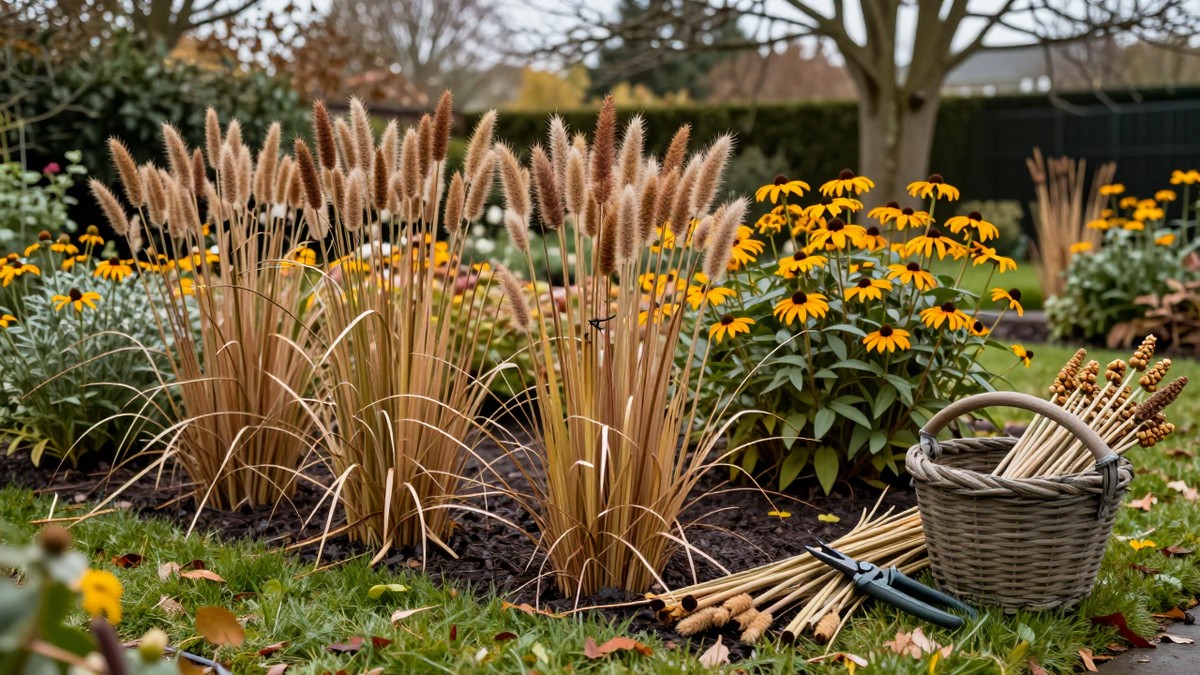
Miscanthus, calamagrostis, sedum, rudbeckia, echinacea, achillea, eryngium, teasel and verbena bonariensis fade to fawn but stay upright. Rub a stem between finger and thumb: dry, rigid and hollow rather than soft means it is holding no water against the crown, so the rot argument does not apply. Those are worth leaving.
New shoots low down at the base
Kneel and part the old growth at ground level. Penstemon, shrubby salvias and hardy fuchsias keep low shoots or dormant buds down there all winter, and the top growth above works as a windbreak and a frost buffer. Cut it away in October and you expose the part you most need to survive.
Your soil, your area, and what this year did
Dig a small hole beside a clump the day after heavy rain. If water sits in it for an hour, yours is a border where foliage lying on a crown all winter turns to rot, and the case for clearing is stronger. Free-draining soil gives you more freedom to leave things standing.
First frosts and the start of spring growth shift by two to three weeks between Cornwall and Aberdeen, and by a fortnight between years, so every month below is a starting point rather than a date. The adjustment rule: inland, northern and frost-pocket gardens bring the autumn jobs forward a fortnight and push the late winter cut back by the same, while mild south and west coasts do the reverse.
Three groups, and where we draw the line
Growers disagree here, and it is a real disagreement rather than one side being uninformed. The tidy-in-autumn camp clears the lot in October and November: fewer slugs, fewer overwintering spores, nothing to do in March. The leave-it-standing camp keeps stems and seedheads for the birds, the insects inside hollow stems, and the frost that makes a border worth looking at in January.
Our position is a split rather than a side: cut what is diseased or collapsing, leave what is standing dry, and treat the marginal plants as a decision for spring.
Cut in autumn: the disease carriers and the collapsers
Phlox, monarda, aquilegia and pulmonaria carrying mildew. Hollyhocks with rust. Peony foliage, which standard guidance says to cut down and dispose of in autumn so peony wilt does not carry over. Hostas, alchemilla, daylilies, hardy geraniums and astrantia once they have gone to mush. Bearded irises, whose old leaves harbour leaf spot.
Leave until late winter: the structure plants
Deciduous ornamental grasses, plus sedum, rudbeckia, echinacea, achillea, eryngium, phlomis, teasel and verbena bonariensis. Four reasons stack up: the seedheads feed goldfinches and other birds, hollow stems shelter overwintering insects, the old growth insulates the crown, and the border looks like something in January instead of bare soil. These come down in late February or March.
Molinia needs no decision, since it sheds and collapses on its own around midwinter. Deciduous ferns belong here too: the old fronds shelter the crown and come off in late winter.
The marginal ones: cut these now and you may lose them
Penstemon, shrubby salvias such as the greggii and microphylla types, and hardy fuchsias all overwinter better with their top growth on. Leave them until April, or May in a cold garden, then cut back to the lowest pair of healthy new shoots. Kniphofia is a variation on the idea: tie the leaves up over the crown to throw off winter wet.
Hydrangeas are the case people get wrong most often. Last summer's faded heads sit above the fat buds that carry next summer's flowers, so cutting them off in autumn exposes those buds to frost, which is why a hydrangea can look healthy in June with nothing on it. Leave the heads and prune in March; our guide on what to do with hydrangeas after flowering covers the varieties pruned differently.
Month by month, September to March
September
Nothing much yet, and that is the honest answer. Foliage still standing is feeding the crown for next year, so early tidiness earns you nothing. Take off anything already carrying mildew or rust, stop deadheading whatever you want seedheads from, and split congested clumps while the soil is warm.
October
First frosts reach most inland and northern gardens and the collapsers go over within days. Clear hostas, alchemilla, daylilies and hardy geraniums as they slump, and take off peony foliage and bearded iris leaves. Grasses and seedheads stay exactly where they are.
November
The bulk of the autumn work, and the month when wet matters more than cold. Lift anything lying flat on a crown, then mulch the cleared ground. Leave penstemon, salvia, fuchsia and hydrangea alone, however untidy they look.
December
Almost nothing to do, which is the point of having left the standing group. One job worth diarising: strip last year's leaves off hellebores in late December or January, before the flower stems push through. It cuts down leaf spot and shows off the flowers.
January
The month the standing group pays you back, with frost picking out grass plumes and seedheads. The only work is clearing stems the gales have flattened onto a crown.
February
The turn. From late February in mild areas, grasses and seedhead plants come down to about 5 to 10 cm before new growth starts. Look at the base of each clump first: green shoots showing means go carefully, no shoots means you can shear straight through.
March
Everything left standing comes down, north and south. Hydrangeas are pruned to the first fat pair of buds below each old flowerhead. Penstemon, salvia and fuchsia wait until the frost risk has gone, then come back to their lowest healthy shoots. Finish with a feed and a mulch.
Making the cut: height, weather and tools
Pick a dry day
Damp foliage carries fungal spores between plants on your sleeves and blades, sappy stems clog a shredder, and treading on soaked clay compacts it around the crowns. If the border is soft underfoot, work off a plank.
Cut to a stub, not to the soil
Leave roughly 5 to 10 cm rather than cutting flush. The stub marks where the crown sits, which matters in March when a fork is going in nearby, and it keeps rain out of a cut hollow stem. On delphiniums and lupins, angle the cut so water runs off.
Comb evergreens rather than cutting them
Carex, festuca and stipa tenuissima are evergreen or semi-evergreen and do not reliably recover from a hard chop. Pull gloved fingers through the clump to rake out dead blades and leave the living ones. Heucheras, epimediums and hellebores get dead leaves picked off individually, not a haircut.
The kit that matters
Shears clear soft masses fastest, secateurs handle anything woody, and a big grass clump is quicker with a hedge trimmer. Cutting a border flat is repetitive, so if your hands ache by the second clump, a pair of ratchet secateurs gets through tough stems with far less grip force. Eryngium, teasel and old rose stems are as sharp dry as fresh, so thorn proof gloves matter too. Wipe blades with disinfectant between diseased plants and healthy ones.
Sort and shred the material
Healthy stems compost slowly and badly if they go on whole, so chop them with shears or shred them. Before you shred, though: soft green sappy material is what jams an impact shredder, so dry the stems for a few days first or feed them in with woodier prunings, which is the sticking point in our electric garden shredder review.
Anything with mildew, rust, blackspot or peony wilt goes to the council green bin or the bonfire. Municipal composting runs hot enough to kill the spores; a garden heap does not.
Mulch, then label
Spread compost or bark over the cleared soil, keeping it off the crowns, then push labels in beside anything you plan to move or divide. A cut back border loses its map immediately, and in February one stub looks like another.
What goes wrong and how to recover
Crown rot under collapsed foliage. A soft, brown, sour smelling crown in spring with no shoots. Scrape the mush away, cut back to firm tissue and work grit into the soil. If any of it is firm and pale, leave it until June.
The marginal group cut in autumn, then a hard winter. Penstemons and shrubby salvias cut in October often do not reappear. Mulch deeply, fleece them during hard frosts, and hold your nerve until late May, because they break dormancy late. Cuttings taken in late summer are the real insurance.
Diseased foliage on the compost heap. Mildew and rust reappear earlier and harder next summer, and there is no fix once it is on the heap. Spread that compost on lawns and shrubs rather than around phlox, monarda or hollyhocks.
Shearing off new growth in spring. Cutting a grass or a sedum in late March without checking the base takes the new shoots with the old. It is rarely fatal: feed the plant and expect flowering a week or two late.
Slugs living in what you left. This is the real cost of the leave-it-standing approach, and it is worst where hostas grow. Where slug damage was bad last year, clear that section and keep the standing stems to a hosta-free bed.
Frequently asked questions
Can I cut everything back in one go in autumn?
You can, and most plants survive it, but you lose the winter structure, the seed birds feed on and the shelter inside hollow stems, and you risk penstemon, salvia, fuchsia and hydrangea. For a single session, cut what is diseased or collapsed and leave whatever is standing dry.
What happens if I never cut anything back at all?
The border keeps going and most plants come through fine. The costs are that wet foliage on a crown can rot it, mildew and rust carry over, slugs overwinter in the debris, and by spring you are cutting around new growth.
When should I cut ornamental grasses?
Late February or March for deciduous grasses such as miscanthus and calamagrostis, down to about 5 to 10 cm before the new growth is tall enough to be sliced. Evergreen and semi-evergreen grasses are combed through with gloved fingers instead, because a hard chop can kill them.
Should I cut perennials back before or after the first frost?
It depends which group the plant is in. The collapsers are worth leaving until frost has flattened them, because that is the sign the crown has shut down. Diseased foliage should not wait, and the marginal plants keep their top growth precisely because frost is coming.
Is late February too late to cut back?
No. For grasses, sedum, rudbeckia, echinacea and the rest of the standing group, late February is the right time rather than a missed deadline. Check the base of each clump first, and once new shoots show, cut around them by hand.