
How to Get Rid of Fungus Gnats in Houseplants (UK Step-by-Step Fix)
Published 15 June 2026
Tiny flies lifting off your houseplant soil are fungus gnats, and they thrive in damp compost. This guide walks through the exact UK fix: let the top of the soil dry out, catch the adults with yellow sticky traps and break the breeding cycle so they do not come back.
We earn commission from qualifying Amazon purchases. It costs you nothing and does not affect what we recommend.
Quick Answer
To get rid of fungus gnats in houseplants, let the top three to four centimetres of compost dry out fully between waterings to kill the larvae, hang yellow sticky traps to catch the flying adults, and keep both going for three to four weeks until every generation has hatched and died off.
What fungus gnats are and why they appear
If you water a houseplant and a little cloud of tiny black flies lifts out of the soil, those are fungus gnats. They are weak, drifting fliers, around 2mm long, and they are easy to mistake for fruit flies. One reviewer of a popular trap said exactly that: they could not work out why nothing was helping until they realised the flies were fungus gnats, not fruit flies.
The reason they appear comes down to one thing: damp compost. Fungus gnats lay their eggs in the top layer of moist soil, and the larvae feed on fungi, algae and organic matter in that wet surface. Warm indoor temperatures speed the whole cycle up, which is why complaints peak through the UK summer when our homes are warmest.
The flies you see are only the adults. The real problem is below the surface, where larvae are quietly developing into the next generation. That is why swatting the adults or spraying the air never works. You have to deal with the soil.
The Order That Clears an Infestation, Lifecycle by Lifecycle
This is the order that actually clears an infestation. Do all of it together rather than picking one step, because each part targets a different stage of the gnat lifecycle.
1. Let the top of the soil dry out
This is the most important step. Fungus gnat larvae cannot survive in dry compost, so let the top three to four centimetres dry out completely between waterings. For most houseplants that means waiting until the surface is fully dry to the touch, then watering less often than you probably are now.
Bottom watering helps here: stand the pot in a tray of water for twenty minutes so the roots drink from below while the surface stays dry. A dry top layer kills larvae and gives the adults nowhere to lay new eggs.
2. Hang yellow sticky traps to catch the adults
While the soil dries, you need to stop the visible adults breeding. Yellow sticky traps are the standard tool for this, and they work because gnats are drawn to the bright yellow colour and stick fast. Catching adults matters because every adult you trap is a batch of eggs that never gets laid.
3. Treat the larvae in the soil
For a faster knockdown, drench the compost with diluted hydrogen peroxide, mixing one part 3% peroxide with four parts water and watering it in as normal. It fizzes briefly, kills larvae on contact and breaks down into water and oxygen, so it is safe for the plant. A layer of horticultural sand or fine gravel on top of the soil is a gentler alternative that stops adults reaching the compost to lay eggs.
4. Repeat through the full lifecycle
The fungus gnat lifecycle runs about three to four weeks. Keep the soil dry and the traps in place for at least that long, because new adults will keep emerging from eggs that were already laid. Stopping after a few days, when the worst is over, is the single most common reason gnats come straight back.
Using yellow sticky traps the right way
Sticky traps do a lot of the visible work, so it is worth using them properly. Push them into the compost close to the soil surface rather than up among the leaves, because that is where the adults gather and where they take off after watering. One trap per affected pot is the right density for most houseplants.
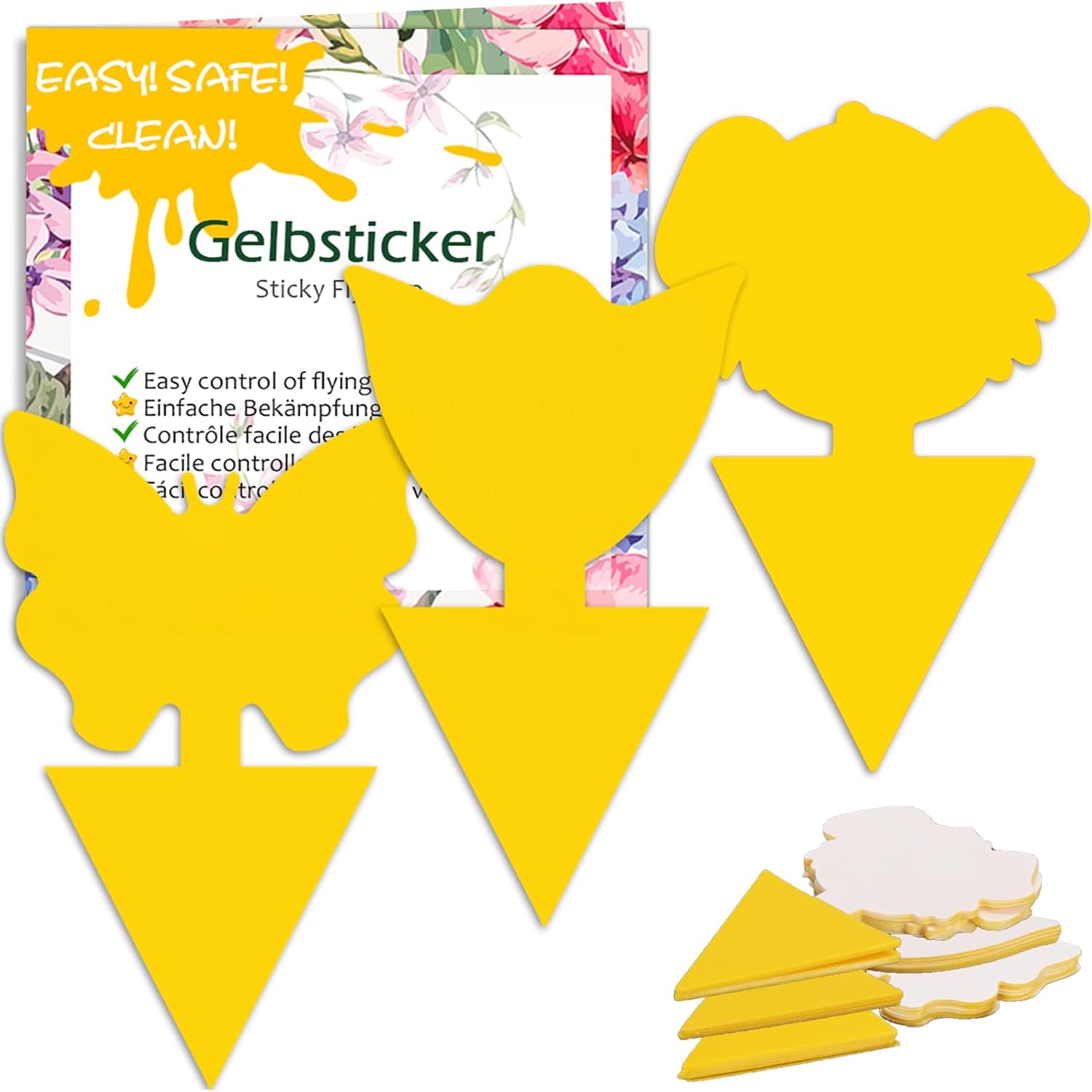
The Blooven fruit fly traps are the pick we keep coming back to for exactly this job. They are double-sided yellow boards that you peel and simply slide into the potting soil, and reviewers report adults landing on them within seconds of being placed. Several UK buyers described catching hundreds of gnats off plants that other treatments had not touched, and because each board has two sticky sides you can flip it over when the first side fills up. Watering does not affect the adhesive, which matters when the whole point is to keep working through the drying-out routine.
The pack of 30 sounds like a lot until you have more than a couple of affected pots, and that is the recurring theme in the reviews: with 50-plus houseplants, one buyer said the pack size suddenly made sense. The honest limitation is that traps only catch adults, so they will not clear an infestation on their own. Pair them with the dry-soil routine above.
One small thing the reviews flag: the traps stand in the pot like a plant label, so on a leafy plant they can stick to a leaf and tear it when you pull them out. Place them at the pot edge, clear of foliage, and that is a non-issue.
How to stop fungus gnats coming back
Once they are gone, prevention is mostly about water and feeding habits. Fungus gnats are a symptom of compost that stays too wet, so the long-term fix is to water less often and let the surface dry between drinks. Empty saucers after watering so pots never sit in standing water.
How you feed your plants plays into this too. Overwatering often comes from feeding little and often with a watering can, then topping up again before the soil has dried. Switching to a controlled liquid feed lets you manage moisture far better, because you decide exactly how much goes in and when.
For no-fuss feeding, Miracle-Gro Pour and Feed is the ready-to-use option: no measuring jugs, no mixing, you pour it straight onto the soil. One bottle gives around 40 caps for 20 medium pots, so it is easy to give each plant a measured amount rather than sloshing water around. It has become the default pick for UK houseplant owners precisely because it takes the guesswork out of feeding.
If you would rather dilute a concentrate and control the strength yourself, Miracle-Gro All Purpose Concentrated Liquid Plant Food mixes with water in a can and carries a balanced 7-3-5 NPK feed. It is a Which? Best Buy and works on both indoor houseplants and the garden, so it suits anyone who wants one bottle for everything. Feeding a measured dose into a known volume of water, rather than free-pouring, is exactly the habit that keeps compost from staying soggy.
For a tiny dose that is very hard to overdo, Baby Bio Houseplant Food has been feeding British houseplants for over 70 years. You add just 5 to 10 drops to half a litre of water, and the 175ml bottle makes up to 70 litres of feed, so a little bottle lasts a long time. Because you are mixing drops into a set amount of water, it naturally encourages controlled watering rather than overwatering, which is the root cause of gnats in the first place.
One last prevention tip: gnats often arrive in bagged compost. A reviewer noted their plant came home from a supermarket already crawling with them. Let fresh bags of compost dry slightly before potting, and keep a sticky trap in any new plant for the first couple of weeks to catch hitchhikers early.
Frequently Asked Questions
What kills fungus gnats instantly?
Nothing wipes out a whole infestation in one go, because the larvae are hidden in the soil. The fastest visible knockdown is yellow sticky traps for the flying adults plus letting the top few centimetres of compost dry out to kill the larvae. A soil drench of diluted hydrogen peroxide, one part 3% peroxide to four parts water, also kills larvae on contact.
Do yellow sticky traps get rid of fungus gnats?
Yellow sticky traps remove the flying adults very effectively, and adults are the ones laying the next batch of eggs, so traps do help break the cycle. On their own they will not clear an infestation because they do nothing to the larvae in the soil. Use them alongside drying out the compost for a full fix.
How long does it take to get rid of fungus gnats?
Expect two to four weeks for a complete clear-out. The gnat lifecycle runs roughly three to four weeks, so you need to keep the soil dry and the traps in place long enough to catch every generation as it hatches. Stopping early, while a few adults are still emerging, is the most common reason they come back.
Does letting soil dry out kill fungus gnats?
Yes. Fungus gnat larvae need consistently moist compost to survive, so letting the top three to four centimetres dry out between waterings kills them and stops new eggs hatching. This is the single most important step, because the damp soil is the real cause of the problem.
Are fungus gnats harmful to my plants?
Adult fungus gnats are mostly a nuisance and do not damage healthy mature plants. The larvae can nibble fine roots and slow down seedlings, cuttings and weak plants, so they are worth dealing with rather than ignoring. They are harmless to people and pets.