
How to Stop Squirrels Eating Bird Food in the UK
Published 2 August 2026
Squirrels can empty a feeder before lunchtime. This UK guide works through the fixes in order of cost, starting with free repositioning, then baffles and weight-activated feeders, then the food swaps, and flags the popular tricks that quietly harm birds.
We earn commission from qualifying Amazon purchases. It costs you nothing and does not affect what we recommend.
Quick Answer
Move the feeder first, because it costs nothing: at least 3m clear of any fence, branch, wall or shed roof a squirrel can launch from, and 1.5m off the ground on a smooth metal pole. Then add hardware, either a baffle that blocks the approach or a weight-activated feeder that shuts under the 450g to 600g of an adult grey squirrel while staying open for tits and finches. Only once placement and hardware are sorted is it worth changing the food itself, moving raided peanuts and fat balls into caged feeders and leaning on nyjer, safflower and mealworms instead.
- Work Out How the Squirrel Is Actually Reaching the Feeder
- Move the Feeder Before You Spend Anything
- Fit a Baffle or Switch to a Weight-Activated Feeder
- Change What You Put Out, Not Just Where
- Cut Off the Spillage and Lock Up Your Food Store
- The Methods to Skip, and What UK Law Says About Trapping
- Frequently Asked Questions
- Related Reading
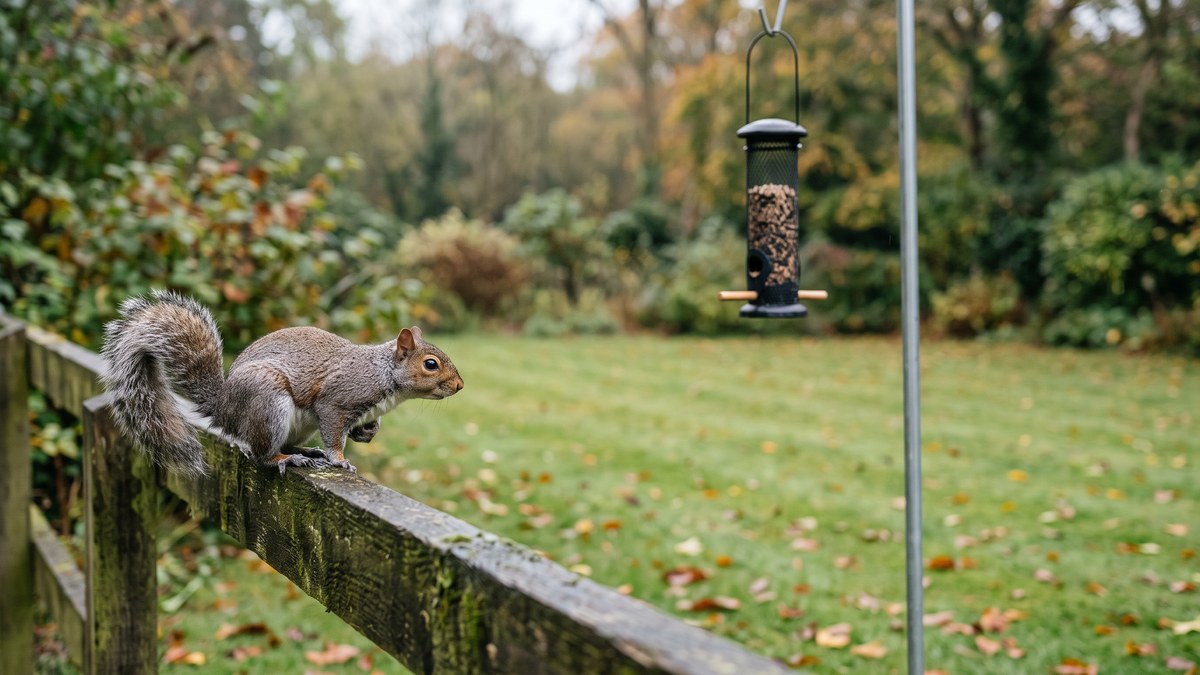
A grey squirrel can strip a filled seed feeder in a single morning, chew the ports open on the way out, and be back before you have finished your tea. If you feed garden birds anywhere in the UK, this is less a question of if and more a question of when.
It is also about to get worse. From late August through to November, grey squirrels switch from casual feeding to caching, burying food for winter. They are no longer eating what they need for the day, they are shifting as much as they can carry, as fast as they can carry it. That is why a feeder that coped all summer suddenly starts emptying overnight in September.
Most advice on this dumps a list of twenty tricks and leaves you to guess which ones matter. The order matters more than the list. Placement is free and fixes the majority of gardens, hardware fixes most of the rest, and changing the food is the last lever, not the first. Work through it in that order and you will spend less and get further.
Work Out How the Squirrel Is Actually Reaching the Feeder
There are only three ways in, and each one has a different fix. Spend ten minutes at the window with a coffee just after dawn and watch, because the fix you buy blind is usually the wrong one.
- Climbing up from the ground, shinning up the pole, post or a nearby trellis. A baffle below the feeder stops this.
- Jumping across from a fence, wall, branch, water butt or garden chair. No baffle helps here, only distance.
- Dropping down from above, off a branch, pergola, shed roof or wall bracket. Only an overhead dome or a big move helps.
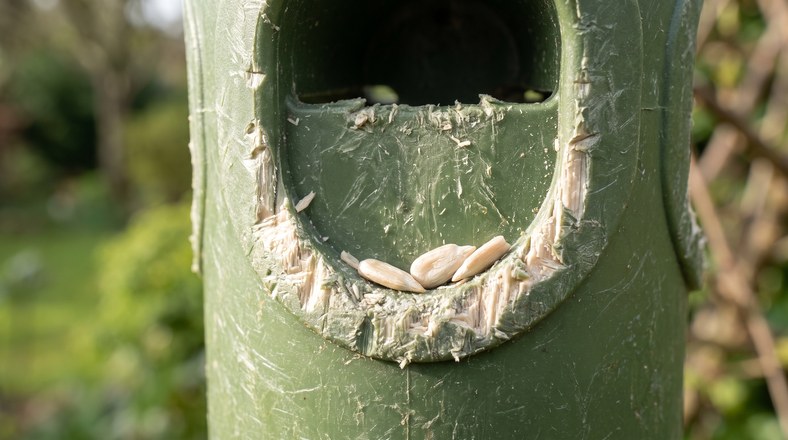
If you cannot catch them in the act, read the evidence instead. Fresh pale gnaw marks around the feeding ports mean they got hands on the feeder itself. A feeder still swinging hard when you look out, with seed sprayed several feet across the lawn, points to a jumper landing heavily. A lid levered off and dropped nearby, with the feeder otherwise untouched, usually means they came down from above and worked at the top.
The numbers you are designing against
An adult grey squirrel can clear roughly 1.5m vertically from a standing start and around 3m horizontally, and a confident one dropping downhill from a height will beat that. Plan for 3m of genuine clear air in every direction, not the 1m gap that feels generous when you are standing in the garden.
Move the Feeder Before You Spend Anything
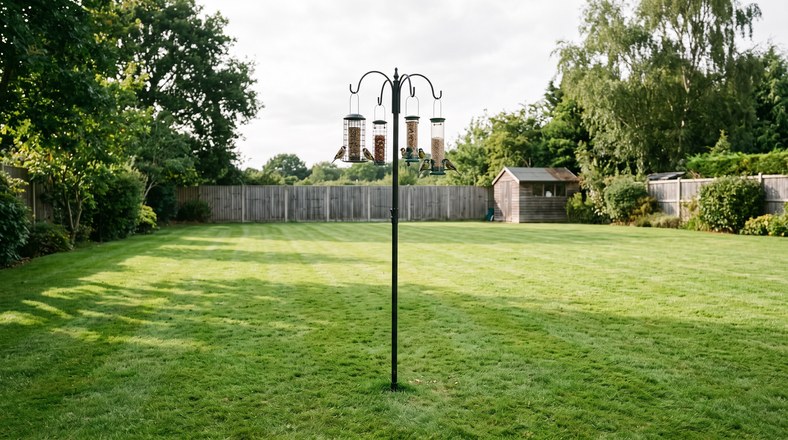
Repositioning fixes more gardens than any product does, and it is free. The target is a feeder standing in genuinely open ground, roughly 1.5m up, with 3m of clear space to the nearest launch point in every direction including above.
Work through this properly with a tape measure. Eyeballing it is how people end up buying a baffle they never needed.
- Use a smooth metal pole. Wood, bamboo and rough plastic all give grip. A slim, smooth steel pole gives a squirrel very little to work with, particularly in the wet.
- Check overhead, not just sideways. Shed roofs, pergola beams, washing lines, wall brackets and low branches are all launch pads. This is the one people miss.
- Clear the stepping stones. Stacked pots, a trug, a wheelie bin, a bench or a bag of compost parked near the feeder over the weekend quietly halves the gap you measured.
- Do not hang it from a branch if you can avoid it. A branch is a road with a feeder at the end of it.
One seasonal catch worth planning for now: a spot that is safely out of reach in August can become reachable in late autumn. Once the leaves come off, thin whippy growth that was screening the feeder is gone, and any branch you were relying on to be too flimsy is suddenly a viable perch. Re-measure in November.
Fit a Baffle or Switch to a Weight-Activated Feeder
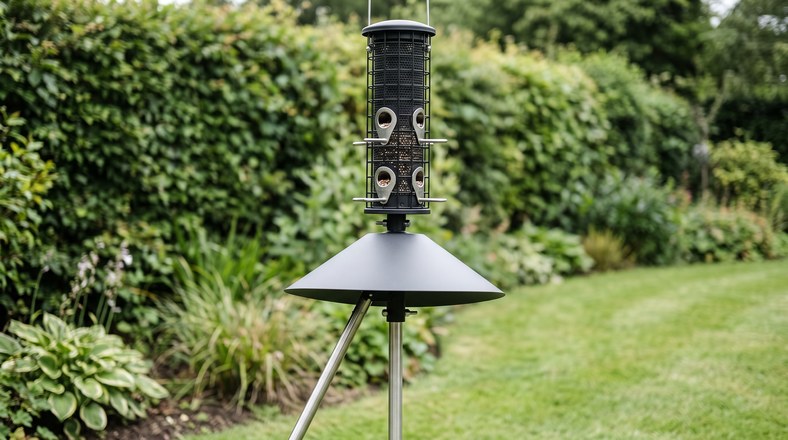
Once placement is as good as your garden allows, hardware picks up the rest. There are two different jobs here and they are often confused. A baffle controls access, blocking the route to the feeder. A squirrel-proof feeder controls feeding, letting them arrive but not eat. In a badly overlooked garden you generally need both.
Getting a baffle right
Baffles fail on geometry far more often than on quality. Two rules cover it.
- Cone baffle, fitted below the feeder: the base of the cone wants to sit 1.2m to 1.5m off the ground so they cannot simply jump over it, and it needs to be wide, ideally 38cm or more across, so they cannot reach around the edge from underneath.
- Dome baffle, fitted above a hanging feeder: aim for at least 45cm across, and hang it so it can tip and wobble. A dome that is rigid is a platform. A dome that tilts slides them off.
How weight-activated feeders work
These have a spring-loaded outer shroud that drops and closes the ports when something heavy lands. The trigger sits in the wide gap between garden birds and squirrels, and the numbers are not close. A blue tit is around 11g, a great tit around 18g, a greenfinch around 28g. An adult grey squirrel is 450g to 600g. Nothing you want to feed is anywhere near the threshold.
They genuinely work on squirrels. What they do not solve is the middleweight problem, and this is the thing most reviews skate over. Starlings weigh roughly 75g to 90g, which is comfortably under the trigger, and they arrive as a gang. Our testing of the Jacobi Jayne feeder below found exactly that split, with squirrels giving up quickly while starlings carried on emptying it. If starlings are your real problem, you want a caged guardian with a mesh gap of roughly 4cm to 5cm, which lets tits and finches through and shuts out squirrels, pigeons and starlings alike.
Change What You Put Out, Not Just Where
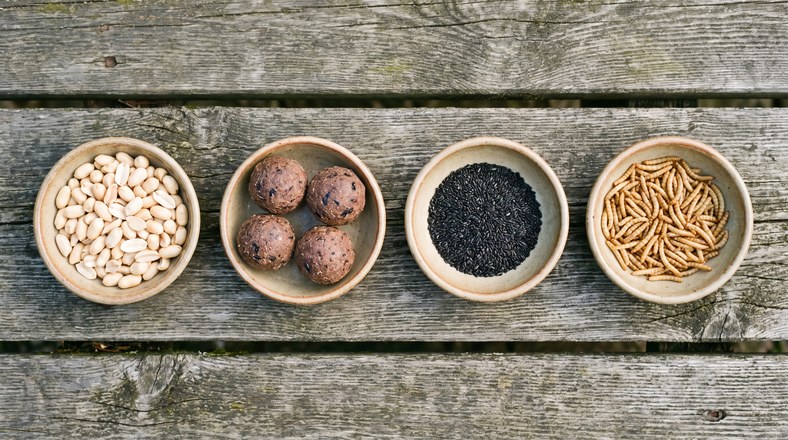
Squirrels are doing energy maths. They go for whatever gives the biggest calorie return for the least effort, which is why some foods pull them in from three gardens away and others get ignored.
The magnets
Peanuts sit right at the top, dense in fat and protein and easy to carry off whole for caching. Fat balls and suet are close behind. Black sunflower seed and sunflower hearts come next. None of these are things you should give up, because they are exactly what woodpeckers, tits, finches and blackbirds need going into winter. They just need the right container.
- Peanuts belong in a rigid steel mesh feeder, ideally inside a caged guardian. Never put peanuts out loose in a tray or in one of the mesh net bags they sometimes ship in, which are a genuine foot and beak injury risk to birds.
- Fat balls should always come out of their individual plastic netting before they go up, then into a fat ball cage. The netting traps bird feet and does nothing to slow a squirrel down.
The foods squirrels mostly leave alone
Nyjer is too small and fiddly to be worth their time, while goldfinches and siskins take it happily. Safflower is bitter enough that most squirrels pass on it. Dried mealworms are a useful third option, because they are lean protein rather than the fat and starch payload a squirrel wants to bury, so they draw robins, blackbirds and wrens without becoming the jackpot that peanuts are. Put mealworms in a covered tray rather than scattering them on the ground.
One timing note before you restock
Feeding guidance in the UK has shifted. The RSPB has paused sales of seed and peanuts between 1 May and 12 October as a disease precaution, and points people towards resuming seed and peanuts from November through to April. Check the current advice before you buy in bulk for autumn, and whatever you feed, wash and dry your feeders regularly. Hygiene matters more than the squirrel question does.
Cut Off the Spillage and Lock Up Your Food Store
This is the step almost everyone skips, and it is why some gardens never quite shake the problem. A squirrel that cannot get into the feeder will happily work the ground underneath it instead, and a reliable carpet of spilled seed keeps them coming back to check the feeder every single day. It also brings in rats, which is a bigger problem than the squirrel ever was.
- Fit a catch tray or seed dish under the feeder so spill is contained rather than scattered, and empty it rather than letting it sit and go mouldy.
- Sweep or rake underneath weekly. Ten seconds with a stiff brush removes the reason they keep patrolling.
- Choose smaller ports. Wide ports let birds flick seed out by the handful while hunting for the bits they want, which does your squirrels a favour.
Your food store is part of the problem
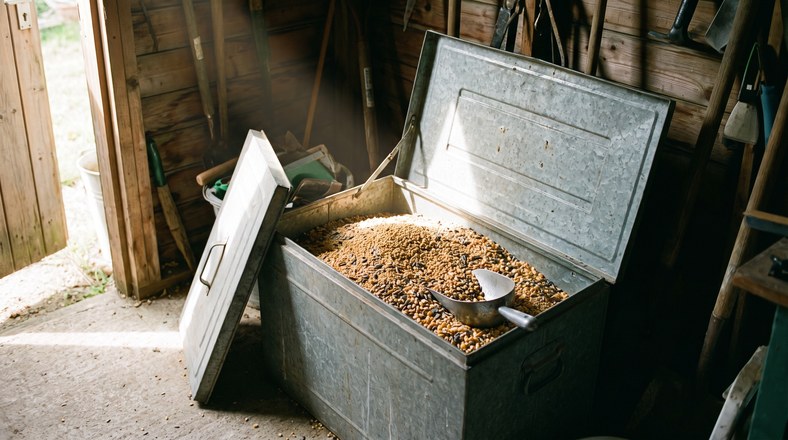
Squirrels will chew straight through a plastic tub or a screw-lid bucket left in a shed, garage or unsecured storage box, and once they have found the stash the feeder becomes a sideshow. Anything that is not metal is a delay, not a barrier.
Decant bird food into a galvanised metal bin with a clamped or weighted lid. This applies even to feed that arrives in its own container. When we reviewed the Extra Select seed mix below, the seed itself was good value for what garden birds actually eat, but the supplied tub was the weak point of the product, and it is not something to trust in an outbuilding over winter.
The Methods to Skip, and What UK Law Says About Trapping
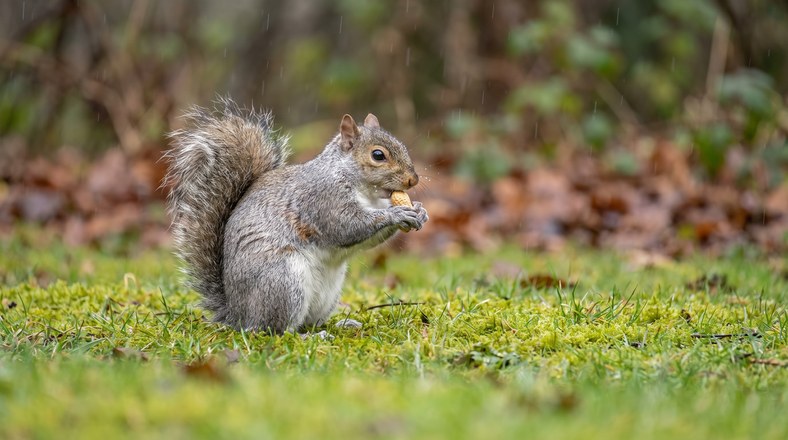
Plenty of widely repeated tricks either stop working within days or actively harm the birds you are feeding. These are the ones worth leaving alone.
- Grease, petroleum jelly, cooking oil or wax on the pole. This does stop a squirrel climbing, for a while. It also transfers onto bird plumage, and oiled feathers lose their waterproofing and their ability to trap warm air. In a wet British winter that is a serious risk to a small bird. Not worth it, and the same goes for spray lubricants anywhere near a feeding station.
- Cayenne or chilli powder sprinkled into seed at home. The principle is sound, because birds do not react to capsaicin and mammals do. The execution is the problem. Loose powder blows about and gets into birds' eyes, the dose is uncontrolled, and the first shower of rain washes it off. If you want to use this approach, buy seed or suet that has been treated with chilli during manufacture, where the coating is bonded and the dose is consistent.
- Aluminium foil wrapped round the pole. Lasts about two dry days, then shreds and leaves litter across the lawn.
- Plastic netting as a barrier. Squirrels chew through it in minutes, and it entangles birds and hedgehogs in the meantime.
Trapping and relocating is not an option in the UK
This is the one people get wrong with the best of intentions. The grey squirrel is listed on Schedule 9 of the Wildlife and Countryside Act 1981, which makes it an offence to release one into the wild or to allow one to escape. Live-trapping a squirrel and driving it to a patch of woodland to set it free is illegal, not a kindness. It is also an offence to cause a wild mammal unnecessary suffering, so a trap left unchecked is its own problem.
For a garden, exclusion is the only route that is both lawful and effective. Make the feeder unreachable and unrewarding, and the squirrel moves on to easier work of its own accord.
What about feeding them separately?
Setting up a squirrel feeding station about 10m from the bird feeders, stocked with unsalted nuts or corn, is sometimes suggested and it does take the pressure off in some gardens. Be honest with yourself about the trade-off though. You are feeding a population that will settle in and breed, and in autumn a well-fed squirrel caches harder rather than eating less. It works nicely for some people and backfires for others, so treat it as an experiment rather than a fix.
Frequently Asked Questions
Does cayenne pepper really stop squirrels eating bird food?
The science behind it holds up. Birds do not have the receptor that makes capsaicin feel hot, so chilli deters mammals selectively without bothering the birds. Sprinkling loose powder into your own seed is the weak version though: the dose is uncontrolled, the powder blows into birds' eyes at the feeder, and the first decent rain washes it off. If you want to use it, buy seed or suet that has been chilli-treated during manufacture so the coating is bonded and consistent.
Is it legal to trap a grey squirrel and release it somewhere else in the UK?
No. The grey squirrel is listed on Schedule 9 of the Wildlife and Countryside Act 1981, which makes it an offence to release one into the wild or allow it to escape. Catching a squirrel and letting it go in nearby woodland is illegal even though it feels like the humane option. It is also an offence to cause a wild mammal unnecessary suffering. For a garden, excluding them from the feeder is the only approach that is both lawful and actually works.
Will a squirrel-proof feeder keep pigeons and starlings off as well?
Pigeons yes, starlings often not. A weight-activated feeder shuts under anything heavy, so a wood pigeon at around 500g triggers it just as a squirrel does. Starlings weigh roughly 75g to 90g, which sits under the trigger, and they turn up in numbers and empty the feeder anyway. If starlings are the real issue, a caged guardian with a mesh gap of about 4cm to 5cm is the better answer, since it physically excludes anything bigger than a finch or tit.
How far should a bird feeder be from a fence or tree?
Allow at least 3m of clear space in every direction, and remember that includes above. An adult grey squirrel can jump around 3m horizontally and about 1.5m straight up, and one launching downhill from a branch or shed roof will manage more. Mount the feeder roughly 1.5m off the ground on a smooth metal pole, then walk round it with a tape measure checking for anything you have not counted, such as a water butt, a bench or a wheelie bin.
Related Reading
- Squirrels Give Up On This Squirrel Proof Bird Feeder For Seed UK Gardens. Starlings Do Not. review
- Garden Ting Peanuts Wild Bird Food Tub review
- Peckish Natural Balance Fat Balls review
- Pet Ting Premium Dried Mealworms review
- Extra Select review
- Keep a Pool Clean Without a Pump UK: Chlorine, Testing and Algae Control for an Above-Ground Pool or Hot Tub
- How to Protect Plants from Frost in the UK
Disclaimer: This article contains Amazon affiliate links. We may earn a small commission from qualifying purchases at no extra cost to you.