
Electric Lawn Scarifier for Small Lawns UK: VonHaus Cannot Agree With Itself on Lawn Size
We earn commission from qualifying Amazon purchases. It costs you nothing and does not affect what we recommend.
Which? puts a 32cm machine squarely in the small-lawn band. The RHS says the moss on a small lawn can be taken out with a spring-tined rake. VonHaus says small to medium on Amazon and medium on its own website, and its manual names no size at all. Here is how a small-lawn buyer should read all of that, alongside the eight UK reviews Amazon shows.
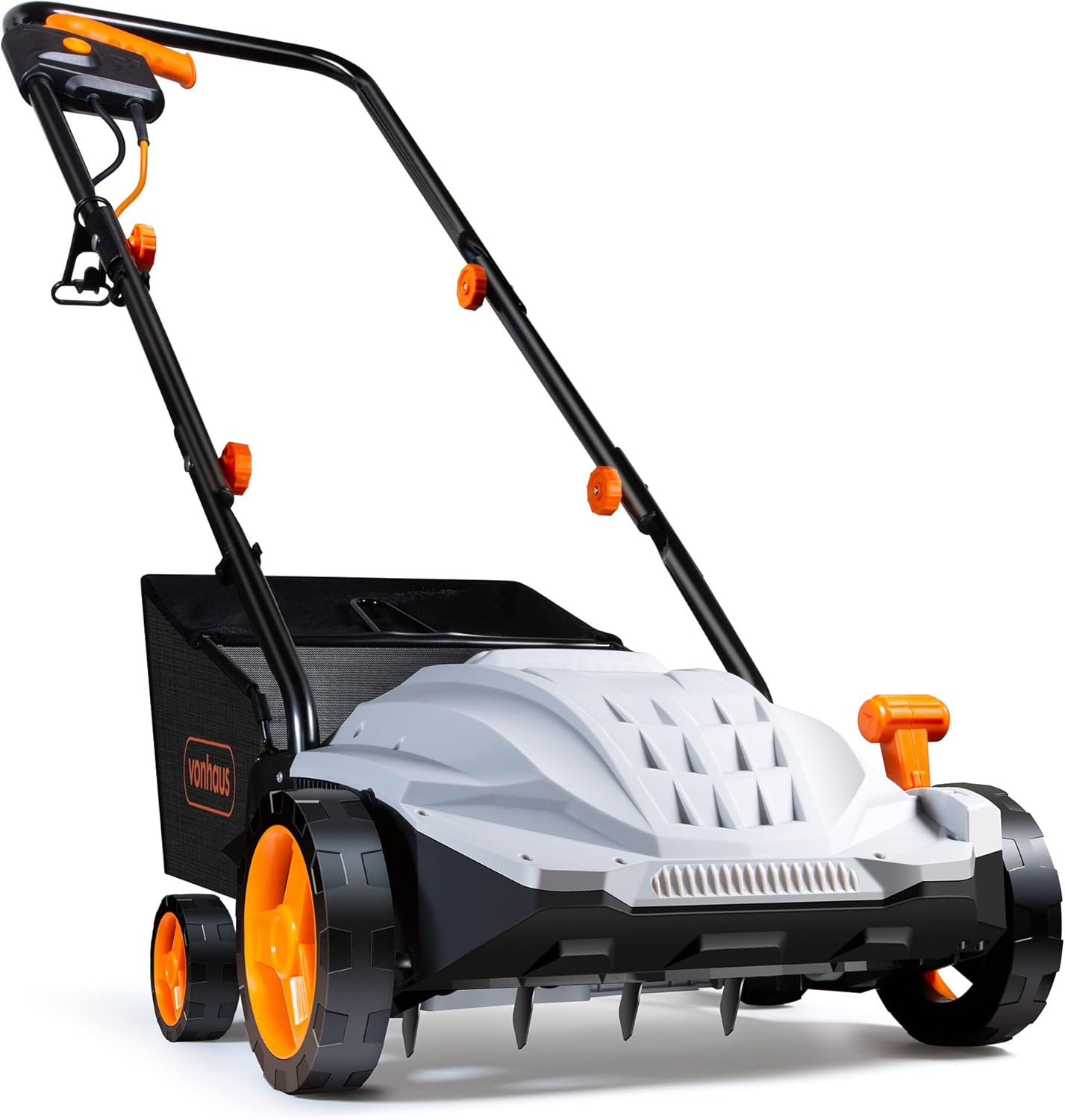
- Small to Medium, or 100 to 300 Square Metres?
- Our Own Moss Guide Says Rake It. Here Is What a Machine Adds
- The 30L Box Against Five of the Eight Owners
- Setting 1 Is the Deepest, Whatever the Manual Implies
- Goggles On, Grass Dry, and Whether September Is Your Window
- Our 4.2, and the 55L Box Some Readers Should Buy Instead
The VonHaus 1500W tops Amazon's Lawn Scarifiers category, with 2,737 ratings at 4.4 stars. VonHaus cannot agree with itself on the size of lawn it is for: “small to medium gardens” on Amazon, medium lawns of 100 to 300 square metres on its own website, four times over. The 12-page manual VonHaus publishes for this model gives no lawn size at all, and in four of its five languages calls itself a supplement to a manual supplied with the product.
So a small-lawn buyer gets two answers from the pages most buyers see, and none from the manual. The eight UK reviews Amazon shows are a small sample and a hot one, averaging 4.75 against the 4.4 badge, so every count below is scoped to those eight. Our score is 4.2 out of 5, on conditions that depend on where your socket is and how mossy the lawn has got.
Small to Medium, or 100 to 300 Square Metres?
The lawn-size answers only look like a contradiction, because they are not all answering the same question.
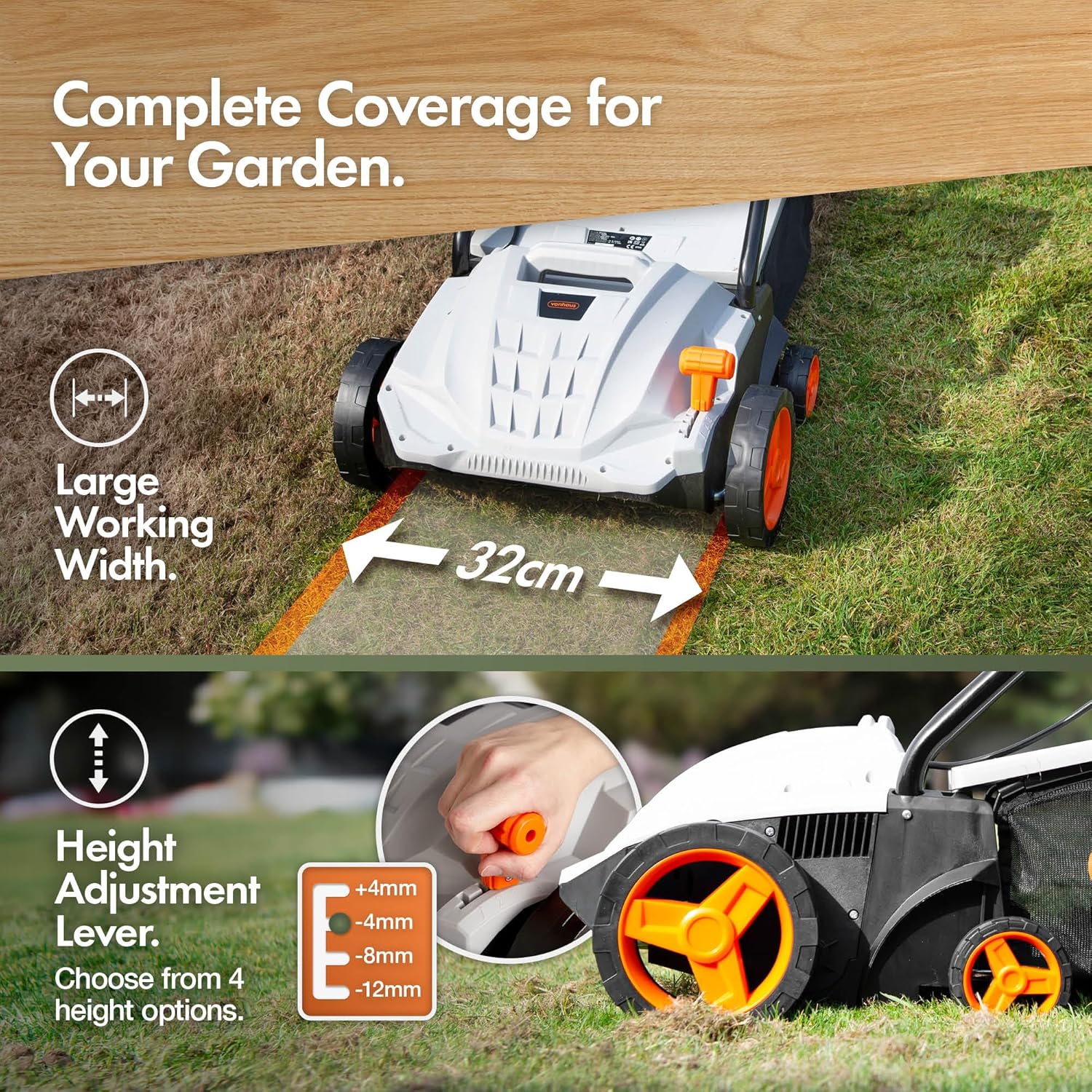
VonHaus on Amazon: small to medium gardens, on a 32cm working width and a 30L box. VonHaus on vonhaus.com: a 1500W scarifier “for medium lawns”, with the 30L bag sized for 100 to 300 square metres. The manual sits it out: no square-metre figure, no size wording and no coverage rate in its 12 pages.
The RHS is answering whether you need a machine at all. Its moss page: “On a small lawn, or if the moss is only in a limited area, this can be done with a spring-tined rake.” Which? is answering what width to buy if you do: lawns under 50 square metres want a cutting width of 30cm to 34cm, because anything wider gets awkward in tight corners. At 32cm this VonHaus sits inside that band.
So the RHS and Which? do not conflict; VonHaus conflicts with itself. The nearest thing to a neutral answer comes from Hyundai, whose HYSC1532E matches on the headline specs (1500W, 320mm, 30L, -12mm to +4mm) and is sold as suitable for small to medium lawns up to 2,000 square feet, roughly 186 square metres. The wording follows the Amazon copy; the figure sits inside VonHaus's own 100 to 300 band.
Our Own Moss Guide Says Rake It. Here Is What a Machine Adds
Our guide to getting rid of moss in a lawn in autumn tells small-lawn readers: “On a small lawn, work over it vigorously with a spring-tine rake”, and to hire or buy a powered scarifier for anything larger. That advice stands and it agrees with the RHS. For a lawn you can hand-rake in one session, a machine you use once or twice a year, on Einhell's and Bosch's own reckoning, is an expensive way to save an afternoon.
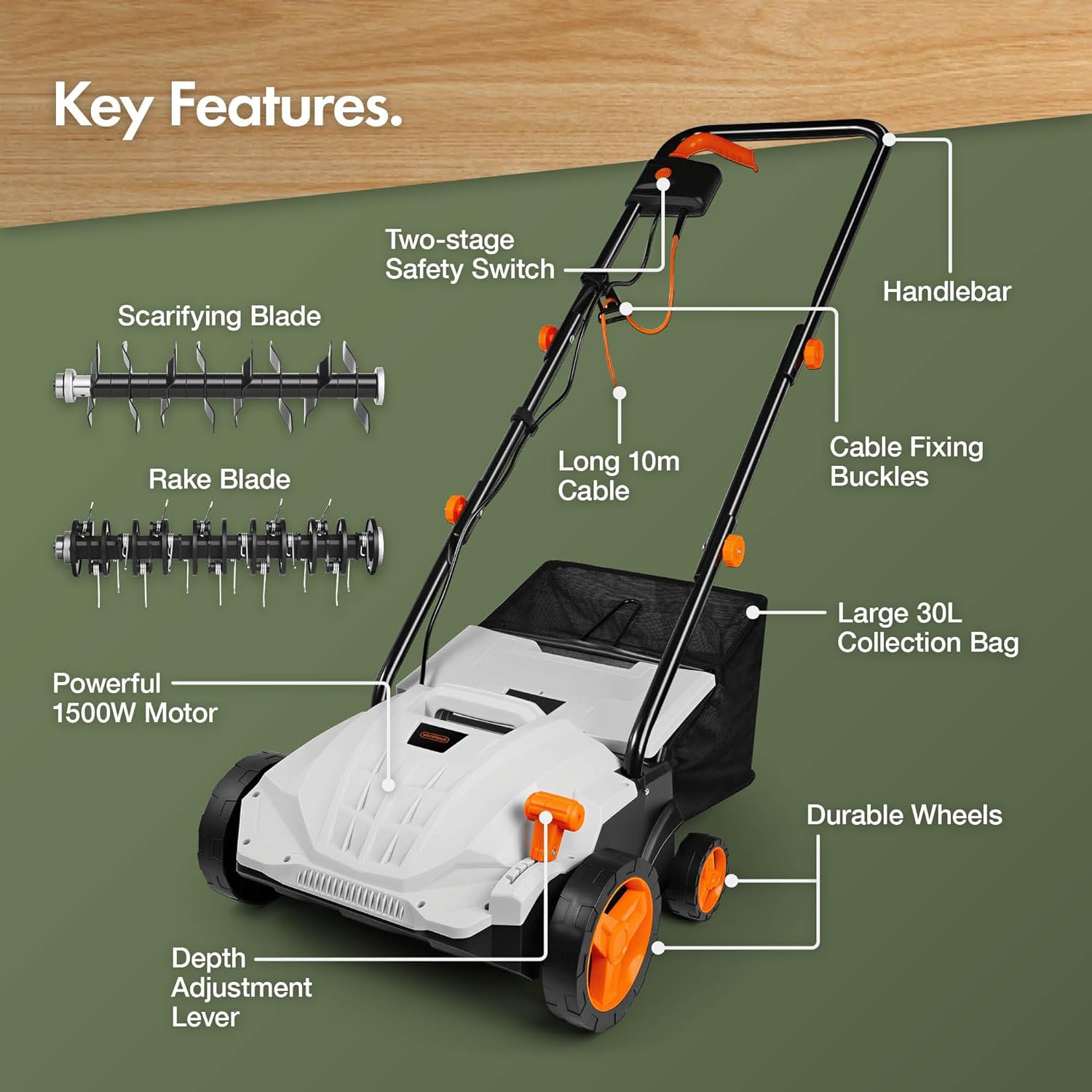
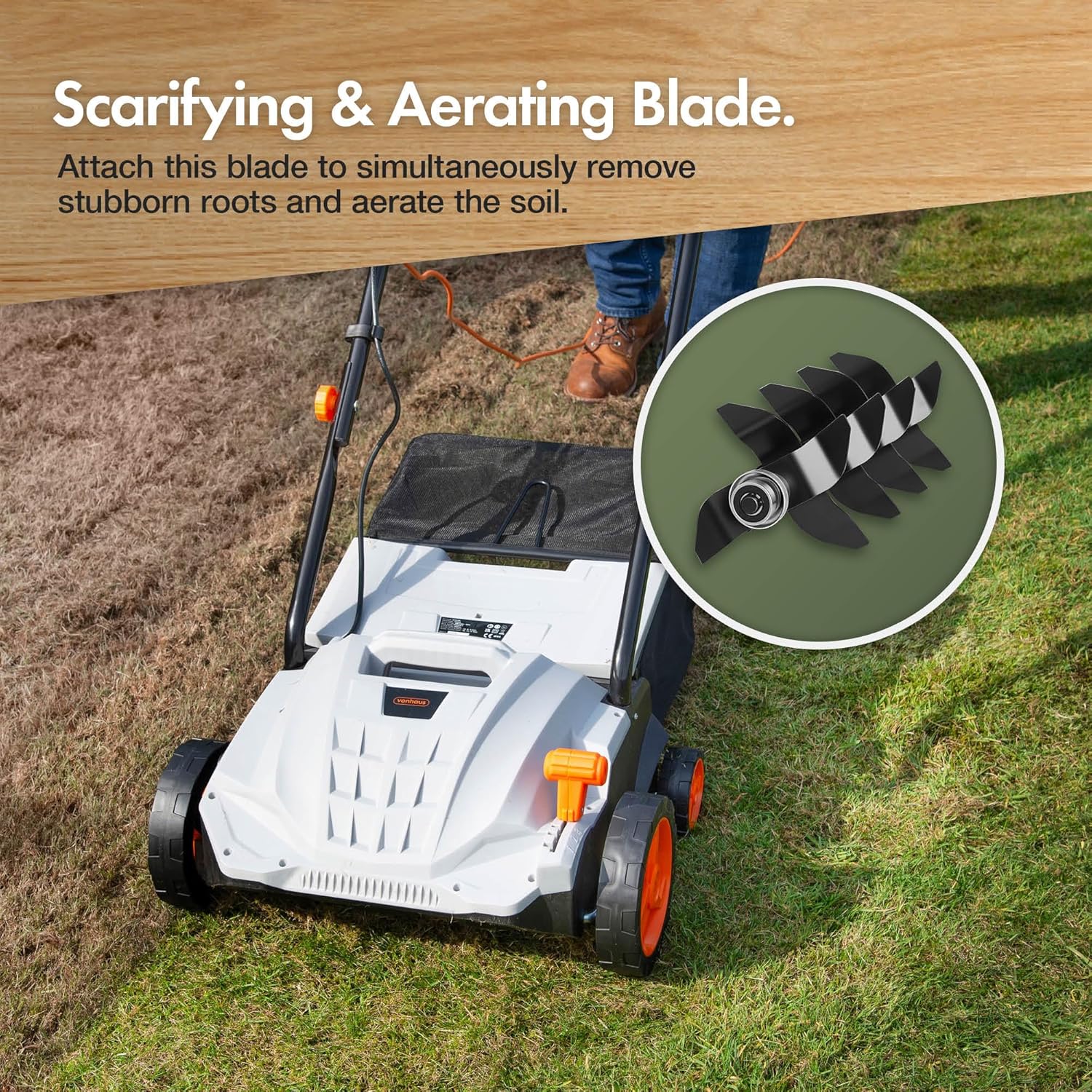
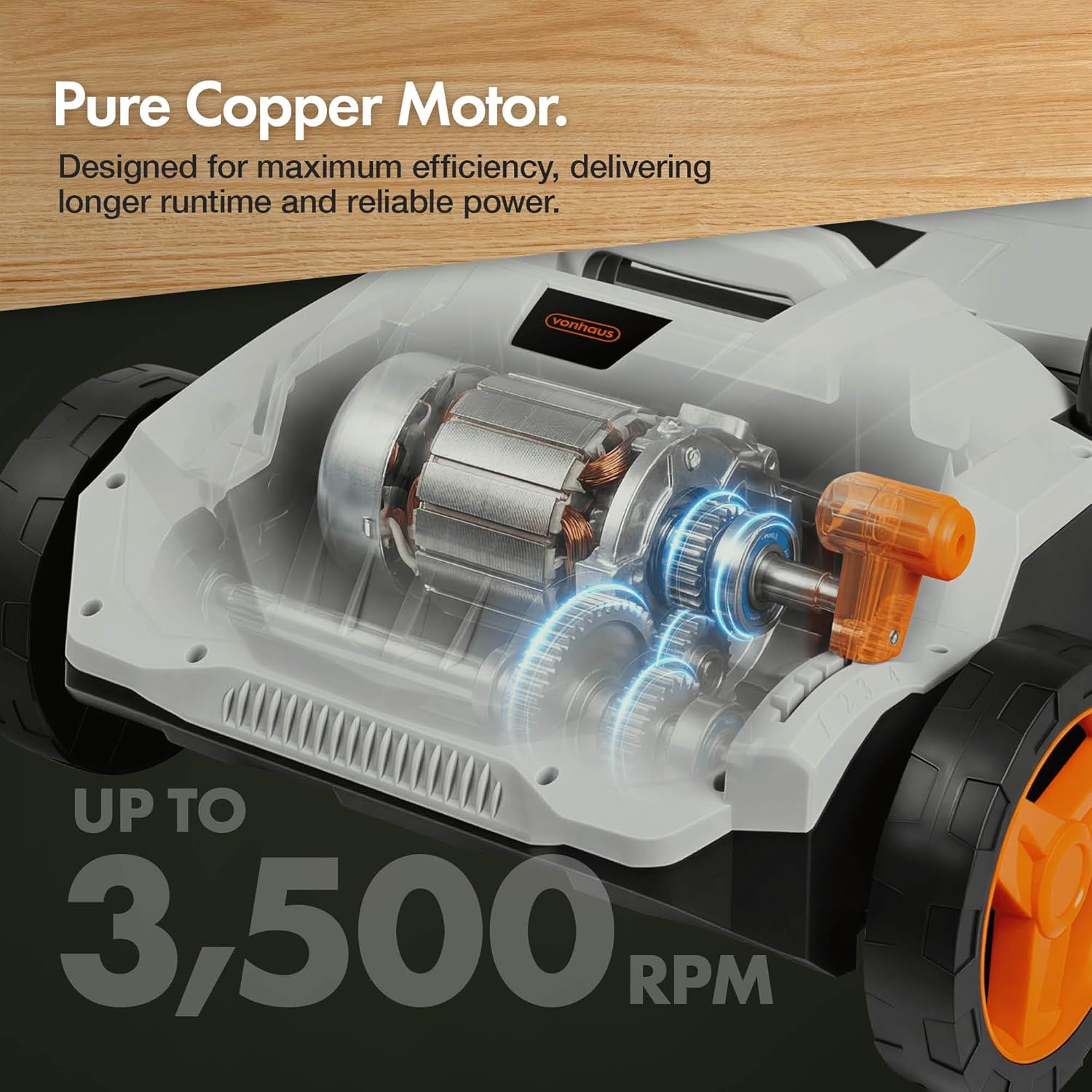
What a machine adds is the second job. The Lawn Association (lawnassociation.org.uk) makes the technical point that a spring-tine rake only removes debris, and that pruning the grass to thicken it needs a blade spinning at speed. Lifting dead material is all our guide ever asks a rake to do. The VonHaus adds the blade drum, which VonHaus says does “root removal and soil aeration”, on a motor rated at 3,500rpm with no load. A hand rake does the first job and not the second.
Two of the eight say they have a small garden. Mac11 (5 stars) calls it “Great for our small garden”. Andy Dunn (4 stars) took a star off for something no lawn-size claim covers: “the mains lead is only 10.5metres long, and was still not long enough to do the job”. The listing says 10m, Andy says 10.5m; either way the limit is the distance from socket to far corner, not the area of grass. SamH, on a lawn “just shy of tennis court size”, thought the cable fine for most small to medium gardens and still brought an extension out. So did Andy, from a small garden. Measure from the socket before you order.
The 30L Box Against Five of the Eight Owners
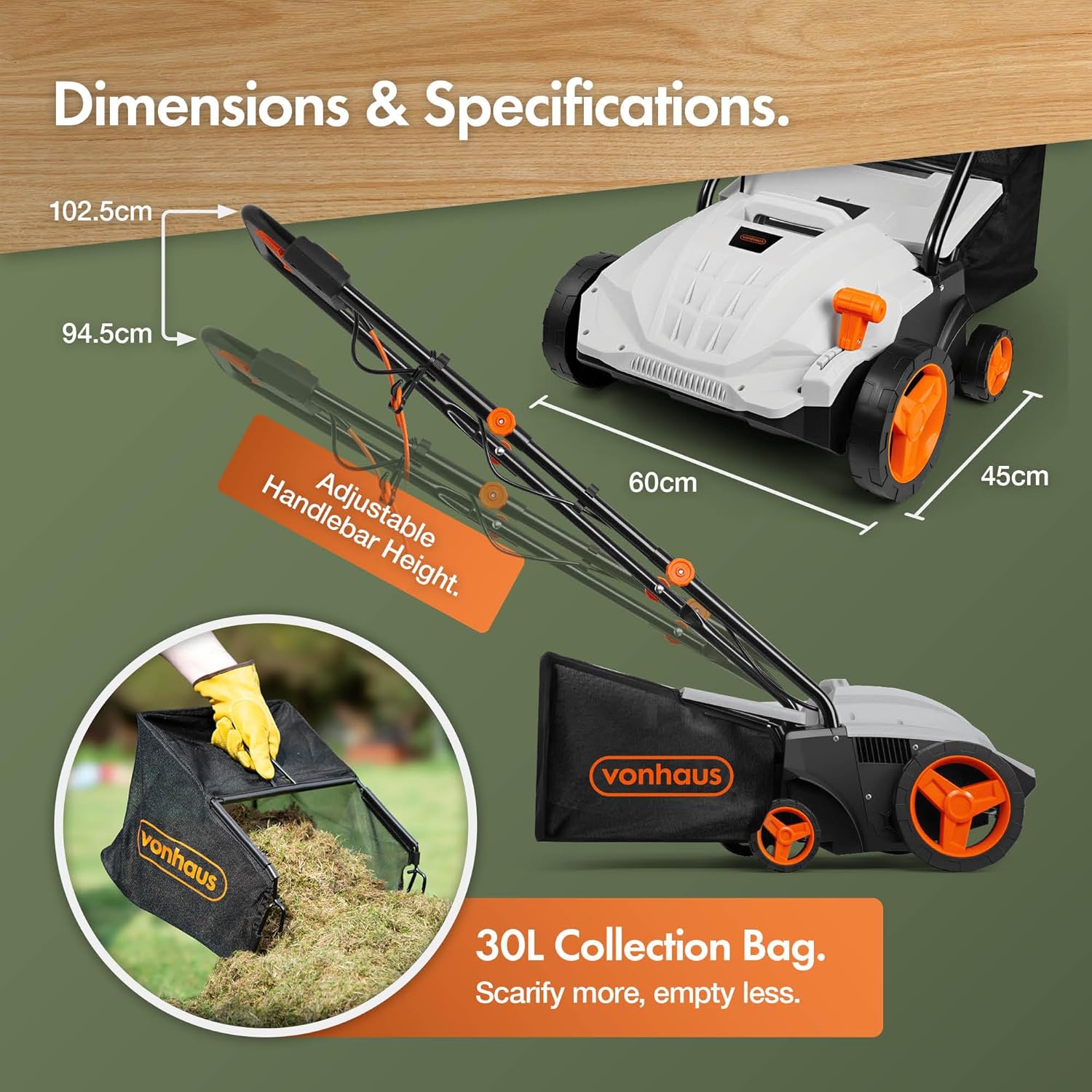
VonHaus's Amazon copy sells the bag on its “generous capacity, you can say goodbye to frequent emptying”. Five of the eight reviews we read say the opposite, and all five still gave four or five stars.
G J Knights titled a five-star review “Great little machine but very regular collection box emptying”. bertie (5 stars) gave up on the box because the moss backed up behind the machine instead of going in, then added the sentence that matters for a small lawn: “if you look after your lawn regularly, so have less coming out then this wouldn’t be a problem.” Before emptying the box or clearing a blockage, stop the machine. Behind the discharge opening is the drum, and the manual is unambiguous: “Ensure the motor has fully stopped before cleaning, clearing a blockage, checking, or carrying out any maintenance on the tool.” SamH, on the near tennis-court lawn, abandoned the box after a couple of yards. The box is a bigger nuisance on a neglected lawn than on a tidy one, whatever the size.
Whether the machine may run without the box, nobody says. The manual lists the grass basket as component 7 and a rear cover as component 8, and nothing more on either: no capacity, no emptying advice, no ruling either way. On its own lawn rakes Bosch treats the box as a guard: “Never operate the machine with defective guards or shields, or without safety devices, for example deflectors and/or grass box in place.” That is Bosch's rule for Bosch's machines; VonHaus neither repeats it nor contradicts it, so what taking the basket off leaves exposed here is not documented. SamH and bertie ran it bare and raked or mowed up afterwards; Neil S treats the basket as optional. We are not calling that sanctioned, because VonHaus has not.
VonHaus Lawn Scarifier/Aerator/Rake Corded 1500W - 30L Box, 10m Cable
For a small UK lawn with a real moss problem and a socket within reach: two drums, a 32cm width, and eight UK reviewers with no complaint about what it lifts.
Setting 1 Is the Deepest, Whatever the Manual Implies
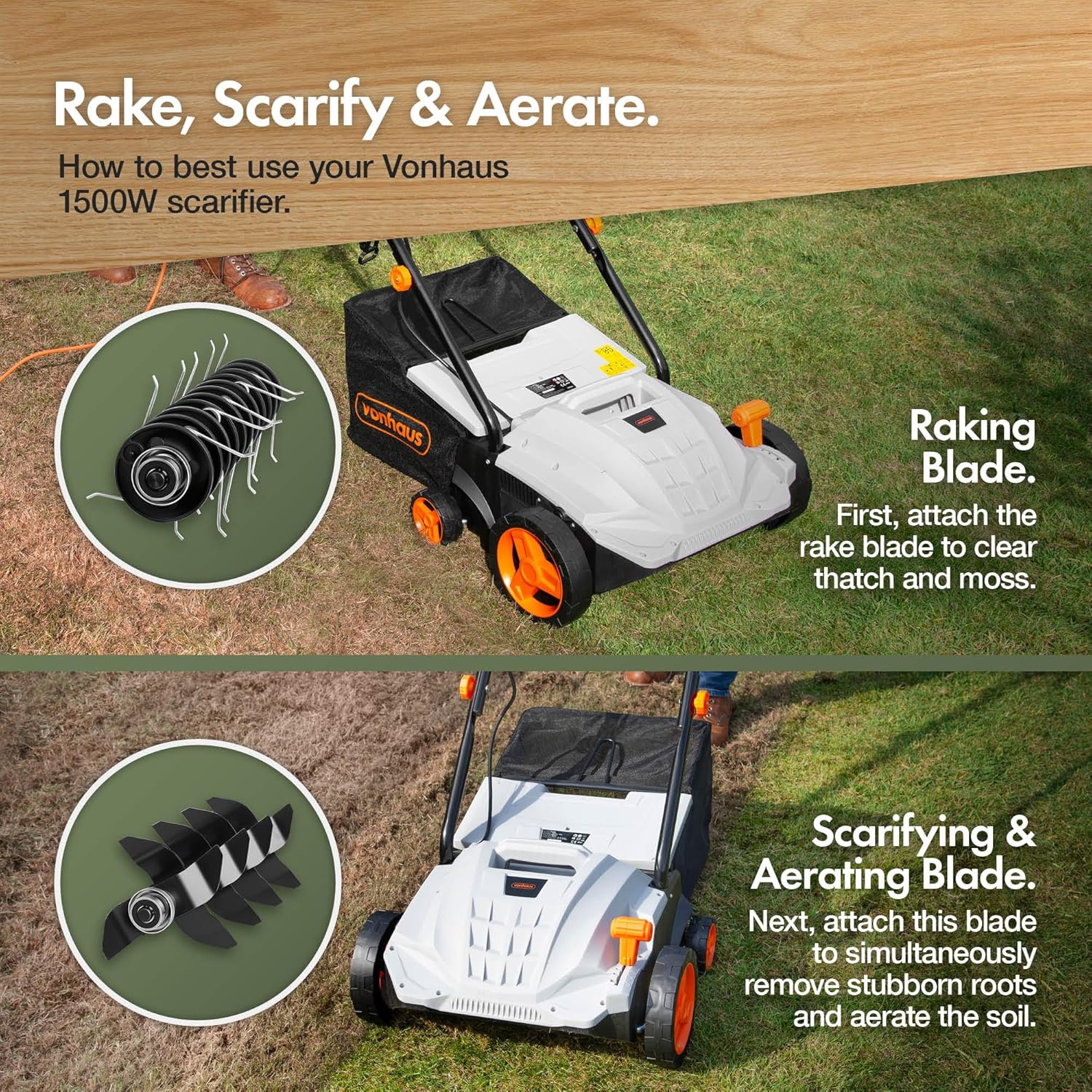
The Amazon title and bullet 4 say four depth settings; the listing's feature panel and the lever image enumerate them: +4mm, -4mm, -8mm, -12mm. The manual's table has four positions but two scales, one per drum: with the scarifying drum, positions 1 to 4 are -12mm, -8mm, -4mm and +4mm; with the raking drum, -15mm, -11mm, -7mm and +1mm. Position 4 is Transport on both, so there are three working depths.
That makes the rake, the gentler-sounding drum, the machine's most aggressive setting: -15mm at position 1, deeper than the blade drum's deepest and deeper than the “-12 to +4mm” VonHaus advertises. Hyundai's manual, whose rake scale is nothing like this one, warns: “It is not advised to use the Rake on position 1, as this can be too aggressive for unhealthy grass”. VonHaus carries no such warning.
Amazon bullet 4 recommends “starting with the highest position, gradually lowering”. The manual recommends “beginning your scarifying process on height setting ‘1’ and progressing lower”. Setting 1 is the deepest, so read literally it sends a beginner in at -12mm with the blades or -15mm with the tines. Bosch's manual says what VonHaus's should: start at the highest working height and lower as required.
In practice that means position 3, the shallowest working depth on either drum: -4mm with the blades, -7mm with the rake. Unplug before you move the lever or swap a drum: the manual says to disconnect the plug “before making any adjustments, changing accessories, or storing”, and its parts list has the scarifying drum pre-installed, so raking first means a swap. bertie went a notch higher still for a look-see: he started on 4 Transport and “got loads of moss out even at that level”, going over three times in total, dropping a level each time, then finished with the blades to open the soil for seed. bertie also answers the reviews saying it ruined a lawn: “If you do it right your lawn will look a little wrecked, but then you reseed”. How long that lasts is disputed: Hyundai's manual gives 4-6 weeks for its own near-identical machine, the UK Lawn Care Association (uklawncare.net) 3-4 months for the sward to fill in. On when to sow, our guide to repairing bare lawn patches wants seed down by mid October in southern England and Wales, late September further north.
Goggles On, Grass Dry, and Whether September Is Your Window
Of the manual's protective kit only eye protection is unconditional: “Always wear safety goggles (not glasses)”. The tool “may bounce upward and/or jump forward” if the tines hit hard-packed soil, stones, roots or stumps; if it strikes something the manual says to “turn it off immediately and check for the cause. Repair before restarting.” So clear the stones first: Bosch tells owners to remove “all stones, sticks, wires, bones and foreign objects”. VonHaus's manual bans working near underground cables, pipes or hoses. It also asks for short bursts with rests, because the tool “produces excessive vibration which can result in loss of sense of touch, numbness, tingling and reduced ability to grip”; VonHaus publishes no vibration figure.
Bosch, Einhell, Webb and Hyundai all specify a residual current device for corded outdoor work, Bosch as a requirement: use only a socket “protected by a circuit-breaker that would be actuated by a 30 mA residual current”. VonHaus is the only one of the five that never mentions an RCD. It does say to keep the cord where it “will not be stepped on, tripped over, or otherwise subjected to damage or stress”, and Einhell caps total cable length at 50 metres.
Wet grass is prohibited outright: it sticks to the underbody, blocks the discharge and can make you slip. The manual wants a dry afternoon with no dew, the grass brought down gradually over a week or two, then mown close without scalping; our moss guide relays that scarifier manufacturers suggest around 2cm for that pass. Soil moisture is the next condition: with “too much (soft ground) or too little (dry hard soil)” you should wait, improve it, “or not rake or scarify at all”. The manual's “do not use any weed killer” covers the few weeks beforehand: scarifying then “disrupts the weed killing process” and “may cause seed germination issues” if you over seed. It is not about moss killer: our moss guide's first step is an iron sulphate moss killer 7 to 14 days ahead.
On timing the manual puts light work in April or “late August or September” and keeps heavy moss removal in autumn, because a scarified lawn is an open seedbed and spring will “just replace moss or thatch with weeds”. Two of its exceptions suit small urban gardens: shady lawns “will thin over winter” and do better in spring; under trees, spring is when “the trees are bare”. A third covers anyone “unable to do it the previous autumn”: better to rake in spring than put it off. September itself is conditional. The RHS's September page addresses “Scotland and northern England”; Which? gates the month on your summer, “If the summer has been dry for you, wait until spring before you do any lawncare”; and our guide to what order to do lawn care makes September into October one of two prime windows. If your summer was not dry, a southern reader is inside the manual's own August or September window now, with room before our bare-patch guide's mid October sowing deadline; waiting for October leaves less of both.
Our 4.2, and the 55L Box Some Readers Should Buy Instead
None of the eight faults the moss removal, and nobody reports a breakage, though three wonder how long it will last: Mac11 finds “the plastic handle seems a bit light”.
Our score is 4.2 out of 5, below the 4.4 badge on purpose: eight reviews at 4.75 is a hotter sample than the 2,737 lifetime ratings behind it. The deductions are the box that five of eight raise, the cable that two of eight had to extend, one of them from a small garden, and a manual whose one depth instruction points the wrong way.
Buy it if you have a small lawn with a real moss or thatch problem, a socket within reach of the far corner or an outdoor-rated extension lead, and no objection to stopping to empty the box. Neil S (5 stars) made exactly this call: “I was torn between this and the more expensive 1800w version but after first use, for sure made the right choice”.
Skip it if the lawn is small enough to rake by hand in a session: our moss guide's spring-tine advice stands for lifting dead material, though a hand rake will not do the blade's job. If the box is your only complaint and the lawn really is small, a wider machine is the wrong trade on Which?'s own rule, and bertie's point applies: less comes off a lawn you look after, so the box fills more slowly. If your lawn is past small, buy the VonHaus 1800W with the 55L box instead: it is the machine Neil S nearly bought, 380mm wide, pitched by VonHaus at lawns over 300 square metres, with 4.4 stars across 810 ratings. It is not the small-lawn choice, and we are not pretending it is.
VonHaus Lawn Scarifier/Aerator/Rake Corded 1500W - 30L Box, 10m Cable
For a small UK lawn with a real moss problem and a socket within reach: two drums, a 32cm width, and eight UK reviewers with no complaint about what it lifts.