
How to overwinter chillies UK: which plants to keep and when to bring them in
Chilli plants are tender perennials, so the ones worth keeping can live for years if they go indoors before the cold gets them. Which types earn a place on the windowsill, the temperature and foliage signals that say move now, what to do from September to April, and the cut, water and pest routine that gets them through.
We earn commission from qualifying Amazon purchases. It costs you nothing and does not affect what we recommend.
Quick answer
To overwinter chillies in the UK, bring the plants indoors once forecast night temperatures fall towards 10C, which is late September to mid October for most gardens. Harvest ripe pods, check for pests, cut back to a short framework, then keep the plant somewhere bright above 10C and water only when the compost is nearly dry. Restart growth from late February.
Working out how to overwinter chillies in the UK starts with a question most guides skip: is this plant worth the windowsill space? Chillies are perennials from the tropical Americas that we grow as annuals because our winters kill them. Kept frost-free and mostly dry, a healthy plant carries on for years and fruits weeks earlier than anything sown in spring.
What follows is mainstream UK horticultural advice, with our own view where growers disagree. Conditions shift by two to three weeks between Cornwall and Aberdeen and by a fortnight between years, so treat the months as a frame and let night temperatures make the call.
Read the plant and the forecast first
Chilli plants stop growing below about 10C and start to suffer below 5C. Frost, even a light one, kills the top growth outright. So the number to watch is the overnight minimum in the forecast, not the date. Once the ten-day outlook shows nights at 10C or lower more than once, the plant is losing more than it gains by staying out.
The plant says the same thing a few days later: glossy leaves turn dull and yellow from the bottom, flowers drop without setting, and fruit that was colouring stalls. See all three and you are already late. Our frost protection guide covers first-frost timing, but for chillies the answer is to move the plant, not fleece it.
Which plants earn a place indoors
Keep plants that are healthy now: a firm main stem, leaves green to the tips, no soft or blackened patches at the base. One that fought aphids all summer or sat in waterlogged compost will not improve in a dim room. Then consider how long the variety took to fruit, which is where species matters.
- Capsicum annuum (jalapeno, cayenne, padron) fruits fast from seed. Sown in February, it crops by July. Overwintering saves a few weeks at most, and second-year plants tend to be woody and less productive. Keep a favourite; otherwise sow fresh.
- Capsicum chinense (habanero, scotch bonnet, Carolina Reaper, ghost chilli) is slow. From a January sowing in heat, many growers see no ripe pods until September, and a poor summer can mean none. These are the plants overwintering was made for.
- Capsicum baccatum (aji amarillo, lemon drop) and Capsicum frutescens (tabasco) sit in between, making big, late plants that take most of a season to get going. Worth keeping if there is room.
- Capsicum pubescens (rocoto, manzano) tolerates cooler nights than the rest, takes a long time to fruit and lives for years as a woody shrub. Always overwinter rocoto.
Is it worth it at all?
Some experienced growers argue that overwintering is more trouble than it is worth, and that a fresh January sowing in a heated propagator gives a cleaner, more vigorous plant with no pest baggage. For annuum types, we agree. For chinense and pubescens, we do not: the head start on a slow plant is the difference between a crop and a disappointment in a cool British summer, and gardeners in the north or on an exposed coast have no other reliable way to ripen anything hot.
Month by month from September to April
The adjustment rule for every month is the same: if forecast nights are already at 10C or lower, act as though it is the next month. If they are still in the teens, you have time.
September
Most of the UK still has a few weeks of useful ripening. Leave plants out in their sunniest spot and stop feeding. In upland and northern gardens, and after any forecast of single-figure nights, this is the month to move.
October
Peak month for the job. The first air frost typically lands in early to mid October across the north and in inland valleys, and not until November, sometimes later, along the south and west coasts and in city centres. Bring plants in the first week the forecast dips towards 10C; never gamble once the outlook says single figures.
November
A plant in a porch or conservatory may still be ripening its last pods; pick them as they colour. Cut back before the month ends so the plant settles into dormancy rather than limping on with weak growth.
December and January
Keep the plant above 10C, keep it dry and check for pests every couple of weeks. Resist watering a plant that looks lifeless: a bare stem that shows green under a scratched fingernail is fine.
February
Days lengthen noticeably from mid month and small shoots may appear at the leaf nodes. Once they do, water slightly more often and move the plant to the brightest spot you have. This is also the month to sow fresh seed if you are running both approaches.
March and April
Growth restarts properly. Repot into fresh compost, begin a weak liquid feed and pinch out any shoot stretching towards the glass. Plants can spend April days in a greenhouse that holds above 10C, but a closed greenhouse overheats fast on a sunny spring day, so prop the door or fit an automatic vent opener. They come back in at night until the last frost, which is May for most of the country and late May or June in the north.
The job, step by step
1. Harvest what is ripe and nearly ripe
Pick every pod that has coloured or started to turn. Fully green pods will not ripen once the plant is cut back, so use them green or leave a couple of fruiting branches on for a few weeks in a warm room. Strip flowers and buds; the plant cannot support them through winter.
2. Check for pests and treat outside
Turn every leaf over. Aphids cluster on new growth, whitefly rise in a cloud when you brush the plant, and spider mite shows as fine speckling on the upper leaf surface. Hose the plant down, then spray with a fatty-acid insecticidal soap or plant invigorator, both approved for UK garden use; neem oil fills American advice but is not approved as a pesticide here. Do it outdoors and before the cut, so the pests do not come in with the plant.
3. Cut back, or do not
Growers disagree here. One camp cuts hard to a framework 10 to 15cm above the compost, leaving two or three main branches with a couple of nodes each and no leaves. The other trims by a third and grows the plant on leafy in a bright room. Both work. Our view is that the hard cut suits most British homes, because the limiting factor from November to February is light, and a leafy plant in a dim room grows weak and draws in pests. Cut hard unless you have a conservatory or a south-facing bay window. Use clean secateurs, cut just above a node, and leave any tiny leaves at the base.
4. Repot or leave alone
Leave it alone unless the container is too big to bring in. Fresh compost around a plant that is barely drinking stays wet for weeks and invites rot. If you must downsize, tease away loose compost, trim the roots by a quarter and pot into the smallest container that holds the rootball. Proper repotting waits until March.
5. Choose the spot
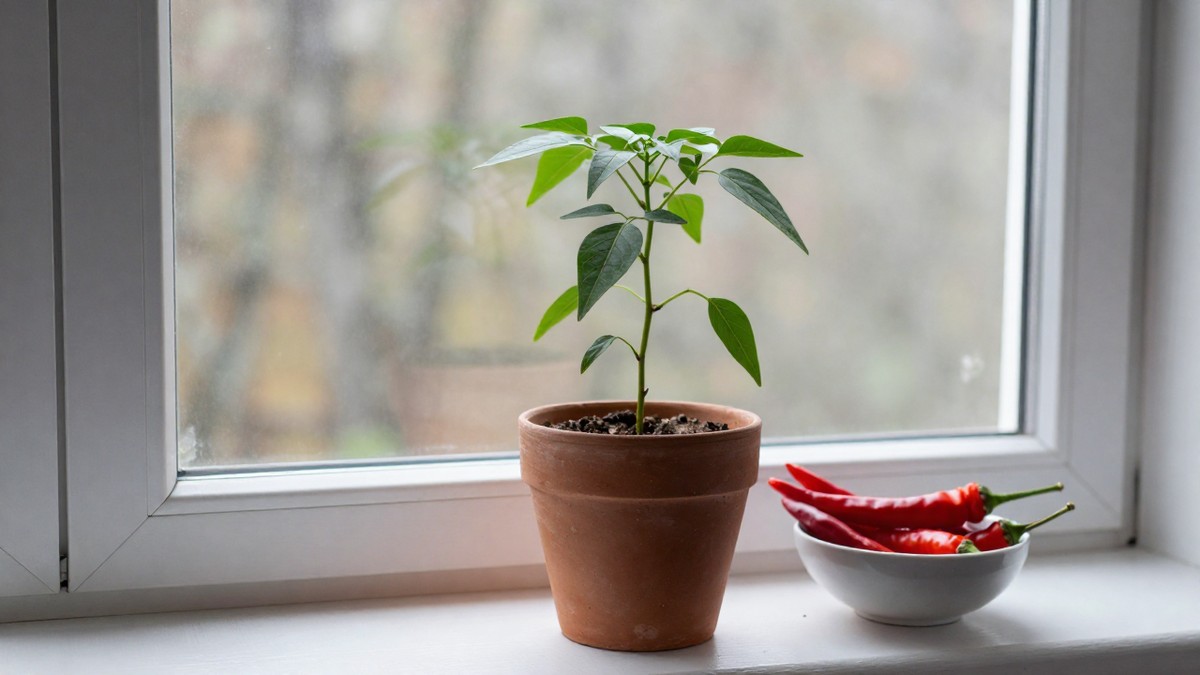
The target is bright, cool and reliably above 10C. A windowsill in a room that is not heated to tropical levels is the classic answer; a porch, a conservatory or a heated greenhouse set to hold 10C all work. An unheated greenhouse does not, in most of the UK: on a clear January night it drops below freezing and the plant dies. If the greenhouse is the only option it needs a thermostatic heater, and it is worth cleaning the greenhouse before winter first, because overwintering pests love the same corners.
Whatever the spot, check what it does at 3am rather than at lunchtime. A max-min thermometer left there for a week tells you the true overnight minimum. Below 5C, find another spot or move the plant away from the glass at night.
6. Water very little
A dormant chilli uses almost no water. Water only when the top few centimetres of compost are dry and the pot feels light, roughly every two to three weeks in a cool room. Wet the compost through, let it drain and never leave the pot standing in water. Too dry looks like a slightly shrivelled stem and compost pulling from the pot edge; a soak fixes it. Too wet looks like a soft, dark stem base and sour-smelling compost, and that is much harder to fix.
7. Light
A bare framework gets by on a north-facing windowsill until February. A leafy plant needs the brightest window you own, turned a quarter every few days so it does not lean, and benefits from a small LED grow light for a few hours a day.
What goes wrong and how to recover
Rot from overwatering. The most common killer. The stem goes dark and soft at the compost line, sometimes with white mould. If only the surface is affected, knock the plant out, cut away brown mushy roots, repot into dry compost and do not water for a fortnight. If the main stem is soft through, the plant has gone.
Leaf drop and panic. A leafy plant moved from a bright garden to a dim room drops most of its leaves within a fortnight. This is normal. Do not water more, do not feed and do not move it again; new leaves come in February.
Aphids and whitefly indoors. Warm rooms and no predators turn a handful of survivors into a colony in a month. Check the growing tips every time you water, squash small numbers, wash off larger ones in the sink and follow with a soap spray.
Spider mite in a dry room. Central heating suits red spider mite perfectly; speckled, bronzed leaves and fine webbing are the signs. Move the plant somewhere cooler and more humid, mist it, and spray with a fatty-acid soap weekly for three weeks to catch hatching generations. A badly infested leafy plant is easier to cut hard than to treat.
Cold behind the curtains. A windowsill at a pleasant 18C by day can fall below 5C once the curtains are drawn and the radiator is off, and chilling damage shows as limp, water-soaked leaves the next morning. Move the plant into the room at night or leave the curtain open behind it.
Leggy growth. Pale, stretched shoots with long gaps between leaves mean too little light and too much warmth. Pinch them back to the first pair of leaves and move the plant somewhere cooler and brighter.
A plant that never wakes up. By the end of March a live plant shows shoots. If the stem is brown and dry under the fingernail and nothing has moved, it died over winter, usually from cold or rot in December. Compost it and rely on the fresh sowing, which is why running both approaches in year one makes sense.
Frequently asked questions
Can I overwinter chillies in an unheated greenhouse?
Not reliably, away from the mildest coasts. An unheated greenhouse falls to within a degree or two of the outside temperature on a clear, still night, and chillies die below freezing. Add a thermostatic heater set to 10C, or bring the plants indoors.
Do I have to cut chillies back to overwinter them?
No, but for most British homes it gives the better result. A hard cut removes the leaves the plant cannot support in low winter light and takes most of the pests with it. Keep a plant leafy only if you have a bright conservatory or a large south-facing window.
How many years will a chilli plant live?
Several, with care. Three to five years is typical before an annuum or chinense plant becomes woody and less productive. Rocoto can live much longer and turns into a proper shrub.
Will an overwintered chilli fruit earlier next year?
Yes, and that is the main reason to do it. An established root system and a woody framework mean the plant flowers as soon as light and warmth return, typically several weeks ahead of a seed-raised plant.
Is it worth overwintering jalapenos or cayennes?
Usually not. Both are Capsicum annuum, which fruits within a few months of a February or March sowing, so the head start is small and second-year plants are often less productive. Keep one if it is a favourite; otherwise sow fresh and give the windowsill to a habanero.